










2026 Budget E-Scooters for UK Commuting: Range, Portability and Key Checks
Why electric scooter legal requirements matter before you compare range or weight

A budget e-scooter can look ideal on paper, then turn into the wrong purchase once you match it to your real routine. Many UK shoppers start with range, folded size and top speed, but the first check is legal use. In the UK, a privately owned electric scooter is illegal to ride in public, including on roads, pavements and in parks, and it can only be used on private land with the landowner’s permission. Rental trial scooters follow separate rules. According to GOV.UK, private use in public can also lead to fines, penalty points and seizure.
That changes how you should compare budget e-scooters UK buyers often shortlist. Instead of chasing the biggest claim, focus on where you will ride, how often you will carry the e-scooter and how much comfort reserve you need. The picks below sort the iScooter UK range by practical fit: lighter options for short private trips, balanced models for repeat use and sturdier choices for rougher private routes. If you are weighing an electric scooter for commuting or weekend errands, range and portability only make sense once the use case is realistic.
Top budget e-scooter picks for different UK commuting routines
1. iScooter i8 for short, simple daily trips
If your priority is basic portability and tidy storage, the iScooter i8 is the most straightforward place to start. It suits riders who want an iscooter electric scooter for short private-land journeys, easy hall storage and less day-to-day lifting fuss. The trade-off is modest battery headroom, so it fits shorter routines better than longer repeat rides.
Why it stands out
- 350 W motor
- Claimed range of 12 miles (20 km)
- Top speed of 15.5 mph (25 km/h)
- 5.2 Ah battery
- 8.5-inch pneumatic tyre setup
- 265 lbs maximum load
Best for
- First-time adult riders
- Compact home storage
- Short private routes
- Buyers who want a simple entry point without extra bulk
What to watch
- The shorter claimed range leaves less reserve for repeated trips.
- Smaller battery capacity gives you less margin in colder weather or on stop-start routes.
- If you regularly cross rough joins or patched surfaces, you may want more comfort support.
2. iScooter i9 for balanced daily practicality
The iScooter i9 is the middle-ground pick when you want better range and portability without stepping into a heavier platform. For many buyers searching budget e-scooters UK options, this is the model that balances everyday usefulness with manageable size. It makes sense when your routine is regular enough to need more than the i8, but you still care about folding convenience.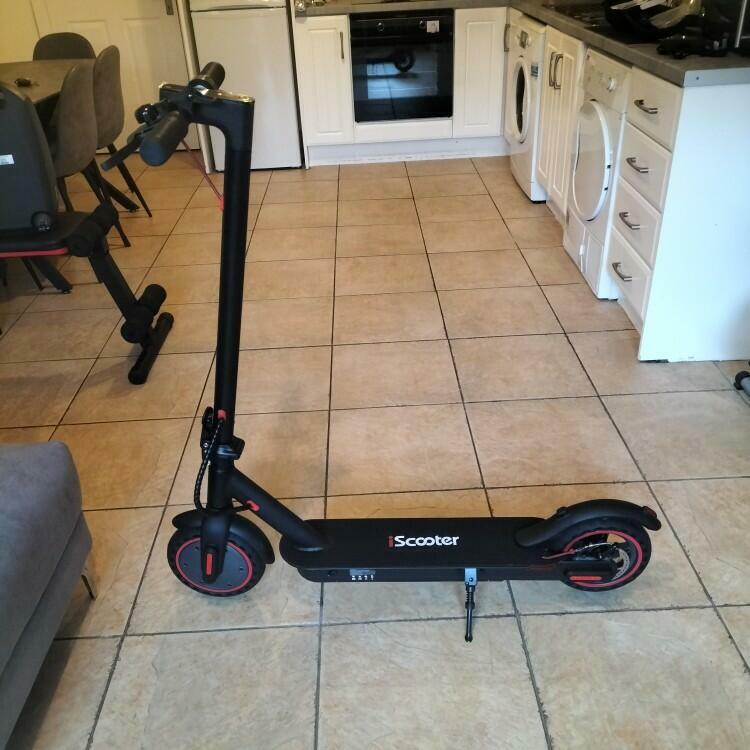
Why it stands out
- 350 W motor
- Claimed range of 18.6 miles (30 km)
- Top speed of 18.6 mph (30 km/h)
- Approx. 3 to 5 hours charging time
- 8.5-inch honeycomb solid tyres
- Quick folding system and 3 riding modes
Best for
- Routine private-land use
- Mixed days where folding matters
- Riders wanting a practical step up from entry level
What to watch
- Solid tyres reduce puncture worries, but some riders may find them firmer over rough surfaces.
- It is a sensible commuter-style option, though not the strongest comfort choice for broken ground.
- If your route needs more ride composure, the iScooter i9 model may feel less forgiving than the i9Max.
3. iScooter i9Max for more comfort reserve
When your shortlist comes down to lighter carry versus steadier ride feel, the iScooter i9Max usually lands in the sensible upgrade spot. It is the better fit for riders who want more battery reserve and a stronger comfort buffer without jumping straight to an off-road-style machine. For an electric scooter for commuting on private land or around larger sites, this is the model with more everyday headroom.
Why it stands out
- 500 W motor
- Claimed range of 24.8 miles (40 km) on the comparison page, with the product page presenting a 25-mile figure
- 10.4 Ah battery
- 10-inch solid tyres
- 265 lbs maximum load
- Product imagery and naming position it as a commuter model with dual-suspension emphasis
Best for
- Riders wanting more consistency than the i8 or i9
- Rougher private routes with joins and dropped-kerb variation
- Users who prefer battery reserve over minimum bulk
What to watch
- You gain comfort and battery capacity, but usually at the cost of lighter carrying convenience.
- Published range figures are still sensitive to terrain, rider weight, temperature and tyre condition.
- If stairs and daily lifting are your main issue, the extra substance may outweigh the benefit.
4. iScooter iX4 for mixed-surface needs
The iScooter iX4 moves away from pure portability and towards terrain tolerance. If your private route includes rough paving, uneven edges or more variable surfaces, this model makes a clearer case than lighter commuter-first options. It is not the best pick for frequent stair carrying, but it becomes more appealing when stability matters more than compactness.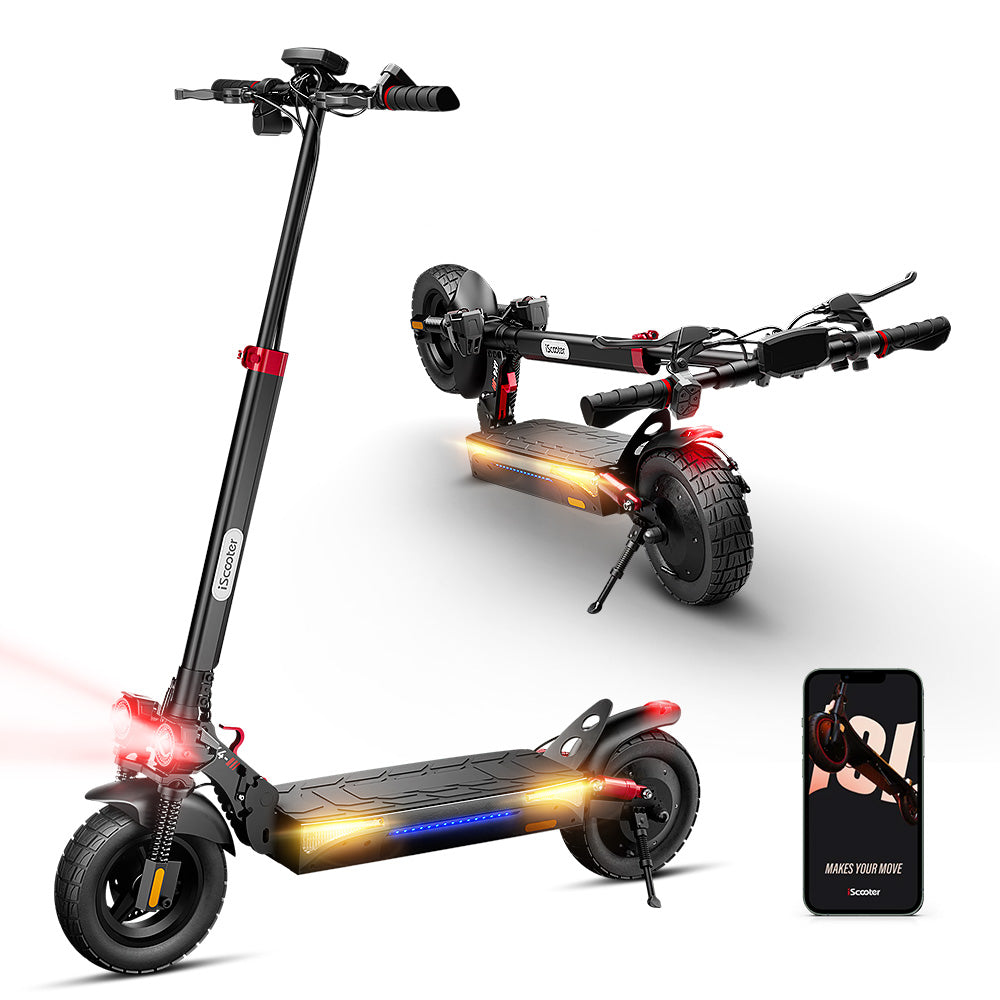
Why it stands out
- 800 W motor
- Claimed range of 31 miles (50 km) on the model comparison page, while the offer page presents 28 miles
- Top speed of 28 mph (45 km/h)
- 48 V 15 Ah battery
- 10-inch solid tyres
- 4-point suspension and app control positioning on the product page
- 330 lbs maximum load
Best for
- Uneven private routes
- Buyers who value suspension-led comfort
- Mixed-surface riding rather than simple storage efficiency
What to watch
- This is bulkier than the i8, i9 or iScooter i9 Max commuter-style choices.
- The stronger platform helps on rougher ground, but it is less carry-friendly in flats or offices.
- Range claims vary across iScooter pages, so treat reserve and route pattern as more useful than the biggest headline number.
Core electric scooter comparison: where range, portability and comfort really differ
For a budget electric scooter for commuting style routine, the best choice is rarely the one with the longest advertised distance. iScooter’s own comparison page says real-world performance varies with terrain, rider weight, wind, temperature and tyre pressure, which is the right way to read any range number. That means the smarter question is whether the scooter covers your actual route with reserve for colder days, stop-start riding and late charging. The i8 works when the trip is short and simple, the i9 improves day-to-day flexibility, and the i9Max gives more battery headroom before you move into the bulkier iX range.
Portability is also more than folded size. If you carry the scooter up stairs, lift it into a boot or store it in a narrow hall, lighter commuter models tend to win even if they give up some comfort. By contrast, the iX4 and iX5 make more sense when rougher surfaces are your main friction point. ONS travel-to-work data shows 9.8 million workers in England and Wales travelled less than 10 kilometres to work in Census 2021, although the ONS also notes that pandemic conditions affected commuting patterns, so this is best used as broad context rather than a direct buying rule. For many shorter routines, modest range with practical storage can be the more useful fit.
How to choose the right electric scooter without overbuying
Match the e-scooter to route texture
A smooth private route rewards lighter, simpler models. Once the surface becomes patchy, broken or uneven, comfort and control matter more than saving every kilogram.
- Choose the i8 or i9 when storage and basic portability lead.
- Choose the i9Max when you want more comfort reserve without moving fully into an off-road-style platform.
- Choose the iX4 or iX5 when terrain quality is the real issue.
Decide how often you will carry it
Photos do not tell you how a scooter feels on stairs or in a tight hall. Therefore, carrying frequency should sit near the top of your shortlist criteria.
- Daily lifting in flats or shared buildings usually favours the lighter end of the range.
- Point-to-point use with little carrying gives larger models more room to make sense.
- If you rarely fold the scooter, comfort may matter more than compactness.
Check support and ownership terms
Budget buys are easier to justify when support is clear. iScooter states free UK delivery in 1 to 3 working days, a 30-day money-back guarantee or return window for unused products, and up to 24 months warranty and after-sales support, which can reduce ownership friction if something needs attention.
Keep electric scooter legality separate from product suitability
A good product fit does not change UK public-use rules. Private e-scooters can only be used on private land with permission, while rented trial scooters can be used on public roads and cycle lanes in authorised trial areas, but not on pavements. GOV.UK also says rental users need a full or provisional UK licence.
Electric scooter maintenance and safety check table
| Problem | Likely cause | Practical fix |
|---|---|---|
| Weak braking | Wear or setup drift | Inspect promptly and stop riding until corrected |
| Lower range | Cold weather, gradients, load or tyre condition | Build in charging margin and check tyres |
| Unstable ride feel | Poor tyre condition or rougher route than expected | Check tyres before each ride and reconsider model fit |
| Folding play | Loose mechanism | Inspect before every ride and service if movement appears |
The basic pre-ride routine matters more than extra features. iScooter’s safety guidance highlights brakes, tyres, lights and rider awareness, while wet conditions require longer stopping distances and more caution. A properly fitted helmet is a sensible part of that routine even where it is not a legal requirement for every situation.
Conclusion
Before comparing an e-scooter’s range, weight or performance, UK buyers must first grasp local legal rules: private scooters are banned on all public land and only permitted on private property, with fines and seizure risks for violations. iScooter’s lineup covers diverse private riding demands: lightweight i8/i9 suit short smooth trips, i9Max offers extra battery and comfort, while iX4 handles rough uneven terrain. Real-world range falls short of lab figures due to hills, cold weather and rider weight. Balance portability, suspension and battery reserve, and confirm fast UK delivery, 30-day returns and long warranty to avoid overbuying unsuitable models.
FAQ
I need a electric commuter scooter for bumpy streets and curb cuts—what brands do comfort and stability well?
For bumpy streets and kerb drops, prioritise ride comfort through pneumatic tyres, a stable deck, dependable braking, and enough motor power to keep the scooter composed over rough patches. Within the iScooter UK range covered here, the iScooter i9Max is the more commuter-friendly option if you want more stability and everyday comfort than entry models, while the iX4 suits riders who face rougher surfaces more often and want a more rugged setup. In practice, 10-inch air-filled tyres and a sturdier frame usually make more difference to comfort than headline top speed. Before you buy an electric scooter in the UK, also check rider weight limit, tyre type, brake setup, and whether the scooter feels manageable to lift and fold for your commute.
What brands are best for a foldable electric scooter that’s good value but not unreliable?
For good value without taking unnecessary risk, start with models that offer clear warranty terms, local after-sales support, and readily available parts rather than chasing the absolute lowest price. In the UK, the iScooter models covered here are presented with fast delivery, a UK support team, up to 24 months warranty, and a 30-day return window for unused products. Models such as the iScooter i9 and i9Max suit riders who want a practical foldable electric scooter for commuting without overspending. Whatever model you consider, check real rider reviews, weight, folding mechanism, battery warranty, and spare tyre or brake availability before you buy.
Which electric scooter should I buy in the UK?
The iScooter i9 is better when you want a simpler, more carry-conscious setup with balanced day-to-day usability. The i9Max is the stronger choice when comfort reserve, larger tyres and extra battery headroom matter more than minimum bulk. If your route is smooth and storage is tight, the i9 often feels like the cleaner fit. If the surface is rougher or your use is heavier, the i9Max is usually easier to justify.
What should I check before every ride?
Check the brakes, tyres, lights, battery security and folding mechanism before every ride. Even a short private trip can feel unstable if tyre condition is poor or the folding latch has play. In wet conditions, leave extra stopping distance and slow down earlier than usual. A helmet and visible clothing are also sensible choices for routine riding.
Can I use a privately owned e-scooter on UK roads or pavements?
No, a privately owned e-scooter cannot legally be ridden on UK public roads, pavements or in parks. Its lawful use is limited to private land where you have the landowner’s permission. Rental trial scooters follow separate rules and can be used on certain public roads and cycle lanes in approved areas. That is why legal fit should come before any comparison of speed, range or folded size.
Table of Contents
- Why electric scooter legal requirements matter before you compare range or weight
- Top budget e-scooter picks for different UK commuting routines
- Core electric scooter comparison: where range, portability and comfort really differ
- How to choose the right electric scooter without overbuying
- Electric scooter maintenance and safety check table
- Conclusion
-
FAQ
- I need a electric commuter scooter for bumpy streets and curb cuts—what brands do comfort and stability well?
- What brands are best for a foldable electric scooter that’s good value but not unreliable?
- Which electric scooter should I buy in the UK?
- What should I check before every ride?
- Can I use a privately owned e-scooter on UK roads or pavements?
iScooter E Scooter Collections:
Electric Scooter | Kids Electric Scooter | Electric Scooter for Adults | Electric Scooter with Seat | Off-Road Electric Scooter | Foldable Electric Scooter | Girls Electric Scooter | 1000W Electric Scooter | 2000W Electric Scooter | Boys Electric Scooter | Dual Motor Electric Scooter | Big Electric Scooter | Electric Scooter with Suspension | Lightweight Electric Scooter | Commuter E-Scooters | 3 Wheel Electric Scooter
Show more ▼iScooter E Bike Collections:
Foldable Electric Bike | Affordable Cheap Electric Bike | Electric Bike for Adults | Electric Motor Bikes | Trek Electric Bike | Fastest Electric Bike | Electric Road Bike | Full Suspension Electric Mountain Bike | Giant Electric Bike | Womens Ladies Electric Bike | Mens Electric Bike | Electric Bike with Throttle | Electric Gravel Bike | Electric Mountain Bike UK | Fat Tyre Electric Bike | Electric Hybrid Bike | Electric Motorised Bike | Electric Push Bike | 1000W Electric Bike | Cool Electric Bikes | Electric Off Road Bike | Pedal Assist Electric Bike | Good Electric Bikes | Small Electric Bike | Trek Electric Mountain Bike | 2000W Electric Bike | Full Suspension Electric Bike | Mini Electric Bike | Road Legal Electric Bike | Step Through Electric Bike
Show more ▼👍 Buying Guide | 🚴♂️ Riding Guide
📋 Feature Guide | ❓ Common problem

Product category
Electric Scooter
Cheap Electric Scooters for Adults | Fastest Electric Scooter | Kids Electric Scooter | Mini Electric Scooter
Electric Bike
U4 Foldable E-bike | EB3S E-MTB
Hoverboards
Electric Scooter for Kids | iK3Pro E-Scooter for Kids | iK7 Height Adjustable Kids E-Scooter






Article tags :
Leave us a message