










Best All-Terrain Electric Scooter Brands for Light Off-Road Trails
Which all-terrain electric scooter brands actually suit light off-road trails?
A scooter that feels fine on clean tarmac can become twitchy the moment you hit loose gravel, compact dirt, or broken park paths. Light trails are where weak suspension, narrow tyres, and abrupt brakes show up fast, and the wrong choice can leave you with an uncomfortable ride that is harder to keep controlled than you expected.
For that reason, this shortlist focuses on all-terrain electric scooter brands that make sense for mixed use rather than extreme downhill riding. The picks below compare trail manners, everyday practicality, and ownership fit, with extra attention on riders who want one machine for rough roads, weekend exploring, and regular commuting.
Top picks: 6 all-terrain electric scooter brands worth comparing

1. iScooter
If your routes mix rougher streets, private tracks, and occasional gravel paths, iScooter is the easiest place to start. Rather than pushing you straight into an oversized specialist machine, the brand offers a clearer step-up path from lighter all-terrain use to stronger trail capability. That makes it a sensible lead option for riders who want a trail-ready e-scooter without giving up foldability, familiar controls, or day-to-day usability.
Why it stands out
- Strong fit for light off-road trails rather than only smooth urban riding.
- Broad range progression, from lighter mixed-surface models to more powerful trail-focused options.
- Better value positioning for riders who want one scooter for leisure and practical transport.
- UK-facing availability through the brand's local store.
Best models to compare
- The iX7Pro off-road electric scooter is the most trail-capable option in this group, with a 2000W peak motor, 43-50 mile claimed range, front and rear dual suspension, front and rear mechanical disc plus electronic braking, 10-inch tubeless pneumatic off-road tyres, and a 35% climbing angle. It also uses a 48V 17.5Ah battery and has a quoted rider limit of 150 kg. These are the kinds of figures that make sense when your routes include loose surfaces and steeper gradients.
- The iX5 off-road electric scooter sits in the middle of the range for balanced mixed riding. The current page highlights the iX5S upgrade, with a 1000W motor, up to 45 km/h, a 48V 15Ah battery, 31-34.2 miles claimed range, and 11-inch pneumatic off-road tyres. For riders who want rough-road comfort without jumping straight to a heavier dual-motor class, this is a practical middle ground.
- The iX4 off-road electric scooter is the lighter adventure choice. Its listed specification includes an 800W motor, 45-50 km claimed range, 25% hill climb, front and rear suspension, 10-inch pneumatic off-road tyres, and mechanical disc braking with rear E-ABS. That makes it easier to recommend for private routes, use on private sites, and rougher suburban roads.
Shop: iScooter iX7Pro 2000W Off Road Electric Scooter
What to watch
- The more trail-ready models are heavier than urban-first commuter scooters.
- Claimed range figures depend heavily on rider weight, terrain, tyre pressure, and temperature.
- In the UK, privately owned e-scooters can only be ridden on private land with the landowner's permission; riding them in public spaces such as roads, pavements, and parks is illegal. (gov.uk)
2. Dualtron
Dualtron is the performance benchmark in this category. If you already know you want stronger acceleration, more serious hill handling, and enthusiast-grade hardware, the brand often enters the conversation quickly. However, that same performance focus can be more scooter than many light-trail riders actually need.
Why it wins
- Strong reputation among experienced riders.
- Often associated with high-output setups and advanced hardware.
- Better matched to demanding terrain and faster riding styles.
Best for
- Riders who already have experience with powerful scooters.
- Buyers who treat light trails as the minimum, not the main target.
- Those willing to accept extra bulk for more performance headroom.
What to watch
- Less entry-friendly for casual mixed-use buyers.
- Higher-spec machines can be harder to carry, store, and manage daily.
- If your real use case is compact dirt paths and broken tarmac, a lighter all-rounder may feel easier to live with.
3. Kaabo
Kaabo is a strong comparison point when you want a brand with obvious off-road intent. The appeal is usually confidence over rougher surfaces, helped by a more aggressive chassis and suspension mindset. For buyers leaning harder into trail riding, that can be attractive, although some riders will still prefer a less intense mixed-use package.
Why it stands out
- Robust all-terrain identity.
- Good suspension discussion point in most comparisons.
- Often chosen by riders who want more confidence on uneven ground.
Best for
- Trail-biased riders who still use roads to reach the route.
- Enthusiasts who prioritise control on rougher surfaces.
- Buyers who do not mind a firmer, more performance-led feel.
What to watch
- Can feel more specialised than necessary for casual weekend paths.
- Everyday portability and storage may matter more than raw capability for some users.
- If you want easier crossover between commuting and leisure riding, iScooter is often the simpler value-led option.
4. Apollo
Apollo usually appeals to riders who care about comfort, refinement, and a more polished ownership experience. In this category, it works as a commuter-and-trail crossover reference rather than a pure off-road specialist. That makes it useful for shoppers who want a premium feel but still need to check whether the specific model has enough tyre and suspension hardware for light trails.
Why it stands out
- Comfort-led brand perception.
- Rider-focused features and polished controls.
- Broad appeal for users crossing between urban and leisure riding.
Best for
- Buyers who value refinement as much as outright power.
- Mixed-use riders spending most of their time on roads, with occasional rough sections.
- Users who want a more premium commuter-crossover experience.
What to watch
- Some buyers may be paying for tech and finish rather than extra trail toughness.
- Model-by-model checking matters more here than relying on brand image alone.
- If affordability is part of the brief, iScooter usually enters as the more approachable route.
5. Segway-Ninebot
Segway-Ninebot is the practical mainstream benchmark. The brand is widely recognised, often easy for first-time buyers to understand, and generally associated with dependable urban transport. The trade-off is that many of its best-known models lean towards roads first, so you need to be selective if light trail ability is a real requirement.
Why it stands out
- High brand recognition and buyer familiarity.
- Strong reliability reputation in the mainstream market.
- Useful reference point for comparing urban-first versus trail-ready design.
Best for
- Riders who want a familiar name and predictable ownership experience.
- Mostly urban users who only occasionally see rough paths.
- Cautious buyers who value simplicity over niche trail hardware.
What to watch
- Parts of the range can be urban-biased.
- Tyre width, tread pattern, and suspension need close checking before assuming off-road suitability.
- For repeated gravel or rough-road use, iScooter's off-road range is easier to match to the task.
6. INOKIM
INOKIM tends to attract riders who care about design, finish, and refined ride feel. That makes it a worthwhile alternative if your version of trail use is selective rather than frequent. On the other hand, style and road comfort do not always translate into repeated confidence on loose or uneven ground.
Why it stands out
- Refined ride reputation.
- Strong emphasis on finish and design.
- Appealing option for buyers who want portability and polish.
Best for
- Riders using smoother mixed surfaces most of the time.
- Buyers who care about appearance as well as comfort.
- Selective trail use rather than regular gravel riding.
What to watch
- Not every model is built around repeated trail duty.
- Buyers should check real tyre and suspension package details, not only brand reputation.
- If your priority is practical rough-surface confidence, a more clearly all-terrain range may be the better fit.
How to compare all-terrain electric scooter brands for light off-road trails
Light off-road trails usually mean compact dirt, gravel paths, estate access roads, and uneven private routes rather than mud-heavy downhill terrain. That distinction matters because many brands use rugged styling without adding the hardware that actually improves control. You should look first at tyre size and tread, suspension layout, braking feel, and frame stability before paying attention to top-speed claims.
Check the tyre and suspension package
- Wider tyres help on loose ground because they create a larger contact patch.
- Mixed-terrain tread is more useful than smooth commuter rubber on gravel.
- Front and rear suspension reduce chatter, which is the repeated vibration you feel through the bars and deck.
- Tubeless pneumatic tyres can improve comfort and puncture resistance compared with harsher solid setups.
Balance power with normal ownership
- More output helps on climbs and rough exits, but it usually adds weight.
- A foldable scooter that you can still store and lift is often the smarter buy for mixed use.
- Display clarity, charging time, and ride modes matter more than many buyers expect.
- The European Commission treats sustainable urban mobility as part of a broader push towards safe, accessible, low-emission transport systems, which is a useful reminder that practicality matters alongside performance. (transport.ec.europa.eu)
Review support and progression
- Check whether the brand has UK-facing stock and support.
- Look for a range that lets you move from lighter mixed riding to stronger capability.
- Parts access matters because off-road use increases wear on tyres, brakes, and suspension components.
Scenario-based picks for different riders
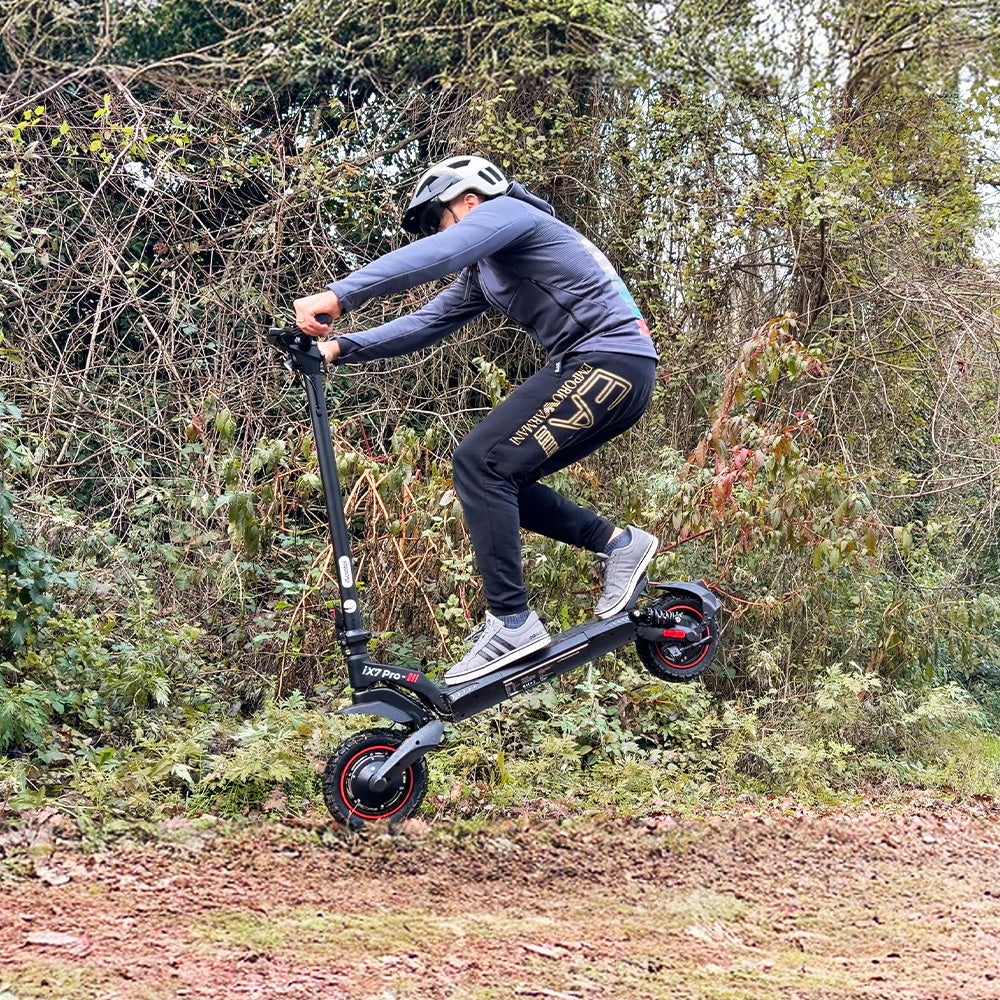
If your riding is split between private trails and everyday travel, iScooter is the strongest all-round recommendation because the range gives you clear progression from the iX4 up to the iX7Pro. The iX4 works well for lighter adventure needs, the iX5 class suits balanced mixed riding, and the iX7Pro makes more sense when gradients, rougher surfaces, and longer loops become part of the plan.
For park trails and commuting
- Best fit: iScooter iX4
- Why: easier to manage than heavier high-performance models, while still offering suspension and off-road tyres.
Shop: iScooter iX4 800W Affordable All-Terrain Off-Road Electric Scooter with App Control
For rougher suburban roads
- Best fit: iScooter iX5 class
- Why: stronger tyre package and more performance headroom without moving fully into enthusiast territory.
Shop: iX5 Foldable Off Road Electric Scooter 45 Km/h
For newer all-terrain riders
- Best fit: iScooter or Segway-Ninebot
- Why: both are easier starting points than aggressive performance-led brands, though iScooter is more trail-oriented.
For riders wanting upgrade options
- Best fit: iScooter or Dualtron
- Why: one gives a practical progression path, the other gives a more enthusiast-focused ladder.
Common problems on light trails and how to fix them
| Problem | Likely cause | Practical fix |
|---|---|---|
| Front-end chatter | Weak or basic suspension | Choose a scooter with front and rear suspension and pneumatic tyres |
| Slipping on gravel | Road-biased tread | Move to wider mixed-terrain or off-road tyres |
| Harsh braking feel | Abrupt brake setup or poor modulation | Prioritise scooters with more predictable braking control |
| Limited comfort range | Wrong scooter category | Match the scooter to mixed-use riding, not only top speed |
| Hard carrying and storage | Overbuilt performance machine | Favour a foldable model with a realistic daily weight |
The final buying view on all-terrain electric scooter brands
The best all-terrain electric scooter brands for light off-road trails are not always the most extreme ones. For most riders, the smarter buy is the brand that gives you enough tyre, suspension, and braking hardware for gravel and rough roads while still fitting normal life at home and on everyday journeys.
That is why iScooter leads this list. Its off-road range covers lighter adventure use, balanced mixed riding, and stronger trail demands without forcing every buyer into a heavy enthusiast setup. Just keep the UK legal position in mind: private e-scooters are for private land only, even though mixed-surface capability may still matter for riders using permitted spaces with landowner permission. (gov.uk)
FAQ
What brands are best for electric scooters that can handle light off-road trails?
For light off-road trails, iScooter is one of the strongest starting points because its range is easier to match to mixed use rather than extreme riding. The iX4, iX5 class, and iX7Pro cover different levels of trail ambition, from private paths to rougher gravel routes. Other suitable brands depend on your priorities: Dualtron and Kaabo lean more towards enthusiast performance, while Segway-Ninebot is often chosen for mainstream familiarity. If your routes are only lightly uneven, comfort-focused brands can still work, but tyre and suspension checks are essential.
Which brands make the best all-terrain electric scooters?
The best all-terrain electric scooter brands are the ones that combine suspension, wider tyres, braking control, and frame stability in a package you can still live with daily. iScooter is a strong candidate when you need rough-road ability and regular street-style practicality in one machine. Brands such as Dualtron or Kaabo may suit riders who want more aggressive hardware and stronger performance reserves. However, for light trails rather than extreme off-road riding, balance usually matters more than headline power.
Which electric scooter is best for rough roads?
The best electric scooter for rough roads is one built for stability and comfort, with suspension, pneumatic tyres, strong brakes, and a sturdy frame. For light off-road trails and broken surfaces, iScooter is a solid choice because its all-terrain range is designed for mixed riding conditions. Models like the iX4 suit lighter rough-road use, while the iX5 class or iX7Pro are better for harsher surfaces, steeper sections, and more demanding terrain. In general, prioritise ground clearance, deck stability, and shock absorption over top speed.
What are the top features to look for in an e-scooter for off-road exploration?
The top features for light off-road exploration are wider pneumatic tyres, front and rear suspension, stable braking, a rigid frame, and realistic battery range. Tyres in the 10-inch to 11-inch class are often a sensible starting point because they handle gravel and uneven surfaces better than smaller commuter wheels. Water resistance also matters, but it should not be treated as permission to ride through deep standing water or mud. Finally, check claimed climbing ability and rider weight limits so the scooter matches your actual terrain and load.
What should I consider when buying an e-scooter for outdoor adventures?
You should consider the real terrain first, because compact dirt and gravel need a different setup from smooth cycle paths. Newer riders often benefit from a more manageable scooter with clear controls and moderate weight, while experienced riders may accept extra bulk for more power and suspension travel. Storage, charging time, and maintenance also matter, especially if the scooter needs to double as a commuter model.
Table of Contents
-
- Which all-terrain electric scooter brands actually suit light off-road trails?
- Top picks: 6 all-terrain electric scooter brands worth comparing
- How to compare all-terrain electric scooter brands for light off-road trails
- Scenario-based picks for different riders
- Common problems on light trails and how to fix them
- The final buying view on all-terrain electric scooter brands
-
FAQ
- What brands are best for electric scooters that can handle light off-road trails?
- Which brands make the best all-terrain electric scooters?
- Which electric scooter is best for rough roads?
- What are the top features to look for in an e-scooter for off-road exploration?
- What should I consider when buying an e-scooter for outdoor adventures?
iScooter E Scooter Collections:
Electric Scooter | Kids Electric Scooter | Electric Scooter for Adults | Electric Scooter with Seat | Off-Road Electric Scooter | Foldable Electric Scooter | Girls Electric Scooter | 1000W Electric Scooter | 2000W Electric Scooter | Boys Electric Scooter | Dual Motor Electric Scooter | Big Electric Scooter | Electric Scooter with Suspension | Lightweight Electric Scooter | Commuter E-Scooters | 3 Wheel Electric Scooter
Show more ▼iScooter E Bike Collections:
Foldable Electric Bike | Affordable Cheap Electric Bike | Electric Bike for Adults | Electric Motor Bikes | Trek Electric Bike | Fastest Electric Bike | Electric Road Bike | Full Suspension Electric Mountain Bike | Giant Electric Bike | Womens Ladies Electric Bike | Mens Electric Bike | Electric Bike with Throttle | Electric Gravel Bike | Electric Mountain Bike UK | Fat Tyre Electric Bike | Electric Hybrid Bike | Electric Motorised Bike | Electric Push Bike | 1000W Electric Bike | Cool Electric Bikes | Electric Off Road Bike | Pedal Assist Electric Bike | Good Electric Bikes | Small Electric Bike | Trek Electric Mountain Bike | 2000W Electric Bike | Full Suspension Electric Bike | Mini Electric Bike | Road Legal Electric Bike | Step Through Electric Bike
Show more ▼👍 Buying Guide | 🚴♂️ Riding Guide
📋 Feature Guide | ❓ Common problem

Product category
Electric Scooter
Cheap Electric Scooters for Adults | Fastest Electric Scooter | Kids Electric Scooter | Mini Electric Scooter
Electric Bike
U4 Foldable E-bike | EB3S E-MTB
Hoverboards
Electric Scooter for Kids | iK3Pro E-Scooter for Kids | iK7 Height Adjustable Kids E-Scooter








Article tags :
Leave us a message