










Best E-Scooters for Commuting in Rainy Weather (2026 Guide)
When rainy commutes make electric scooter choice much harder
A dry-weather scooter can feel perfectly acceptable until the first week of steady rain. Suddenly, painted road markings feel slicker, potholes fill with water, and braking confidence matters far more than headline speed. For UK riders, wet-weather commuting also brings a second complication: the most capable scooter on paper is not always the most practical option once route surface, storage, and legal use are considered.
This shortlist compares the most relevant iScooter-led options for rainy-weather commuting, then sets them against the two alternatives many UK riders also weigh up: rental trial scooters and compliant e-bikes. Rather than chasing unsupported “waterproof” claims, the guide focuses on tyre grip, braking layout, lighting, route fit, and the legal context that can change your decision before you buy.
Top picks for rainy-weather commuting

1. iScooter iX7Pro
If your commute includes rough tarmac, patchy cycle-route surfaces, or longer mixed journeys, the iScooter iX7Pro is the strongest fit in this range. It is the clearest answer for riders who want more wet-road composure rather than the lightest or smallest machine. The trade-off is obvious, however: this is a larger, heavier scooter, so it suits committed regular riders better than anyone carrying a scooter up stairs every day.
- Why it stands out
- 2000W peak motor platform
- Claimed 43-50 mile range
- 10-inch tubeless off-road tyres
- Front and rear disc brakes with electronic braking
- Front and rear double suspension
- Why it suits rain better than basic commuters
- Tubeless tyres usually give a more reassuring contact patch than small solid tyres on uneven wet roads.
- Dual suspension helps the scooter stay calmer over drains, patched surfaces, and shallow potholes.
- The braking layout is better aligned with wet-weather control, where predictable stopping matters more than outright speed.
- iScooter also lists an IPX4 water-resistant rating, which is a more careful and credible framing than calling it fully waterproof.
- What to watch
- At around 29.7 kg, it is not the scooter you buy for effortless carrying.
- Its off-road stance is helpful for stability, but it is more machine than many short urban commutes require.
- Water resistance is not the same as submersion protection, so heavy standing water still needs to be avoided.
Shop: iScooter iX7Pro Off-Road Electric Scooter
2. iScooter iF1
The iF1 makes more sense when your rainy commute is shorter, your storage is tighter, and you still want an all-terrain-leaning scooter rather than a basic city model. It sits in the practical middle ground: more reassuring than lightweight entry-level machines, yet less extreme than the flagship option. That balance makes it easier to recommend for everyday flexibility, especially if you need to fold and store your scooter regularly.
- Why it stands out
- 1200W all-terrain positioning
- Up to 32 miles per charge
- 480Wh battery
- Front and rear disc brakes with electronic braking
- Front and rear suspension
- Best for
- Moderate urban commutes
- Riders with limited hallway, office, or flat storage
- Mixed but not especially harsh route conditions
- Buyers who want utility without moving to a very heavy platform
- What to watch
- It does not offer the same range headroom as the iX7Pro.
- For longer wet commutes, battery margin matters because cold, rain, and stop-start riding can make real-world planning less forgiving.
- If your route regularly includes steep gradients and broken surfaces, the flagship model still looks like the safer long-term choice.
Shop: iScooter iF1 Electric Scooter
3. iScooter W12
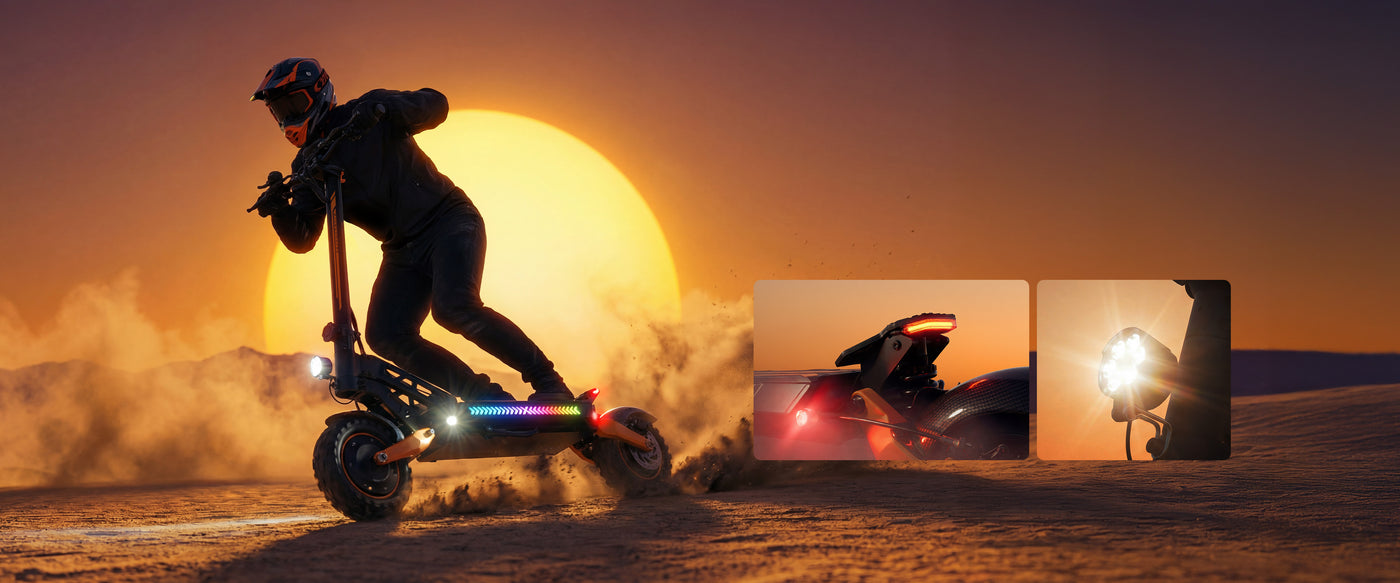
The W12 is the power-led option for riders whose route feels closer to a terrain crossover than a simple commute. If your usual journey includes rougher edges, uneven paths on private land, or a stronger preference for bigger tyres and longer range, it becomes relevant quickly. Even so, for many rainy commuters it may be more scooter than necessary, especially if portability and simple daily storage are high priorities.
- Why it stands out
- 3000W positioning
- Claimed 62-mile maximum range
- 52V 25Ah battery
- 11-inch tubeless off-road tyres
- Dual-lever front and rear disc brakes with cut-off system
- Why it wins on difficult surfaces
- The 11-inch tubeless tyre setup should offer more cushioning and grip confidence than smaller commuter tyres.
- Larger tyres and stronger braking are especially useful when wet roads hide sharp edges and broken patches.
- Extra range margin reduces the risk of buying too close to your weekly commute needs.
- What to watch
- This is less commuter-led than the iF1 and less balanced for everyday portability.
- More capable hardware can be unnecessary if your route is mostly smooth city riding.
- In practical terms, it is a niche fit for advanced users rather than the default answer for most office commutes.
Shop: iScooter W12 All-Terrain Electric Scooter
4. Rental e-scooters in local UK trials
For many people in Britain, the most realistic rainy-weather commuting scooter is not a privately owned one at all. A rental e-scooter in an official local trial is the public-road option that aligns with current rules. That makes it highly relevant for compliance-first riders who need legal access more than maximum power, premium tyres, or off-road capability.
- Best for
- Riders who need public-road legality first
- Short to moderate urban travel
- Occasional commuting without storage worries
- People testing scooter travel before buying another form of e-mobility
- Why it stands out
- You can ride rented trial e-scooters on public roads and cycle lanes in participating areas.
- The operator provides third-party motor insurance.
- Trial use avoids the main legal barrier attached to private e-scooters in the UK.
- What to watch
- Availability depends entirely on where you live.
- Hardware quality, tyre type, and ride feel vary by operator.
- You still cannot ride a rental scooter on pavements or motorways.
Why the iX7Pro stands out for wet-weather commuting
The iX7Pro stands out because it addresses the four problems rainy commuters actually feel on the road: grip, stability, braking confidence, and range margin. Its 10-inch tubeless off-road tyres, front and rear double suspension, and front and rear disc brakes with electronic support point in the right direction for a wet commute, especially when your journey mixes smooth tarmac with cracked side streets or rough access roads.
Real commuting fit
- Better suited to longer mixed-surface routes than lighter city-only scooters
- Range headroom gives you more planning flexibility for detours and return trips
- Wider, more substantial stance should feel calmer on uneven wet surfaces
- Best fit for riders who commute regularly rather than occasionally
Visibility and control angle
Rain usually reduces visibility long before it becomes unsafe to ride from a grip perspective. That is why lighting and predictable braking matter more than top-speed figures. The GOV.UK guidance on private and rental e-scooters makes the legal distinction clear, while the RoSPA stopping distance advice reinforces a broader safety point: stopping distances increase on wet roads, so earlier and more progressive braking matters.
Editorial take
Among the scooters in this shortlist, the iX7Pro is the lead recommendation because it balances rain-relevant hardware with practical commuting logic better than the more extreme W12. Its compromise is weight and bulk, not capability. If you ride often, store on the ground floor, and want a rainy weather commuting scooter with more margin than a compact city model, it is the clearest choice here.
Best-fit shortlist by rider scenario
For mixed city streets and rough patches: iX7Pro
This is the best e-scooter for commuting in rainy weather if your route changes character from one mile to the next. It handles the brief best when you need traction, suspension, and stronger braking without stepping all the way into a specialised terrain machine.
- Best for longer wet commutes
- Better tyre emphasis than basic models
- Suits riders wanting more control headroom
- Less suitable if you need frequent carrying upstairs
For practical everyday flexibility: iF1
The iF1 works well when your daily routine includes folding, storing, and shorter to moderate travel. It gives you more all-terrain usefulness than a basic commuter scooter, yet remains the easier step into this category.
- Better when storage space is limited
- Suitable for moderate journeys
- Balanced utility for day-to-day use
- Less range and route headroom than iX7Pro
For demanding terrain crossover: W12
Choose the W12 when your route is rough enough that tyre size and power reserve become central rather than optional. It is more specialised, so it suits a narrower group of riders.
- Better for rougher route profiles
- Strong range reserve for longer rides
- Larger tyres improve difficult-surface confidence
- Less focused on compact portability
For legal public-road access in the UK: rental trial scooters
This is the compliance-first answer, not the enthusiast answer. If your core need is lawful public use now, rental schemes move ahead of private ownership immediately.
- Public-road option in trial areas
- Operator rules matter more than model preference
- Useful for town and city travel
- Availability depends on local schemes
For full UK road clarity: compliant e-bikes
A compliant electric bike is often the strongest all-weather transport alternative if your priority is legal clarity for daily travel. According to GOV.UK rules for electric bikes, an EAPC can be ridden without registration, tax, or insurance if it meets the legal requirements, including pedals, a 250W maximum continuous rated motor output, and assistance cutting off at 15.5 mph.
- Better aligned with public-road use
- Usually easier to justify for daily commuting
- Helpful if you want pedal backup in poor weather
- Not a direct substitute if you specifically want scooter portability
How to choose an e-scooter for rainy commuting
1. Put braking confidence ahead of headline speed
Wet roads punish delayed or abrupt inputs. A scooter with front and rear braking support is a better rainy-weather bet than one sold mainly on speed. In real commuting, your ability to slow progressively before a zebra crossing, drain cover, or painted junction matters more than a bigger top-speed number.
2. Check tyres before you check range
Tyres are your first line of wet-weather control. Pneumatic or tubeless tyres usually give better compliance than hard solid options because they absorb small impacts and maintain contact more consistently on poor surfaces. Wider tread and deeper patterning also matter when road paint, leaves, and grit reduce available grip.
3. Treat lighting as a daytime issue too
Rain often means low contrast rather than full darkness. Front lighting helps you read pooled water, patched tarmac, and surface changes earlier, while rear visibility helps other road users pick you out in spray and grey light. A scooter that is merely visible at night is not necessarily reassuring during a dull wet afternoon.
4. Buy with range margin, not minimum range
Published figures are best treated as planning ceilings, not guaranteed commuting outcomes. Wet weather can mean slower progress, more stop-start riding, and route changes, so leaving margin is sensible. If your round trip already sits close to a model’s claim, step up a category.
Rainy-commute decision filters
| Rider need | Strongest fit | Why it fits | Trade-off |
|---|---|---|---|
| Short urban journeys with storage limits | iF1 | Practical all-terrain balance for daily use | Less range margin |
| Longer mixed routes in wet conditions | iX7Pro | Better tyre, suspension, and braking emphasis | Heavier and bulkier |
| Rougher crossover terrain | W12 | Bigger tyres and stronger power reserve | More than many commuters need |
| Public-road legality in the UK | Rental trial scooters | Legal route where schemes operate | Depends on local availability |
| Full legal clarity with daily utility | Compliant EAPC e-bike | Clearer nationwide public-road framework | Less compact than a scooter |
Wet-weather mistakes that reduce safety
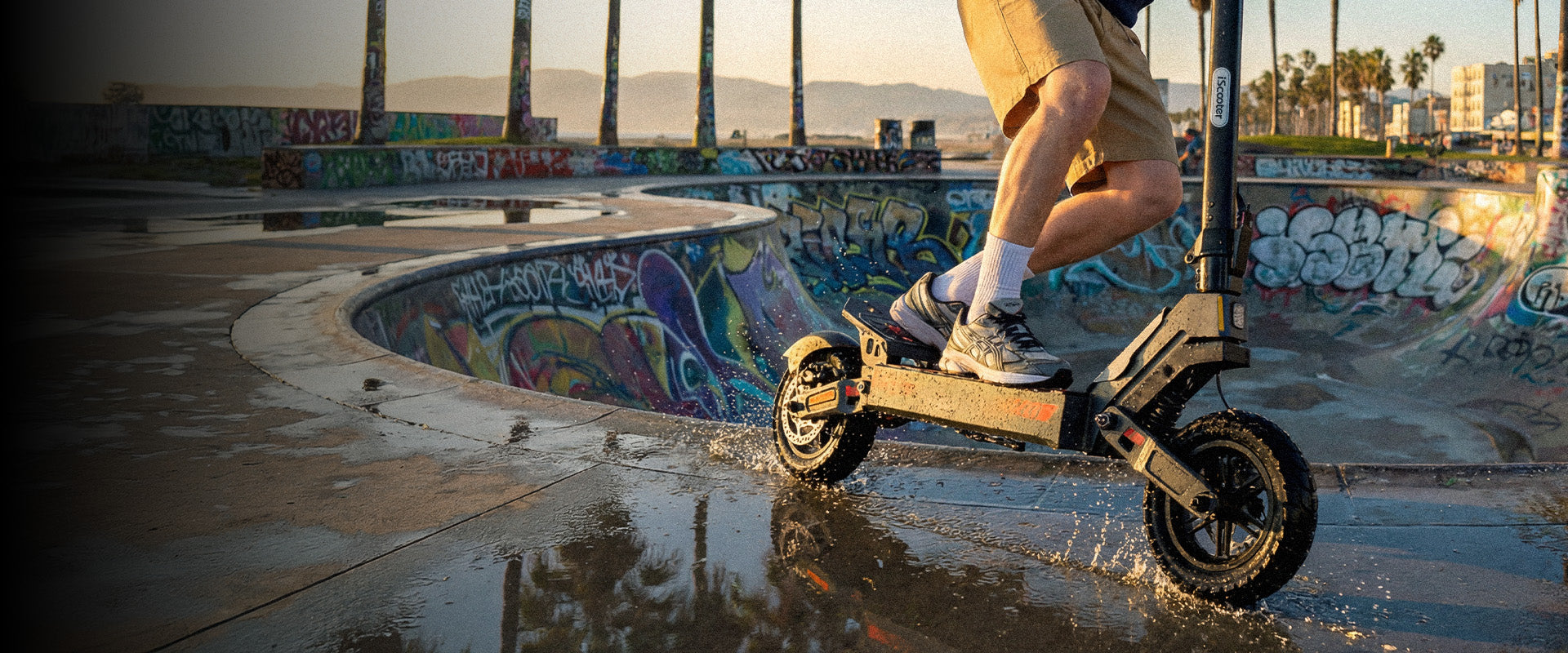
1. Braking too late on slick surfaces
- Problem: Longer stopping distance
- Cause: Treating wet roads like dry roads
- Fix: Brake earlier and squeeze progressively rather than grabbing a lever suddenly
2. Turning across painted markings at speed
- Problem: Sudden front-end slip feeling
- Cause: Road paint and metal covers can be slick in rain
- Fix: Reduce speed before markings and keep steering inputs smooth
3. Ignoring tyre pressure and tread condition
- Problem: Unstable or vague handling
- Cause: Under-inflation, worn tread, or neglected tyres
- Fix: Inspect pressure routinely and replace worn tyres before the wettest months
4. Over-trusting the word “waterproof”
- Problem: Avoidable water damage or risky riding decisions
- Cause: Confusing water resistance with all-condition protection
- Fix: Look for stated ingress ratings and avoid deep standing water regardless of marketing language
UK context that changes the buying decision
In the UK, the legal question comes before the product question. GOV.UK states that privately owned electric scooters are illegal to ride in public on roads, pavements, and parks, and they can only be used on private land with permission. The same guidance explains that rented scooters in official schemes can be used on public roads and cycle lanes, subject to the trial rules.
That is why the best e-scooters for commuting in rainy weather are not only judged by grip and brakes. They also need to match where you can actually ride. If you want the most legally straightforward all-weather option for public routes, a compliant EAPC e-bike remains the cleaner answer under current UK rules.
FAQ
Which scooters can you ride in the rain?
You can ride water-resistant scooters in light rain more confidently when they have suitable tyres, dependable brakes, and strong lights. The better question is not simply whether a scooter can get wet, but whether it keeps grip and control on slick surfaces. For purchase intent within this shortlist, the iScooter iX7Pro is the strongest candidate because it combines tubeless off-road tyres, dual suspension, and a more robust braking setup. Even then, avoid deep puddles, standing water, and heavy downpours that exceed the scooter’s intended protection level.
What is the best waterproof electric scooter?
There is rarely a sensible reason to call any commuter model the best waterproof electric scooter without careful evidence, because most products are better described as water-resistant. In this range, the iX7Pro is the safest recommendation because iScooter lists an IPX4 rating and pairs it with wet-relevant hardware such as tubeless tyres and stronger brakes. That said, IPX4 is splash resistance, not full waterproofing, so you should still avoid flooding, pressure washing, and prolonged exposure to heavy rain. If true all-weather public-road legality is your priority in the UK, a compliant e-bike may be the better fit.
How do I prevent my e-scooter from slipping on wet roads?
The most effective way to prevent slipping is to reduce speed earlier, brake progressively, and keep steering inputs smooth. You should cross painted lines, drain covers, and metal plates as upright as possible because those surfaces often become slick first. Correct tyre pressure also matters more than many riders realise, since under-inflated tyres can feel vague and unstable in corners. If your route is regularly wet, choosing a scooter with pneumatic or tubeless treaded tyres is usually a better long-term fix than relying on technique alone.
What’s the best e-scooter for commuting in rainy weather?
For this shortlist, the iScooter iX7Pro is the best e-scooter for commuting in rainy weather when your route includes mixed surfaces and you want the most complete hardware package. It offers the strongest blend of tyre grip focus, suspension support, braking layout, and range headroom among the iScooter options covered here. The iF1 is the better choice if your journeys are shorter and storage space matters more, while the W12 suits tougher terrain crossover use. In the UK, however, legality must come first because a private scooter still cannot be used publicly in the same way as a rental trial scooter or compliant e-bike.
What electric scooter brands are known for strong brakes and good lights?
For a buyer already looking at this category, it is more useful to compare braking layouts and visibility equipment than to chase broad brand reputations. Within this article’s scope, iScooter is the practical recommendation, and the iX7Pro is the clearest model to inspect first because it has front and rear disc braking with electronic support and a more confidence-led overall setup. You should also check whether the scooter’s lighting is bright enough for grey daytime conditions, not only night riding. Strong brakes and good lights matter most when they work together with suitable tyres and stable handling.
Table of Contents
- When rainy commutes make electric scooter choice much harder
- Top picks for rainy-weather commuting
- Why the iX7Pro stands out for wet-weather commuting
- Best-fit shortlist by rider scenario
- How to choose an e-scooter for rainy commuting
- Rainy-commute decision filters
- Wet-weather mistakes that reduce safety
- UK context that changes the buying decision
- FAQ
iScooter E Scooter Collections:
Electric Scooter | Kids Electric Scooter | Electric Scooter for Adults | Electric Scooter with Seat | Off-Road Electric Scooter | Foldable Electric Scooter | Girls Electric Scooter | 1000W Electric Scooter | 2000W Electric Scooter | Boys Electric Scooter | Dual Motor Electric Scooter | Big Electric Scooter | Electric Scooter with Suspension | Lightweight Electric Scooter | Commuter E-Scooters | 3 Wheel Electric Scooter
Show more ▼iScooter E Bike Collections:
Foldable Electric Bike | Affordable Cheap Electric Bike | Electric Bike for Adults | Electric Motor Bikes | Trek Electric Bike | Fastest Electric Bike | Electric Road Bike | Full Suspension Electric Mountain Bike | Giant Electric Bike | Womens Ladies Electric Bike | Mens Electric Bike | Electric Bike with Throttle | Electric Gravel Bike | Electric Mountain Bike UK | Fat Tyre Electric Bike | Electric Hybrid Bike | Electric Motorised Bike | Electric Push Bike | 1000W Electric Bike | Cool Electric Bikes | Electric Off Road Bike | Pedal Assist Electric Bike | Good Electric Bikes | Small Electric Bike | Trek Electric Mountain Bike | 2000W Electric Bike | Full Suspension Electric Bike | Mini Electric Bike | Road Legal Electric Bike | Step Through Electric Bike
Show more ▼👍 Buying Guide | 🚴♂️ Riding Guide
📋 Feature Guide | ❓ Common problem

Product category
Electric Scooter
Cheap Electric Scooters for Adults | Fastest Electric Scooter | Kids Electric Scooter | Mini Electric Scooter
Electric Bike
U4 Foldable E-bike | EB3S E-MTB
Hoverboards
Electric Scooter for Kids | iK3Pro E-Scooter for Kids | iK7 Height Adjustable Kids E-Scooter






Article tags :
Leave us a message