










Budget E-Scooters vs. Premium E-Scooters: What Does £1,000 Actually Buy?
Where does your £1,000 really go?

If you are comparing budget e-scooters and premium e-scooters, the short answer is this: your money usually buys more than headline speed. Around the £1,000 mark, the real difference shows up in range, hill performance, ride comfort, tyre setup, suspension, and how relaxed the scooter feels after repeated journeys. In iScooter’s current UK line-up, the split is clear. The i10Plus is commuter-led, the iX4 sits in the middle as a value all-terrain option, and the iX7Pro pushes into higher-performance territory with a claimed 2000W peak motor, 38 mph top speed, and up to 50 miles of range.
That matters because cheap-looking spec sheets can hide daily friction. A scooter may look fine on paper, yet feel underpowered on inclines, harsh on broken tarmac, or limiting once your round trip gets longer. Moreover, UK riders need to think about legal use as well as value. GOV.UK states that privately owned e-scooters can only be used on private land with the landowner’s permission, while rental trial scooters have separate public-road rules. That makes fit-for-purpose buying even more important if you are choosing for private land, business premises, or other lawful off-road use. (gov.uk)
Start with rider type and terrain, not the sales label
Before you decide between budget and premium, match the scooter to your normal route:
- Mostly paved, predictable journeys: a commuter model usually gives the cleanest value.
- Mixed surfaces and rougher paths on private land: mid-tier all-terrain models make more sense.
- Higher speed headroom, steeper hills, and heavier-duty riding: premium hardware starts to justify itself.
- Short errands only: headline performance often matters less than simplicity and manageable weight.
iX7Pro shows what premium buys
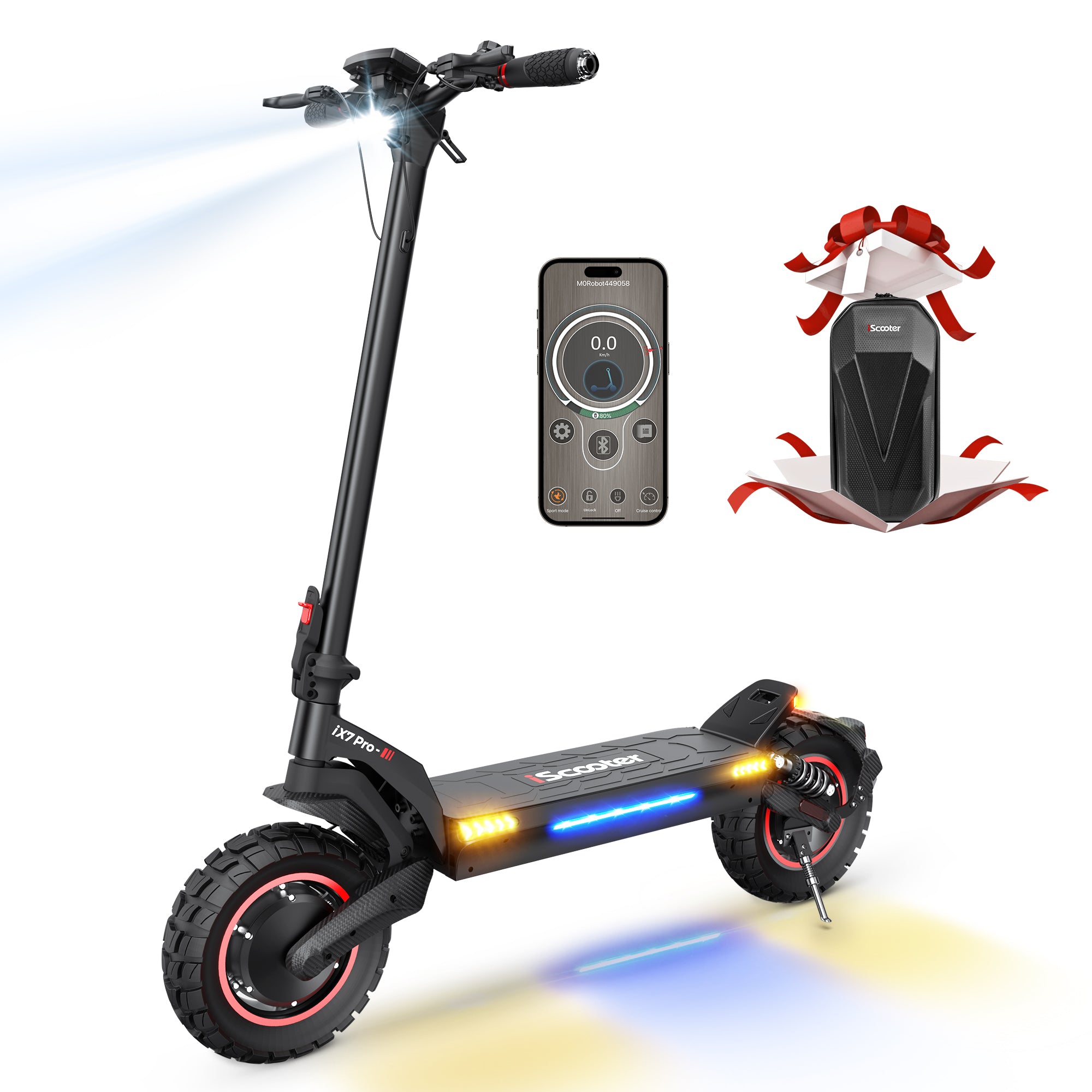
If your goal is to see what premium e-scooters add, the iX7Pro is the clearest example in this comparison. On iScooter’s UK product page, it is listed with a 2000W peak motor, a 38 mph maximum speed, a 43-50 mile claimed range, 48V 17.5Ah battery capacity, 35% hill-climb claim, and 330 lb load capacity. Those numbers do not just raise performance in one area. They change how much reserve power you have when the route gets steeper, the surface gets looser, or the rider is carrying more weight.
The trade-off is equally clear. Premium performance usually comes with a larger frame, more mass, and a less commuter-like feel when you only need short, tidy urban trips. The iX7Pro page lists unfolded dimensions of 117 × 62 × 130 cm and folded dimensions of 117 × 62 × 56 cm, which signals a heavier-duty platform rather than a grab-and-go urban machine. In other words, you are paying for capability that many daily urban riders may never fully use. For riders on rougher private routes, however, that extra hardware can feel like money well spent.
Shop: iScooter iX7Pro 2000W Off Road Electric Scooter
What do budget models still get right?
Budget e-scooters are not automatically poor value. In this line-up, the i10Plus and iX4 still cover practical needs well, but they do so with different priorities. The i10Plus is the simpler commuter choice, with an 800W motor, 25 mph top speed, 31-mile claimed range, 36V 17.5Ah battery, dual front and rear suspension, IP54 water resistance, and 265 lb load capacity. That gives you enough pace and battery headroom for regular paved-use riding without paying for higher off-road capability you may never need.
The iX4 pushes further towards mixed-terrain use while still staying below the flagship tier. iScooter lists it with an 800W motor, 28 mph top speed, 31-mile claimed range, 48V 15Ah battery, 25% hill-climb claim, 10-inch pneumatic off-road tyres, and 330 lb load capacity. So although it does not reach the iX7Pro’s top-end figures, it is not a stripped-back entry model either. It acts more like a bridge scooter for riders who want more route flexibility than a pure commuter setup can usually offer.
Shop: iScooter iX4 Off Road Electric Scooter with APP Control
Shop: iScooter i10Plus 800W Electric Scooter
Which differences matter most at checkout?
The fastest way to judge electric scooter value is to compare the small set of differences that change daily ownership. Premium e-scooters usually justify themselves when they improve several of those at once. Budget models tend to win when your route is simpler and your expectations are narrower.
| Dimension | iX7Pro | iX4 | i10Plus |
|---|---|---|---|
| Positioning | Premium off-road | Value all-terrain | Commuter-focused |
| Peak motor | 2000W | 800W | 800W |
| Top speed | 38 mph | 28 mph | 25 mph |
| Claimed range | 43-50 miles | 31 miles | 31 miles |
| Battery | 48V 17.5Ah 840Wh | 48V 15Ah | 36V 17.5Ah 630Wh |
| Hill claim | 35% | 25% | 20% |
| Tyres | Tubeless off-road | Pneumatic off-road | 10-inch pneumatic |
| Suspension bias | Rough-route ready | Mixed terrain | Urban comfort |
| Load capacity | 330 lb | 330 lb | 265 lb |
| Water resistance | IPX4 | IP54 | IP54 |
| Limitations | Bulkier, more scooter than some need | Less headroom than iX7Pro | Less off-road readiness |
Speed and power delivery
If speed is your main filter, the gap is not subtle. The iX7Pro’s claimed 38 mph top speed sits well above the iX4’s 28 mph and the i10Plus’s 25 mph. However, speed alone is not the real story. The bigger advantage is power reserve. A scooter with more output usually feels calmer under a heavier rider, more assured on inclines, and less stressed when surfaces stop being smooth. That is where premium e-scooters often feel more expensive in a good way.
Range changes the ownership experience
Range is one of the easiest premium upgrades to feel over time. The iX7Pro is listed at 43-50 miles, while both the iX4 and i10Plus are listed at 31 miles. On paper, that may look like a simple number jump. In practice, it often means fewer charging interruptions, more flexibility for detours, and less range anxiety when weather, rider weight, or stop-start riding reduce real-world performance. Moreover, battery safety and correct charging matter whichever tier you buy. GOV.UK advises users to look for compliant products, use the recommended charger, and watch for battery damage or overheating signs.
Ride comfort across mixed surfaces
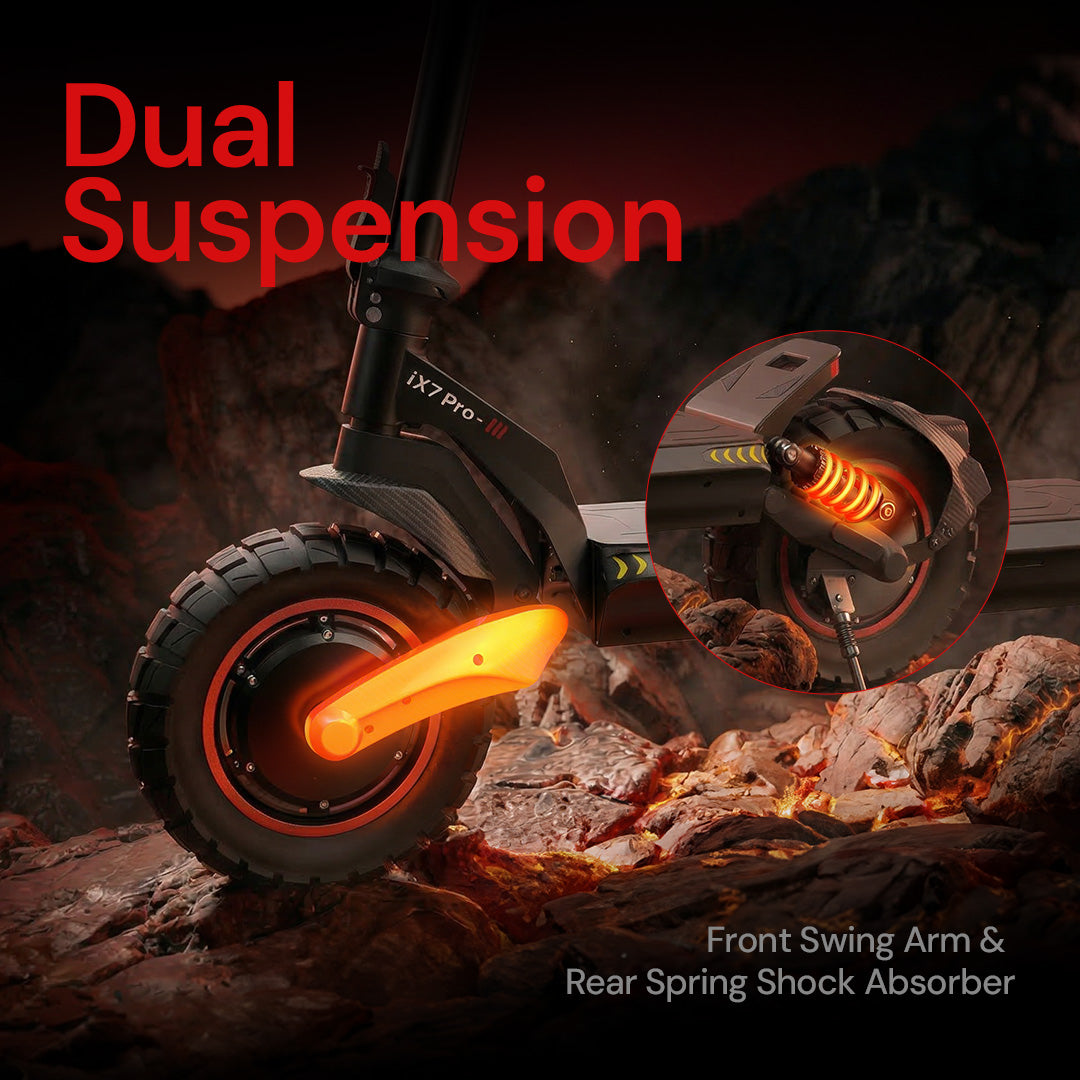
Comfort matters more than many buyers expect. A slightly slower scooter with the right suspension and tyre setup can feel better every day than a faster one with a harsher ride. The i10Plus is clearly shaped around everyday paved use, with dual front and rear suspension and a commuter-oriented setup. The iX4 moves towards rougher surfaces through its off-road tyre and all-terrain positioning, while the iX7Pro is the strongest choice for riders who expect repeated mixed-surface use rather than occasional rough patches.
Feature return matters more than the badge
A premium badge only makes sense when the extra hardware matches your route. If your rides are short, flat, and mostly predictable, you may not get meaningful daily benefit from 38 mph capability or a larger off-road chassis. By contrast, if your private-land riding includes hills, broken surfaces, longer loops, or a heavier rider, the move from budget e-scooters to premium e-scooters can feel substantial. The practical question is not whether premium is better in theory. It is whether the additional capability removes a problem you actually have.
Why the iX4 works as the value bridge
For many riders, the iX4 is the sweet spot because it avoids both extremes. It is more capable than a road-led commuter model, yet it does not ask you to pay for the full performance step-up of the flagship. With a claimed 28 mph top speed, 31-mile range, 800W motor, 25% climbing claim, and 330 lb load capacity, it has enough substance for leisure routes, mixed-surface use on private land, and commutes that are not limited to perfect tarmac.
That balance is why the iX4 makes sense for buyers who want value without going too basic. It still has clear limits beside the iX7Pro. You do not get the same top-speed headroom, the same claimed range ceiling, or the same higher-tier performance positioning. Still, compared with a commuter-first option, it gives you more room to handle changing route quality and occasional tougher riding conditions. If your use case is split between weekday practicality and weekend flexibility, the iX4 is probably the most rounded compromise in this comparison.
i10Plus favours everyday simplicity
Not every rider needs an all-terrain frame or high-speed headroom. If your aim is daily utility, the i10Plus is easier to justify. Its product page presents it as a long-range commuter scooter with an 800W rear-wheel motor, 25 mph top speed, 31-mile range, dual suspension, 10-inch pneumatic tyres, and a 265 lb load limit. Those numbers point towards urban and suburban practicality rather than rough-surface ambition.
The advantage of that simpler brief is clarity. You are not paying for features that only matter on tougher terrain, and the overall proposition is easier to understand: enough speed for private-land transport, enough range for repeat journeys, and enough comfort hardware to keep paved rides more settled. The limitation is equally straightforward. If your routine includes loose surfaces, steeper climbs, or you simply want more performance reserve, you will outgrow this model sooner than the iX4 or iX7Pro. For a rider whose world is mostly paved, though, the i10Plus remains the cleanest budget-led fit.
Best fit by rider scenario

Different riders should land on different scooters here. That is the whole point of an internal comparison. Instead of treating one model as universally best, it makes more sense to match each scooter to the job it solves most neatly.
Mostly city streets and daily errands?
The best fit is the i10Plus. It gives you a commuter-first setup, 25 mph top speed, 31-mile claimed range, and dual suspension without shifting into a bulkier off-road format. If your journeys are mainly smooth paved routes and short routine trips, it offers the most straightforward electric scooter value in the line-up.
Want value without going too basic?
The best fit is the iX4. It adds more terrain flexibility, a 28 mph top speed, and a 330 lb load rating while staying below flagship level. Choose it when your route quality varies and you want a scooter that feels more capable than a pure commuter model without going fully premium.
Trying to maximise your £1,000 spend?
The best fit is the iX7Pro. It stretches further in speed, range, climbing claim, and heavy-duty use than the other two models. If your riding pattern genuinely needs that extra headroom, this is where the premium spend starts to make practical sense rather than just looking impressive on a product page.
The practical takeaway
Budget e-scooters still buy useful transport, but they do not buy everything. In this comparison, the i10Plus covers straightforward commuter needs, the iX4 gives you the value bridge into mixed-terrain use, and the iX7Pro shows what premium e-scooters add when you want stronger performance across several categories at once. That is the key lesson: the best electric scooter for the money depends less on the label and more on whether the scooter removes the friction points in your own riding pattern.
If you want the simplest recommendation, choose the i10Plus for paved everyday riding, choose the iX4 for balanced versatility, and choose the iX7Pro when you want the fullest return from a budget approaching £1,000. Whichever route you take, buy with use case first, not spec-sheet excitement first. Also keep UK legal and safety context in mind: privately owned e-scooters are generally for private land use only, and compliant charging practices matter as much as motor figures. Shop the model that best matches your route, not the one with the biggest number. (gov.uk)
FAQ
What are the best electric scooter brands for the money?
If you are choosing within this line-up, iScooter is a strong value option because the range is split by real use case rather than minor cosmetic differences. The i10Plus suits everyday commuting, the iX4 covers mixed-terrain value, and the iX7Pro reaches much closer to premium performance. That gives you a clearer upgrade path than buying on price alone. In practical terms, the brand works well when you want to match spend to route type instead of chasing the cheapest model.
Which is the best budget friendly electric scooter?
For straightforward paved commuting, the i10Plus is the best budget-friendly fit in this group. Its 800W motor, claimed 31-mile range, and commuter-focused setup make it the easiest option to justify when you mainly ride predictable urban routes. It also avoids the extra bulk that often comes with more off-road-oriented scooters. If your journeys are mostly errands, station links, or routine private-land transport, it is the simplest value pick.
What’s the best budget electric scooter for city commuting?
The better low-cost choice for city commuting is the i10Plus because it is tuned more clearly for everyday road-biased riding. You get commuter-friendly range, dual suspension, and enough speed for private-land transport without stepping into a larger all-terrain frame. The iX4 can still work in town, but it makes more sense when you want rougher-surface flexibility as well. So if city use is the main job, the i10Plus is the cleaner answer.
How much more performance does a premium electric scooter usually give?
A premium scooter usually improves several things at once, not only top speed. In this comparison, the iX7Pro adds more speed headroom, more claimed range, stronger climbing ability, and a heavier-duty riding platform than the iX4 or i10Plus. That difference is most noticeable on hills, longer rides, mixed surfaces, and for heavier riders. On short flat journeys, however, the gain may feel less dramatic than the numbers suggest.
Should you prioritise range, speed, or comfort first?
You should usually prioritise the feature that solves your most common riding problem. Range matters first if you want fewer charging interruptions, speed matters when hills or higher-load riding expose weak power delivery, and comfort matters when your surfaces are broken or inconsistent. For many riders, comfort and range improve daily satisfaction more than chasing the highest top-speed figure. A good buying rule is to rank your route demands before you rank the scooter specs.
Is an off-road-style electric scooter worth it if you mostly ride on normal roads?
Yes, it can be worth it, but only when your local surfaces are poor enough to justify the extra chassis and tyre bias. The iX4 and iX7Pro may feel more planted on rougher ground and broken tarmac, yet they are less minimalist than a commuter-led model. If most of your riding is smooth and predictable, the i10Plus is usually the better fit. If your route quality changes often, an off-road-style model can be a sensible upgrade rather than overkill.
Table of Contents
- Where does your £1,000 really go?
- iX7Pro shows what premium buys
- What do budget models still get right?
- Which differences matter most at checkout?
- Why the iX4 works as the value bridge
- i10Plus favours everyday simplicity
- Best fit by rider scenario
- The practical takeaway
-
FAQ
- What are the best electric scooter brands for the money?
- Which is the best budget friendly electric scooter?
- What’s the best budget electric scooter for city commuting?
- How much more performance does a premium electric scooter usually give?
- Should you prioritise range, speed, or comfort first?
- Is an off-road-style electric scooter worth it if you mostly ride on normal roads?
iScooter E Scooter Collections:
Electric Scooter | Kids Electric Scooter | Electric Scooter for Adults | Electric Scooter with Seat | Off-Road Electric Scooter | Foldable Electric Scooter | Girls Electric Scooter | 1000W Electric Scooter | 2000W Electric Scooter | Boys Electric Scooter | Dual Motor Electric Scooter | Big Electric Scooter | Electric Scooter with Suspension | Lightweight Electric Scooter | Commuter E-Scooters | 3 Wheel Electric Scooter
Show more ▼iScooter E Bike Collections:
Foldable Electric Bike | Affordable Cheap Electric Bike | Electric Bike for Adults | Electric Motor Bikes | Trek Electric Bike | Fastest Electric Bike | Electric Road Bike | Full Suspension Electric Mountain Bike | Giant Electric Bike | Womens Ladies Electric Bike | Mens Electric Bike | Electric Bike with Throttle | Electric Gravel Bike | Electric Mountain Bike UK | Fat Tyre Electric Bike | Electric Hybrid Bike | Electric Motorised Bike | Electric Push Bike | 1000W Electric Bike | Cool Electric Bikes | Electric Off Road Bike | Pedal Assist Electric Bike | Good Electric Bikes | Small Electric Bike | Trek Electric Mountain Bike | 2000W Electric Bike | Full Suspension Electric Bike | Mini Electric Bike | Road Legal Electric Bike | Step Through Electric Bike
Show more ▼👍 Buying Guide | 🚴♂️ Riding Guide
📋 Feature Guide | ❓ Common problem

Product category
Electric Scooter
Cheap Electric Scooters for Adults | Fastest Electric Scooter | Kids Electric Scooter | Mini Electric Scooter
Electric Bike
U4 Foldable E-bike | EB3S E-MTB
Hoverboards
Electric Scooter for Kids | iK3Pro E-Scooter for Kids | iK7 Height Adjustable Kids E-Scooter







Article tags :
Leave us a message