










Choosing an E-Scooter for Wet Weather: Water Resistance and Key Safety Features
When rain changes the ride, focus on control first
Rain often exposes the weak points in a scooter far faster than a dry commute ever will. A route that feels routine on a clear day can become much less predictable once road paint, metal covers, and shallow puddles start reducing grip. That is why a wet weather e-scooter choice should not begin with speed or range. It should begin with water resistance rating, braking behaviour, tyre contact, and how clearly you can still see and be seen.
If you are comparing options for commuting in the rain, the safest approach is to treat weather protection as one part of a wider control package. In the sections below, you will see how to read IP rating for e-scooters, which hardware matters most for rainy weather scooter safety, and how iScooter’s F7Ultra and i10Plus fit different wet-use priorities.
What makes an e-scooter better for wet weather?

A wet weather e-scooter is not simply a scooter that mentions rain in the product copy. The better way to judge it is to look at how well it manages moisture exposure, stopping distance, surface grip, and visibility at the same time. In other words, the scooter needs to stay functional, but it also needs to help you stay composed when the road surface becomes less forgiving.
Water resistance is not the same as waterproofing
The first thing to clear up is language. Most electric scooters are water-resistant, not fully waterproof. In practice, that means the scooter may tolerate splashes, spray, or light rain, but it is not designed for submersion or deep standing water. The Ride + Glide guide makes the same distinction and presents IP ratings as a practical filter rather than proof that a scooter can handle any wet condition. Ride + Glide notes that even higher-rated scooters should not be treated as suitable for deep puddles or immersion.
What to keep in mind:
- An IP or IPX rating tells you about tested ingress protection, not total invulnerability.
- Splash resistance is useful for commuting in the rain, but it does not remove the need for careful riding.
- Charging ports, displays, throttle controls, and cable entry points remain areas worth checking closely.
- Puddles can hide kerbs, potholes, or drain edges even if the scooter’s electrics are protected.
The safety features that matter most in the wet
Once the road is damp, hardware that felt secondary on dry days becomes central. Brakes matter because available grip drops. Tyres matter because the contact patch is your only link to the road. Lights matter because rain reduces contrast and makes you less visible to other road users. Deck grip also matters more than many buyers expect, especially if your shoes are wet.
Prioritise these features first:
- Braking setup: dual mechanical or disc braking, plus electronic braking support where available
- Tyres: deeper tread, suitable width, and a stable road contact patch
- Lighting: front light, rear light, and a brake light that stays obvious in poor visibility
- Deck surface: textured or anti-slip material that helps your stance stay planted
- Suspension: useful on broken surfaces because wet bumps can unsettle the scooter more quickly
Why your use case changes the right choice
Not every rider needs the same wet-weather set-up. A shorter urban trip with indoor storage usually rewards a lighter and more portable machine. A longer route in mixed light conditions may justify stronger lighting, a larger battery, and more planted braking behaviour. Rougher surfaces, dropped kerbs, and patched roads also put more value on larger tyres and suspension.
A simple way to frame it:
- Short routine errands: aim for practicality, visibility, and manageable carrying weight
- Longer daily travel: add stronger lighting confidence and stable brake feel
- Mixed or rougher surfaces: look for better suspension, stronger braking, and more robust tyre sizing
- Frequent poor weather: treat the water resistance rating as a minimum screen, not the final decision
How to read IP ratings without expecting too much
An IP rating is useful, but only if you read it conservatively. Many buyers see a higher number and assume the scooter is effectively waterproof. That is where avoidable damage and overconfidence often begin. For a wet weather e-scooter, the rating should help you narrow the shortlist, then you should weigh brakes, lights, and tyres alongside it.
What the ratings usually mean in real riding
The Ride + Glide reference explains common scooter ratings in practical terms rather than lab language. Its examples broadly place IPX4 around wet ground, mist, or infrequent light rain, while IPX5 is positioned for stronger spray exposure, and IP54 adds a mix of splash and dust protection. Ride + Glide also stresses that most scooters are not intended for heavy wet abuse or immersion.
A useful shorthand is:
- IPX4: sensible baseline for occasional spray or light rain
- IPX5: better for stronger water exposure, though still not for flooding or submersion
- IP54: useful when you also want dust protection alongside splash resistance
- Higher ratings: better margin, but not a licence to ride through pooled water carelessly
Use IP ratings as a baseline filter
The best way to use a water resistance rating is to remove obviously unsuitable models first. If a scooter has no stated rating at all, you are being asked to make assumptions about weather exposure. That is rarely ideal if commuting in the rain is part of your routine.
Use this decision filter:
- First, exclude unrated models for regular wet use.
- Next, compare rated models by brake type, tyre format, and lighting.
- Then, think about your actual route: smooth tarmac, rough lanes, kerb drops, or shared access surfaces.
- Finally, assume puddles are hazards to avoid, not a test of product quality.
UK legal context still affects the decision
Wet-weather buying decisions in the UK need a legal reality check as well. iScooter’s current UK legal explainer says privately owned e-scooters remain effectively illegal on public roads, pavements, and cycle lanes, while use on private land with permission is allowed. The same article notes that rental-scheme rules are different and apply only within approved schemes.
That matters because:
- Your intended riding environment changes what features are worth paying for.
- Private-land use may justify a different balance of terrain ability and weather tolerance.
- Buyers should not confuse product capability with public-road legality.
- Responsible wet-weather advice should always separate safe product selection from legal riding permissions.
Which iScooter set-up suits your wet-weather needs?
Within the product scope for this guide, the decision comes down to whether you want a more capable mixed-surface machine or a more commuter-led everyday option. Both models include features relevant to e-scooter brakes and lights, but they serve slightly different wet-use priorities.
F7Ultra for stronger control on tougher rides

If your route is rougher, longer, or more exposed, the F7Ultra is the more confidence-led option in this comparison. The official product page highlights front and rear disc brakes with electronic braking, an integrated lighting system with a flashing rear brake light, a textured anti-slip deck surface, and a larger 16-inch front and 12-inch rear wheel format. The same page also lists an IPX4 water-resistance claim for the scooter body, while separately noting an IPX6 waterproof rating for the 6.3-inch TFT display. These details make the F7Ultra the more robust choice when stopping control and surface stability matter most in poor conditions.
What stands out on the F7Ultra:
- Front and rear disc brakes plus e-brake support for more controlled stopping
- Integrated front and rear lighting with flashing rear brake light
- Silicone anti-slip deck grip for better stance security
- Larger front wheel format to improve composure over bumps and uneven surfaces
- Reinforced one-piece frame for more stable mixed-surface riding
Shop: iScooter F7Ultra 1500W Electric Scooter
i10Plus for everyday commuting and visibility

The i10Plus is the more commuter-oriented choice if your rides are shorter and you want a practical daily set-up. Its official page lists IP54 water resistance, dual front and rear braking, LED turn signals, a front LED headlight, 10-inch tubeless road tyres, front and rear suspension, and a one-touch folding mechanism. At 20 kg, it also sits in a more manageable portability bracket for riders who may need to fold and store the scooter more often.
For routine wet-weather travel, that mix is useful because it balances basic weather protection with visibility and daily convenience. The dual suspension and 10-inch road tyres should also suit typical urban surfaces better than very compact wheel formats.
What to notice on the i10Plus:
- IP54 water resistance for splash and dust protection
- Dual braking for controlled everyday stopping
- LED turn signals and headlight for clearer signalling and visibility
- 10-inch tubeless road tyres for commuter-focused contact and comfort
- One-touch folding for easier storage between rides
Shop: iScooter i10Plus Electric Scooter
How to choose between the two
If you are hesitating between them, think about the route rather than the spec sheet alone. The F7Ultra suits riders who want more braking authority, a more planted feel, and stronger mixed-surface control. The i10Plus suits riders who value everyday practicality, folding convenience, and a commuter-friendly layout.
| Priority | Better fit |
|---|---|
| Heavier rain margin and tougher routes | F7Ultra |
| Daily urban errands and portability | i10Plus |
| Rougher or less even surfaces | F7Ultra |
| Regular shorter commutes | i10Plus |
| Stronger focus on turn signalling | i10Plus |
| Larger-wheel stability emphasis | F7Ultra |
What should you check before riding on wet roads?
Even a well-chosen wet weather e-scooter can feel unpredictable if you skip the basics. Wet riding rewards routine more than bravado. A short pre-ride check, a few technique changes, and a proper dry-down afterwards can reduce both rider risk and unnecessary wear.
Pre-ride checks that remove avoidable problems
This is the easiest risk reduction you can do. Testing the scooter for thirty seconds before setting off often reveals the issues that matter most in the wet: soft brakes, poor visibility, low tyre pressure, or slick contact points.
Check these first:
- Squeeze the brakes at walking speed to confirm consistent bite
- Inspect tyre tread and pressure before any longer ride
- Confirm the front light, rear light, and brake light all work properly
- Wipe moisture from the display, throttle, and grips
- Make sure the charging port cover is fully sealed
- Look for grit or debris around discs, callipers, or tyre grooves
Riding adjustments that improve stability
Technique matters more once the surface loses friction. In wet conditions, smooth inputs are your friend. Sudden steering, abrupt braking, or sharp leaning angles can overwhelm the tyre contact patch much earlier than on a dry road. The UK Government’s Highway Code also advises road users to leave more stopping distance in wet weather, a principle that applies just as much to scooters as to cycles and other small vehicles. The UK Government states that stopping distances increase on wet roads.
A safer wet-weather rhythm looks like this:
- Reduce speed before painted markings, drain covers, and crossings
- Brake earlier and progressively rather than grabbing a brake late
- Keep a more upright body position in turns
- Avoid deep puddles, leaves, and metal surfaces where possible
- Leave more space ahead than you would in dry conditions
Post-ride habits that protect the scooter
What you do after the ride affects long-term reliability. Water left on exposed parts can trap grit, and grit is particularly unhelpful around braking components and folding points. A quick wipe-down is usually enough, but it should be done consistently.
After a wet ride:
- Dry exposed surfaces with a soft cloth
- Check that the charging area is dry before plugging in
- Store the scooter in a cool, dry indoor space
- Inspect brakes and tyre grooves for trapped grit
- Do not leave the scooter wet in a warm hallway where moisture lingers in hidden areas
Best practices and common wet-weather mistakes
Buying for rain is mostly about avoiding false confidence. A higher water resistance rating helps, but it does not cancel out poor braking, weak lighting, or careless technique. The most reliable approach is to combine sensible product selection with conservative riding habits.
Good habits worth keeping
These habits make the biggest difference over time:
- Brake early and progressively
- Keep lights clean and visible
- Choose tyres and wheel formats that suit your real route
- Treat suspension as a control feature, not just a comfort feature
- Recheck grip surfaces and brake feel after repeated wet rides
Moreover, regular maintenance matters more in damp conditions. Brake systems, tyre condition, and deck grip all degrade gradually, and wet commuting simply makes those changes show up sooner.
Mistakes that cause avoidable trouble
A few errors come up again and again:
- Treating an IP rating as a waterproof guarantee
- Cornering sharply on painted road markings
- Riding through puddles to test the rating
- Ignoring dim or dirty lights in low-contrast weather
- Parking the scooter wet and forgetting to dry it later
Notably, the biggest buying mistake is often overvaluing headline performance and undervaluing control. For rainy weather scooter safety, the scooter that feels calmer and clearer in poor conditions is usually the better choice than the one with the more dramatic speed claim.
The main takeaway for safer wet-weather buying
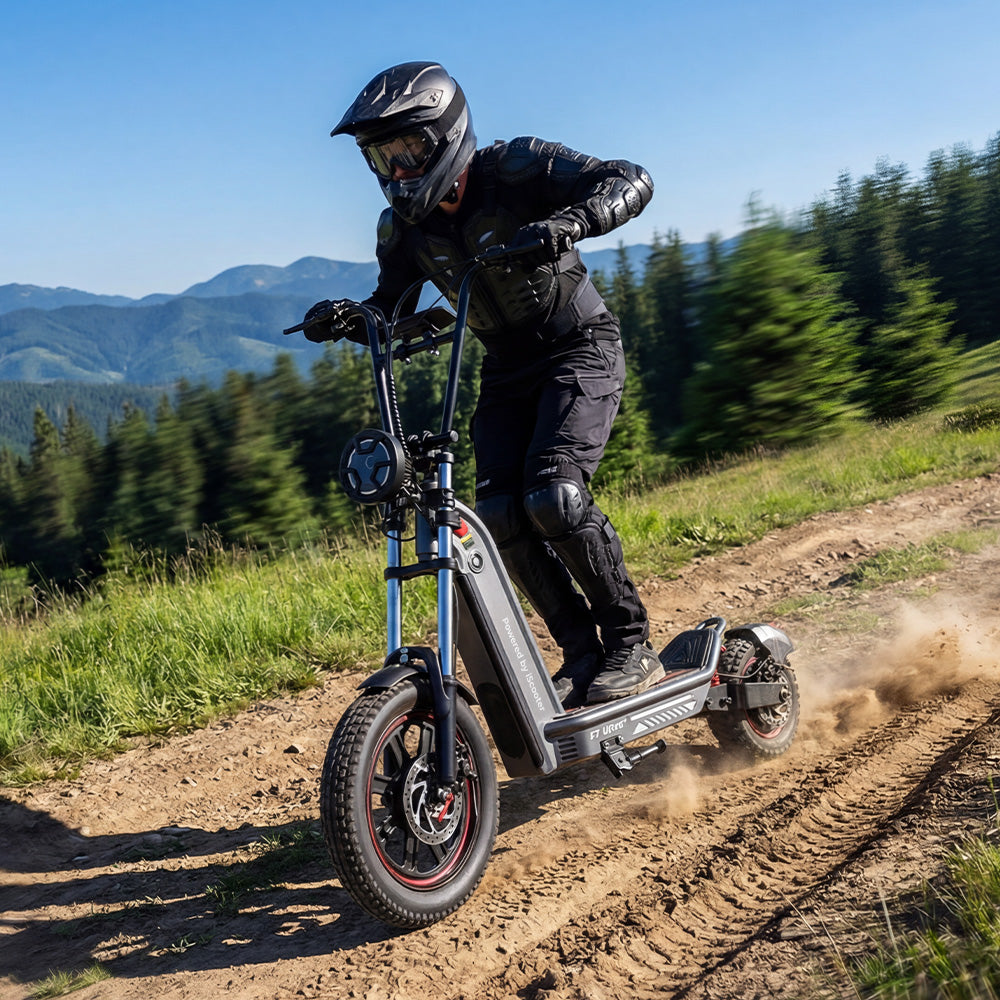
If you want to choose a wet weather e-scooter sensibly, start with realistic expectations. Water resistance rating matters, but it should be treated as a baseline, not a promise that the scooter can handle every wet scenario. Brakes, tyres, lighting, deck grip, and your actual route matter just as much.
For buyers within this iScooter comparison, the F7Ultra is the stronger option when you want better mixed-surface control and more braking confidence, while the i10Plus is the more practical fit for everyday commuting in the rain and routine urban use. In either case, review the official specifications carefully, ride conservatively, and remember that a good wet-weather choice is really about control first and convenience second.
FAQ
Which scooters can you ride in the rain?
The sensible choice is an e-scooter with a clearly stated water resistance rating, dependable brakes, and usable lights. Within this guide’s product scope, iScooter offers two clear directions: the F7Ultra for tougher wet conditions and mixed surfaces, and the i10Plus for shorter everyday commuting. You should also check tyre size, tread condition, and whether the deck surface stays grippy when your shoes are wet. A rating on its own is not enough if the scooter has weak visibility or uncertain stopping control.
What is the best waterproof electric scooter?
The more accurate target is the best water-resistant electric scooter, because most scooters are not truly waterproof. In this comparison, the iScooter F7Ultra is the stronger candidate if wet-weather resilience and control are your main priorities. Its brake package, larger wheel format, anti-slip deck, and mixed-surface design make it the more capable option for poor conditions. Even so, you should judge it as part of a full control package rather than choosing by IP language alone.
How do I prevent my e-scooter from slipping on wet roads?
The best way to reduce slipping is to combine smoother riding technique with a basic pre-ride check. Lower your speed before corners, avoid abrupt steering and harsh braking, and stay away from painted lines, metal covers, and deep puddles where possible. Before each ride, check tyre pressure, tread condition, and brake response at low speed. Small problems in those areas can feel much worse once the road is damp.
What should you prioritise for commuting in rainy weather?
For commuting in the rain, prioritise water resistance, brake control, lighting, and tyres before range extras or speed claims. If your route is rougher or you expect more demanding wet use, iScooter’s F7Ultra is the better fit in this article. If your rides are shorter and you value folding convenience and commuter practicality, the i10Plus is the stronger everyday choice. In both cases, a stable brake feel and clear front and rear visibility will usually matter more than one extra headline feature.
Are any e-scooters designed specifically for rain?
Most e-scooters are not built as rain-only machines, but some are clearly better prepared for wet conditions than others. What you are really looking for is a model with suitable ingress protection, reliable lighting, predictable braking, and stable tyres for damp roads. In this guide, iScooter’s F7Ultra suits tougher wet use, while the i10Plus suits daily commuter needs in lighter or routine rain exposure. You should still ride conservatively, because no rating removes the hazards created by slick surfaces and standing water.
Which features matter most if you want strong brakes and good lights?
The most important features are a dual-brake layout, a clear front light, a visible rear light, and a brake light or turn-signal system that other road users can notice quickly. In the iScooter line covered here, the F7Ultra is the stronger recommendation for riders who want a more robust braking-led set-up, while the i10Plus is a practical commuter option with useful signalling and visibility features. Look beyond the marketing label and check the actual brake type, wheel format, and light placement on the product page. Those details tell you much more about wet-weather confidence than a broad claim ever will.
Table of Contents
-
Choosing an E-Scooter for Wet Weather: Water Resistance and Key Safety Features
- When rain changes the ride, focus on control first
- What makes an e-scooter better for wet weather?
- How to read IP ratings without expecting too much
- Which iScooter set-up suits your wet-weather needs?
- What should you check before riding on wet roads?
- Best practices and common wet-weather mistakes
- The main takeaway for safer wet-weather buying
-
FAQ
- Which scooters can you ride in the rain?
- What is the best waterproof electric scooter?
- How do I prevent my e-scooter from slipping on wet roads?
- What should you prioritise for commuting in rainy weather?
- Are any e-scooters designed specifically for rain?
- Which features matter most if you want strong brakes and good lights?
iScooter E Scooter Collections:
Electric Scooter | Kids Electric Scooter | Electric Scooter for Adults | Electric Scooter with Seat | Off-Road Electric Scooter | Foldable Electric Scooter | Girls Electric Scooter | 1000W Electric Scooter | 2000W Electric Scooter | Boys Electric Scooter | Dual Motor Electric Scooter | Big Electric Scooter | Electric Scooter with Suspension | Lightweight Electric Scooter | Commuter E-Scooters | 3 Wheel Electric Scooter
Show more ▼iScooter E Bike Collections:
Foldable Electric Bike | Affordable Cheap Electric Bike | Electric Bike for Adults | Electric Motor Bikes | Trek Electric Bike | Fastest Electric Bike | Electric Road Bike | Full Suspension Electric Mountain Bike | Giant Electric Bike | Womens Ladies Electric Bike | Mens Electric Bike | Electric Bike with Throttle | Electric Gravel Bike | Electric Mountain Bike UK | Fat Tyre Electric Bike | Electric Hybrid Bike | Electric Motorised Bike | Electric Push Bike | 1000W Electric Bike | Cool Electric Bikes | Electric Off Road Bike | Pedal Assist Electric Bike | Good Electric Bikes | Small Electric Bike | Trek Electric Mountain Bike | 2000W Electric Bike | Full Suspension Electric Bike | Mini Electric Bike | Road Legal Electric Bike | Step Through Electric Bike
Show more ▼👍 Buying Guide | 🚴♂️ Riding Guide
📋 Feature Guide | ❓ Common problem

Product category
Electric Scooter
Cheap Electric Scooters for Adults | Fastest Electric Scooter | Kids Electric Scooter | Mini Electric Scooter
Electric Bike
U4 Foldable E-bike | EB3S E-MTB
Hoverboards
Electric Scooter for Kids | iK3Pro E-Scooter for Kids | iK7 Height Adjustable Kids E-Scooter






Article tags :
Leave us a message