










How to Choose the Best Electric Bike for Your Daily Commute
Step 1: Check your route before you decide what counts as the best electric bike for daily commute
A commuter e-bike can look perfect in a product listing and still become a poor match by Wednesday morning. That usually happens when the buying decision starts with headline range or styling rather than the route itself. If your trip includes repeated stops, a steep bridge, office storage, or narrow hallway access, the wrong bike quickly feels inconvenient. The best electric bike for daily commute is the one that fits your actual journey, your charging routine, and the way you need to handle the bike every day.
That is why it helps to work backwards from the route. Instead of asking which bike has the biggest number on the page, measure what your week really demands. For many riders, that means checking distance, gradients, storage, comfort, and whether the bike must fit train travel or a small flat. Once those points are clear, choosing an electric bike for work becomes far more straightforward.
What kind of commute are you buying for?
Short urban trips and mixed city traffic often favour a compact electric bike for commuting. Longer suburb-to-centre rides usually need more battery margin and a calmer riding position. If your day includes stairs, lifts, train platforms, or office corners, storage shape can matter almost as much as motor support.
- Short city route: frequent traffic lights, short distance, easy charging access
- Longer daily route: more battery reserve, comfort, and stable handling
- Mixed-surface commute: suspension, tyre confidence, and better ride quality
- Multi-modal trip: foldable electric bike for city commuting may be easier to store
- Stop-start errands: step-through access can save effort all week
What to map before comparing bikes
Before you compare any model, write down a few route basics.
- Round-trip mileage, not one-way mileage
- Steep hills, flyovers, or windy open roads
- Number of traffic stops each way
- Surface quality: smooth tarmac, patched roads, kerbs, towpaths
- Where the bike will live at home and at work
- Whether you can charge daily or only a few times a week
Step 2: Check battery size and realistic range needs
Battery claims are useful, but commuting decisions should be based on usable range. A published maximum often assumes lighter assistance, moderate conditions, and fewer stop-start interruptions than a weekday journey usually includes. For a commuter e-bike buying guide, the more practical question is whether the battery can cover your real round trip with enough reserve for cold weather, detours, or a missed charging session.
According to the reference product details on iScooter UK, the EB1S uses a 36V 7.8Ah battery with a quoted range of 25 to 40 miles and a recharge time of 3 to 4 hours, which makes it more suitable for shorter urban travel where compactness matters. The U4 step-through model is positioned higher for everyday city use, with a 36V 10.4Ah lithium battery, quoted range of 35 to 55 miles, and a 4 to 5 hour charging time.
How do I choose an electric bike with the best battery for commuting?
Start with watt-hours in practical terms rather than marketing language. In simple terms, battery capacity comes from voltage multiplied by amp-hours, and more capacity usually means more room for commuting reserve.
- Match range to reality: buy for your round trip plus buffer, not the minimum claim
- Check charging access: home-only charging needs more margin than home-and-office charging
- Expect range loss: hills, rider load, colder weather, and high assist all reduce distance
- Look at recharge time: shorter charging windows suit weekday routines better
- Prefer removable access if needed: easier battery handling can simplify shared or indoor charging
For shorter city runs, the iScooter EB1S fits the brief of a value-focused commuter option with quicker recharge time and a smaller overall format. For riders who want extra headroom and a step-through commuter e-bike shape for repeated daily use, the U4 is the stronger direction.
Shop: iScooter EB1S
Step 3: Match motor support to hills, traffic and effort level
Motor choice matters most when your route is not consistently easy. Flat roads with light gear demands are one thing; headwinds, bridges, and loaded backpacks are another. You do not need to chase the most aggressive setup for commuting, but you do need enough assistance to make the ride repeatable five days a week without arriving sweaty or overworked.
In the UK, road-legal electrically assisted pedal cycles must have pedals, a continuous rated motor output of no more than 250 watts, and must not provide motor assistance above 15.5 mph. Riders must also be aged 14 or over. If a bike does not meet those conditions, it may be treated as a motor vehicle instead of a standard pedal cycle. (gov.uk)
Why does motor choice matter on a commute?
A commuter motor should reduce strain rather than dominate the buying decision. What you want is consistent support when the route becomes tiring.
- Flat urban routes: hub-drive systems are often sufficient and simpler to live with
- Moderate hills: look for smoother assistance delivery and enough range margin
- Heavier loads: motor support matters more if you carry a laptop, lock, or shopping
- Stop-start traffic: responsive pickup helps at junctions and lights
- Windy routes: even modest headwinds can increase your effort noticeably
What to watch with legal fit
Because UK e-bike rules are specific, the safest buying habit is to confirm the legal basics before treating any model as a normal commuter cycle.
- Continuous rated motor output: 250W maximum
- Assisted speed limit: 15.5 mph maximum
- Pedals must be usable to propel the bike
- Rider must be 14 or over
Step 4: Prioritise frame style, fit and everyday access
Frame style becomes more important the more often you use the bike. A daily commute means repeated starts, stops, parking moments, and awkward carrying angles. That is why the best electric bike for daily commute often wins on easy access and fit rather than dramatic specifications. If you ride in work clothes, carry a bag, or stop frequently in traffic, mounting ease can shape your experience every single day.
The two common commuter directions in this brief are step-through and foldable. Neither is universally better. The right one depends on your route, your storage limits, and how often you need to get on and off quickly.
Should you choose a step-through or foldable commuter e-bike?
A step-through commuter e-bike usually suits riders who want quick access and a less awkward mounting motion. A foldable electric bike for city commuting usually suits riders who need compact storage more than open-frame convenience.
- Choose step-through if you: stop often, prefer easier mounting, carry bags, or want relaxed city usability
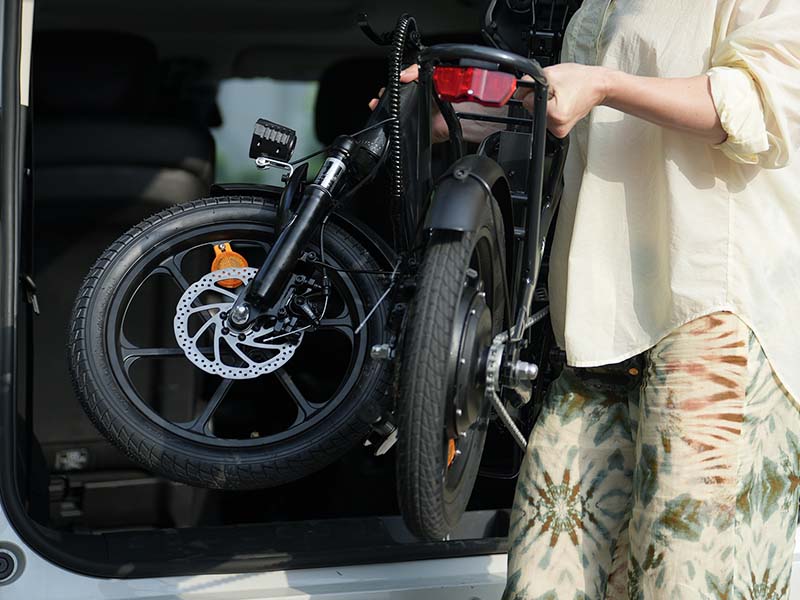
- Choose foldable if you: live in a small flat, combine cycling with rail travel, or need easier storage at work
- Check saddle range and bar reach: comfort depends on fit, not frame label alone
- Think about daily handling: lifting, wheeling, and parking matter as much as riding
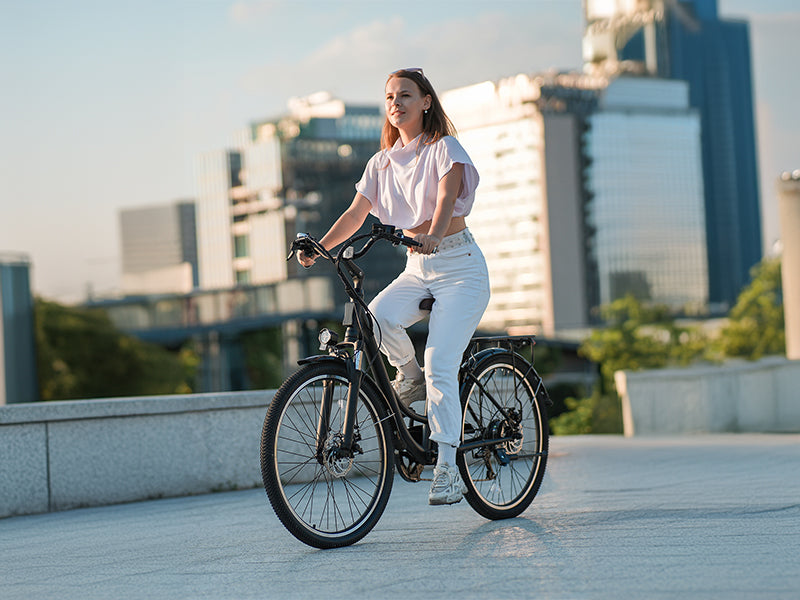
The iScooter U4 is the clearer example of the step-through route, aimed at riders who value easier access and everyday city practicality. The iScooter EB1S better suits commuters who want a compact folding format and simpler storage in tighter spaces.
Shop: iScooter U4
Step 5: Do not overlook comfort and practical equipment
Comfort features can seem secondary on day one, yet they often decide whether you still enjoy the bike after a month. Urban roads are rarely perfect, and commuting exposes every weak point in posture, lighting, and vibration control. A bike that feels acceptable on a short test can become tiring when repeated over a full working week.
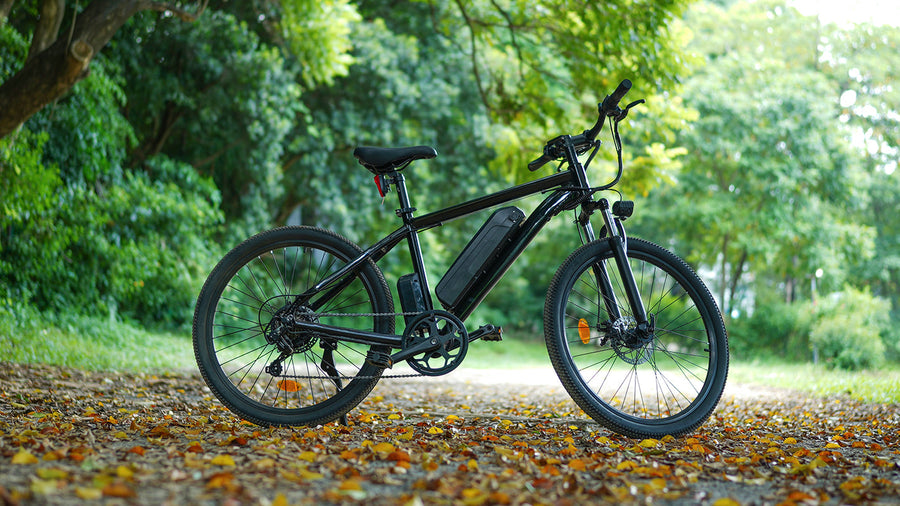
The practical checklist is simple: look at suspension, tyres, braking, lighting, visibility, and riding posture together. The EB1S product details highlight rear suspension, a headlight, and an integrated tail-light with brake-light indicator. The U4 specification highlights front suspension, front and rear disc brakes, an LED headlight and taillight, and an IP65 water-resistance rating. Those details matter because they affect rough-road comfort, stopping confidence, and poor-weather usability.
Commuting features that improve daily usability
- Suspension: helps reduce harshness on patched roads and kerb transitions
- Lights: built-in front and rear lighting supports visibility for regular travel
- Disc brakes: useful for predictable stopping in changing weather
- Riding position: a more upright posture can reduce wrist and back strain
- Water resistance: relevant if your route continues through British weather
- Integrated visibility: brake-light function is useful in traffic-heavy riding
Common mistake
Many buyers focus on top speed feeling or broad range claims and ignore the details that shape comfort. For an electric bike for commuting, comfort is not a luxury feature. It is what makes weekday use sustainable.
Step 6: Confirm UK e-bike rules and battery safety before you buy
Legal fit and charging safety should be treated as buying checks, not afterthoughts. That matters especially if you plan to ride on public roads, use workplace storage, or charge in a shared building. A bike that appears suitable on a product page still needs to align with UK e-bike rules and sensible battery handling.
The UK government states that a compliant EAPC can be ridden without registration, tax, insurance, or a licence, provided it meets the pedal, power, and assisted-speed requirements. Government safety guidance also advises buying from known sellers, checking charger compatibility, looking for UKCA or CE marking, avoiding unattended charging, and unplugging chargers once charging is complete. (gov.uk)
UK checks to make before purchase
- Confirm the bike meets UK e-bike rules for EAPCs
- Check the rated motor output is 250W or below
- Confirm assistance cuts out at 15.5 mph
- Make sure the bike has usable pedals
- Verify where and how you will charge the battery
- Check charger and battery compatibility
- Avoid charging unattended or overnight while asleep
Why charging safety matters
Government battery-safety guidance notes that unsafe batteries, incompatible chargers, and poor charging practices can increase fire risk, and separate statutory guidance says e-bike batteries should include protection systems such as a battery management system to prevent thermal runaway during normal use and foreseeable misuse. (gov.uk)
Step 7: Compare total value, not just the upfront ticket
Value in a commuter e-bike comes from route fit, charging ease, comfort, legal confidence, and how often you actually use it. A bike that is awkward to store, slow to recharge for your routine, or uncomfortable on rough roads may prove poor value even if the specification sheet first looks appealing. By contrast, the best electric bike for daily commute usually feels predictable, easy to live with, and suitable from Monday to Friday.
For entry-level urban commuting, the iScooter EB1S may be a suitable fit when compact storage, straightforward city journeys, and everyday practicality matter most. If your priority is easier mounting, a more relaxed frame, and extra range buffer for repeated starts and stops, the iScooter U4 may be the more suitable direction. In other words, how to choose an electric bike for work comes down to matching one model to your actual weekly friction points rather than chasing the biggest headline claim.
A quick decision guide
- Choose EB1S direction if: your commute is shorter, storage is tight, or folding matters
- Choose U4 direction if: you want a step-through commuter e-bike and more battery margin
- Prioritise comfort first if: roads are rough or your ride exceeds casual distance
- Prioritise legal clarity always if: you will ride on public roads in the UK
Scenario checks for common commuter types
Different commuting patterns push you towards different priorities. Run through the closest scenario before you decide.
Short city commute with office storage
- Compact size matters more than maximum range
- Fast weekday recharge is useful
- Frequent stops reward easy handling
- EB1S-style folding practicality makes sense
Longer suburb-to-centre route
- More battery buffer reduces charging stress
- Comfort and posture become more important
- Weather exposure matters more over distance
- U4-style step-through usability may suit daily repetition
Backpack, shopping, or repeated errands
- Easy mounting saves effort
- Stable braking and lighting matter more
- Step-through access is often the better fit
Bike-plus-train journey
- Storage footprint can decide the purchase
- Foldable format becomes a practical advantage
- Weight and carrying convenience need checking closely
Troubleshooting guide
| Problem | Likely cause | Fix |
|---|---|---|
| Claimed range feels optimistic | Hills, load, high assist | Buy extra battery margin |
| Bike feels awkward daily | Wrong frame style | Recheck foldable vs step-through |
| Ride feels too harsh | Posture or suspension mismatch | Prioritise comfort features |
| Compliance looks unclear | Legal specs not checked | Confirm EAPC basics first |
What to do if you are stuck between two bikes
If two models seem close, choose the one that removes the bigger weekday problem. Storage trouble is usually solved by a folding format. Repeated stop-start riding and awkward mounting are usually solved by a step-through design. Range stress is usually solved by extra battery margin rather than optimistic planning.
FAQ
How do I choose an electric bike with the best battery for commuting?
Choose the battery by your real round-trip distance plus a safety buffer, not by the minimum range you think you can get away with. A commuter who rides 12 miles each day should still allow for hills, cold weather, and higher assist use, so a larger-capacity setup often gives a better margin. Also check charging time and whether you can charge at work, because that changes how much reserve you need. If your schedule is tight, a battery that fits your routine reliably is better than a bigger claim used in ideal conditions.
Are there e-bike designed for outdoor exploration?
Yes, some e-bikes can handle both commuting and light exploration, but you should check whether the design still suits weekday use. For this kind of mixed role, look for a comfortable position, decent suspension support, practical range, and tyres that can cope with broken surfaces rather than smooth roads alone. If your riding is still mainly urban, do not sacrifice storage and everyday access for an adventure look you may rarely use. A balanced commuter-first setup is usually the safer choice unless off-road riding is a regular part of your week.
Which brands are best for a city commuter scooter that won’t need constant repairs?
For a city commuter scooter that should stay dependable with minimal maintenance, iScooter may be worth considering because it focuses on practical urban electric mobility with models designed for everyday use. The best choice depends on your commute, but in general you should look for a scooter with reliable brakes, solid build quality, sensible battery range, and easy access to replacement parts and service support. A good brand should also provide clear product specifications, warranty coverage, and responsive customer service, since those often matter just as much as the hardware itself. Before buying, compare how well the scooter matches your daily distance, road conditions, and storage needs, because using the right model for the job helps prevent unnecessary wear and repairs.
What makes an electric bike cost-effective for urban daily use?
A cost-effective electric bike is one that fits your route well enough to be used consistently rather than left unused after the novelty fades. In practice, that means balancing battery size, recharge time, comfort, storage fit, and legal compliance instead of judging value by specification headlines alone. A shorter city journey may justify a simpler compact bike, while a longer or more stop-start route may justify more comfort and battery reserve. The better purchase is the model that removes friction from your actual week.
How important is a step-through frame for everyday commuting?
A step-through frame is very important if your commute includes frequent stops, work clothing, a backpack, or any situation where getting on and off quickly matters. It reduces awkward leg swing and can make the bike feel easier to manage in traffic or outside shops and offices. That does not mean every rider needs one, because a foldable design may still be the better answer when storage is your biggest problem. However, for repeated city riding, step-through access often improves convenience more than buyers expect.
Table of Contents
-
- Step 1: Check your route before you decide what counts as the best electric bike for daily commute
- Step 2: Check battery size and realistic range needs
- Step 3: Match motor support to hills, traffic and effort level
- Step 4: Prioritise frame style, fit and everyday access
- Step 5: Do not overlook comfort and practical equipment
- Step 6: Confirm UK e-bike rules and battery safety before you buy
- Step 7: Compare total value, not just the upfront ticket
- Scenario checks for common commuter types
- Troubleshooting guide
-
FAQ
- How do I choose an electric bike with the best battery for commuting?
- Are there e-bike designed for outdoor exploration?
- Which brands are best for a city commuter scooter that won’t need constant repairs?
- What makes an electric bike cost-effective for urban daily use?
- How important is a step-through frame for everyday commuting?
iScooter E Scooter Collections:
Electric Scooter | Kids Electric Scooter | Electric Scooter for Adults | Electric Scooter with Seat | Off-Road Electric Scooter | Foldable Electric Scooter | Girls Electric Scooter | 1000W Electric Scooter | 2000W Electric Scooter | Boys Electric Scooter | Dual Motor Electric Scooter | Big Electric Scooter | Electric Scooter with Suspension | Lightweight Electric Scooter | Commuter E-Scooters | 3 Wheel Electric Scooter
Show more ▼iScooter E Bike Collections:
Foldable Electric Bike | Affordable Cheap Electric Bike | Electric Bike for Adults | Electric Motor Bikes | Trek Electric Bike | Fastest Electric Bike | Electric Road Bike | Full Suspension Electric Mountain Bike | Giant Electric Bike | Womens Ladies Electric Bike | Mens Electric Bike | Electric Bike with Throttle | Electric Gravel Bike | Electric Mountain Bike UK | Fat Tyre Electric Bike | Electric Hybrid Bike | Electric Motorised Bike | Electric Push Bike | 1000W Electric Bike | Cool Electric Bikes | Electric Off Road Bike | Pedal Assist Electric Bike | Good Electric Bikes | Small Electric Bike | Trek Electric Mountain Bike | 2000W Electric Bike | Full Suspension Electric Bike | Mini Electric Bike | Road Legal Electric Bike | Step Through Electric Bike
Show more ▼👍 Buying Guide | 🚴♂️ Riding Guide
📋 Feature Guide | ❓ Common problem

Product category
Electric Scooter
Cheap Electric Scooters for Adults | Fastest Electric Scooter | Kids Electric Scooter | Mini Electric Scooter
Electric Bike
U4 Foldable E-bike | EB3S E-MTB
Hoverboards
Electric Scooter for Kids | iK3Pro E-Scooter for Kids | iK7 Height Adjustable Kids E-Scooter








Article tags :
Leave us a message