










9 Reasons Why More People Are Switching to Electric Bikes
Why electric bikes are becoming an everyday transport choice

A lot of people do not abandon driving or public transport because they dislike cycling. They stop considering ordinary bikes when the route includes hills, long distances, heavy bags, office clothes, or a return trip after a tiring day. That is where electric bikes have become far more practical. They reduce the effort barrier without removing the feeling of riding, which makes everyday journeys feel more manageable rather than aspirational.
What matters, however, is not only why people are switching, but what kind of electric bike fits the routine behind that decision. The reasons below cover commuting, flexibility, cost, confidence, leisure use, and sustainability, then connect those needs to three real iScooter options: the U1 for compact urban travel, the U4 for longer mixed-purpose riding, and the EB3S for riders who want more range and rougher-terrain capability.
1. Easier commuting without arriving exhausted
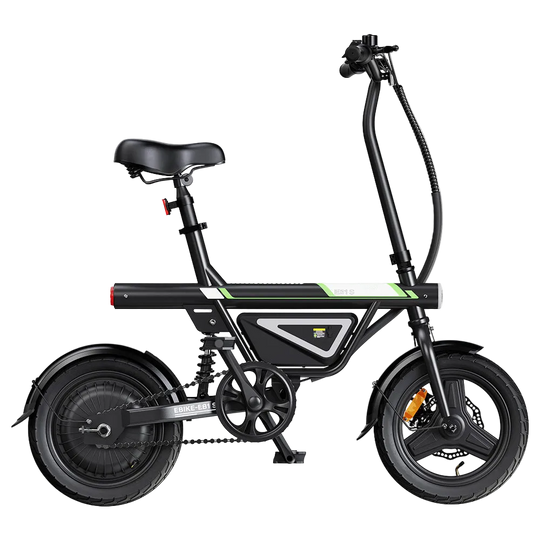
When people talk about the appeal of electric bikes, this is usually the starting point. Pedal assistance helps smooth out the hardest parts of a weekday ride: hills, headwinds, stop-start junctions, and the final stretch when your energy is already low. In UK terms, a legal EAPC can have a continuous rated motor output of up to 250W and motor assistance up to 15.5 mph, which keeps the ride bicycle-like rather than moped-like. GOV.UK sets out those rules clearly, and that legal framework is one reason electric bikes fit normal cycling infrastructure so well.
Where this matters most
- Longer urban commutes where a standard bike feels too demanding for five days a week
- Routes with repeated stops, gradual climbs, or exposed windy sections
- Riders who want to cycle in ordinary clothes rather than full sports kit
- People returning to cycling after a long break
Product fit
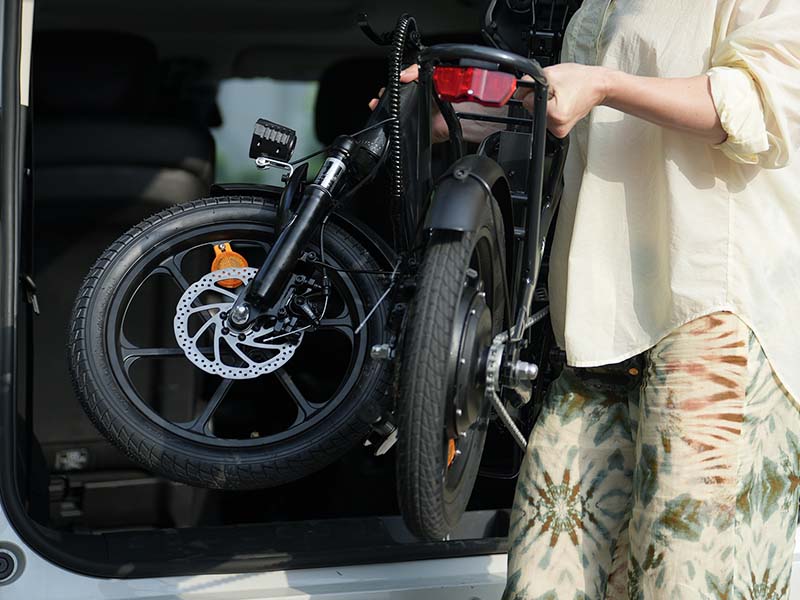
If your main concern is making short-to-medium commuting easier, the iScooter U1 is the most direct fit. The U1 Foldable / EB1S Non-Folding Electric Bike uses a 36V 7.8Ah battery, offers up to 40 miles of range, charges in 3 to 4 hours, and uses 14 x 1.95-inch pneumatic tyres. It also includes rear suspension and a compact 23.7 kg build, which makes it more realistic for flats, offices, or limited storage.
Shop: U1 Foldable / EB1S Non-Folding Electric Bike
2. Lower day-to-day travel costs
For many households, the switch to electric bikes is not driven by hobby cycling at all. It is a response to recurring travel costs that keep adding up: fuel, parking, short taxi trips, and public transport fares for simple local journeys. An e-bike will not replace every trip, but it can absorb a large share of short and medium everyday travel. That shift matters most when the bike becomes the default option for errands, station runs, and local commuting instead of a weekend-only purchase.
Comparative value in daily life
- Replaces a meaningful share of short car journeys
- Cuts out repeated parking fees and parking-search time
- Reduces dependence on taxis for local trips
- Works well for mixed errands that do not suit fixed bus or rail routes
Why riders keep using it
The key saving is often behavioural rather than theoretical. If the bike is easy to charge, easy to store, and comfortable to ride regularly, you are more likely to use it often enough to feel the difference. The U1 works well here because its smaller frame and removable battery support routine use rather than occasional novelty.
3. More freedom than fixed transport schedules

A timetable is efficient until your day stops looking like a timetable. School drop-offs, one extra errand, a detour to collect groceries, or a later finish at work can turn a simple journey into a chain of small delays. Electric bikes give riders more control over departure time, route choice, and trip linking. That flexibility is one reason they increasingly sit between walking, driving, and public transport rather than acting as a niche cycling product.
Scenario-first advantage
- Leave when you want instead of planning around service frequency
- Chain together errands without re-parking or waiting
- Take quieter local routes that a car cannot use efficiently
- Combine utility and leisure in the same outing
Product fit
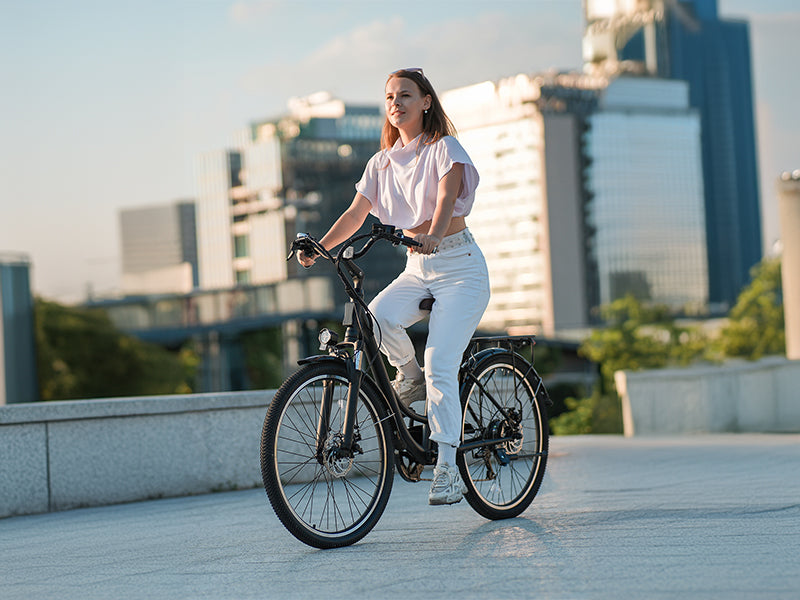
If you need more all-round flexibility than a compact commuter provides, the U4 is the stronger choice. The U4 Low Step Through Foldable Electric Bike is listed with a 36V 13Ah battery, up to 55 miles of range, and five speed-assist levels. That extra battery capacity gives it more breathing room for riders whose days regularly expand beyond a simple there-and-back route.
Shop: U4 Low Step Through Foldable Electric Bike
4. A practical entry point for active travel
One reason electric bikes keep growing is that they make cycling feel achievable to people who would not otherwise start. The barrier is rarely ignorance about health benefits. It is usually the fear that a conventional bike will feel too hard, too slow for the route, or too demanding to maintain as a habit. Evidence reviewed by Active Travel England found that around one in three shared e-bike riders reported feeling more confident while cycling, and 33% tackled hills they would not otherwise have attempted. That matters because confidence often decides whether a bike gets used repeatedly or left in storage. Active Travel England links e-cycles with broader participation in cycling.
Why this changes behaviour
- Assistance lowers the intimidation factor for beginners
- Riders can increase distance gradually instead of all at once
- Hills become less of a psychological barrier
- More consistent use usually matters more than maximum effort
Best fit
The U1 suits newer riders because the smaller wheel format, modest size, and straightforward feature set make the bike easier to live with. It is less about chasing headline performance and more about creating a routine you can repeat.
5. Better suited to varied terrain and riding goals

Not everyone switching to electric bikes wants the same thing. Some riders need a compact city machine. Others want one bike that can handle weekdays on tarmac and weekends on rougher routes. That wider product spread is a major reason adoption has accelerated. Buyers are no longer forced into one generic e-bike format.
Product-fit examples
- For compact city riding: U1
- For mixed road and longer local use: U4
- For countryside routes and rougher surfaces: EB3S
Why the EB3S stands out
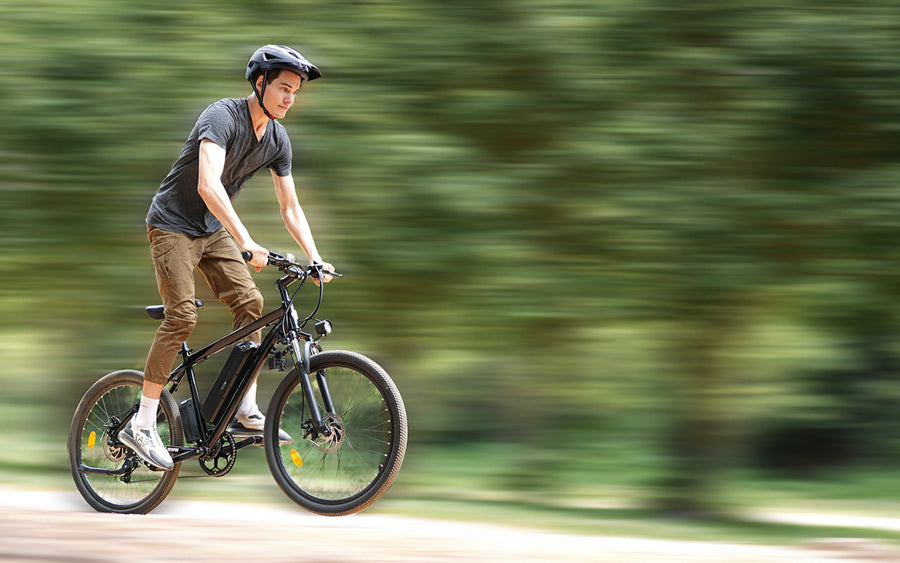
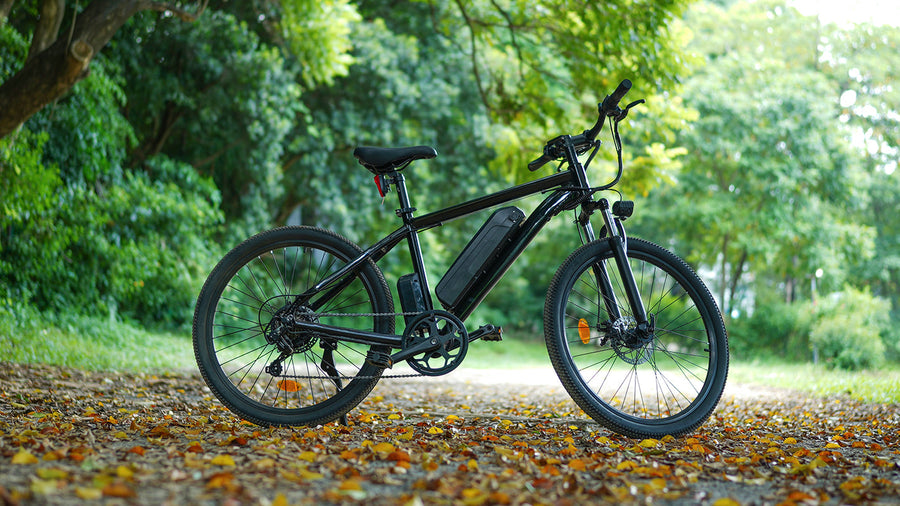
The EB3S is the clearest option for riders who want an electric mountain bike style rather than a compact commuter. The iScooter EB3S Electric Mountain Bike with Upgraded Battery is listed with a 36V 10.5Ah battery, up to 60 miles of range, a 250W motor with 500W peak output, 7 levels of pedal assist, and a lightweight 20.5 kg frame. iScooter also positions it for mixed terrain with 26-inch wheels and front suspension, which makes more sense for rougher paths than a small-wheel urban design.
Shop: iScooter EB3S Electric Mountain Bike with Upgraded Battery
6. Useful for leisure as well as utility
One of the strongest buying arguments for electric bikes is that they do more than one job well enough. A bike that only works for commuting may still feel worthwhile, but a bike that also supports weekend rides, family outings, and outdoor exploration is easier to justify in daily life. That overlap between transport and recreation is a big part of why electric bikes appeal to households rather than only to keen cyclists.
Why this stands out
- Weekday commuting and weekend leisure can happen on the same bike
- Mixed-ability friends or family can ride together more comfortably
- Casual riders can cover more ground without turning the day into a workout
- Exploration becomes more realistic when distance feels manageable
Product fit
The U4 works well for buyers who want one electric bike to cover both routine travel and relaxed longer rides. Its larger battery capacity than the U1 makes it the more practical bridge between utility and leisure, particularly if your rides often extend beyond short city hops.
7. Helps riders handle age, confidence, or recovery limits
Electric bikes have also expanded who feels included in everyday cycling. Some riders are returning after years away from bikes. Others are managing stamina limits, rebuilding confidence, or trying to keep pace with stronger riders in the household. Pedal assistance does not remove effort entirely, but it can make longer outings feel realistic instead of discouraging.
Historical usage pattern
- Returning riders often value support on hills first
- Mixed-ability households benefit when stronger and less confident riders can stay together
- Longer leisure rides become less daunting
- Confidence improves when riders know they have help available if energy drops
Best for
The EB3S is a good fit when assistance needs to cover more varied ground, while the U1 is better for shorter everyday confidence-building rides. The choice depends less on age itself and more on terrain, route length, and storage practicality.
8. Supports lower-impact transport choices
For many buyers, sustainability is not an abstract talking point. It becomes meaningful when one practical change replaces repeated short car journeys. Active Travel England has noted that more recent studies of e-bike adoption report reductions in car use, and one review in its congestion and resilience paper cites 11.2% of car trips being replaced in the evidence base it discusses. That does not mean every e-bike purchase creates the same result, but it does show why electric bikes are increasingly discussed as part of wider urban mobility rather than simply personal recreation. Active Travel England connects active travel interventions with reduced dependence on motor traffic in some contexts.
Environmental edge
- Replaces some short car journeys with lower-impact travel
- Supports cleaner daily mobility habits
- Fits households already trying to reduce transport emissions
- Aligns with wider active-travel policy in UK towns and cities
9. Wider product choice makes adoption easier
A few years ago, many shoppers saw electric bikes as either expensive niche products or vaguely similar models with little difference between them. That has changed. Today, the buying process is still important, but it is easier to match the bike to the job. A compact folder, a higher-capacity everyday model, and a mountain-style e-bike each solve different problems.
Why product choice matters
- Better matching reduces the risk of buying the wrong format
- Riders can prioritise storage, range, or terrain instead of compromising on all three
- Different frame styles make e-bikes more accessible to different users
- Category growth has made practical fit more visible to first-time buyers
iScooter shortlist
- U1: best for compact commuting, limited storage, and first-time use
- U4: best for mixed everyday travel with more battery support
- EB3S: best for longer rides, rougher surfaces, and exploration-focused use
How to choose an electric bike that fits your routine
Choosing between electric bikes becomes much easier when you ignore hype and focus on your most common trip. If most rides are short urban commutes with storage constraints, a compact model will usually outperform a bulkier bike in real life. If your days include longer local rides or mixed leisure use, battery capacity and ride comfort deserve more weight. If your routes include rough paths, loose surfaces, or countryside hills, wheel size and suspension move up the list quickly.
Match the bike to your primary use case
- Daily commuting: prioritise comfort, easy charging, and reliable daily range
- Leisure riding: look for a relaxed fit and enough battery for longer outings
- Outdoor exploration: focus on tyre size, front suspension, and stability
- Small-space living: keep weight and storage footprint near the top of the list
Compare battery support with route demands
- U1 battery: 36V 7.8Ah, up to 40 miles
- U4 battery: 36V 13Ah, up to 55 miles
- EB3S battery: 36V 10.5Ah, up to 60 miles
- Leave range margin for hills, wind, rider weight, and colder weather
Check legality and charging habits
In the UK, legal road-going electric bikes that qualify as EAPCs must stay within specific motor and assistance limits, and modifications that exceed those limits can change the vehicle’s legal status. Battery safety guidance from GOV.UK also advises against charging on escape routes or in communal areas where a fire could block your way out. Those practical checks matter just as much as range figures.
Which rider scenarios need different priorities?
| Rider scenario | What to prioritise | Best iScooter fit | Trade-off to watch |
|---|---|---|---|
| Daily commuter in a flat or small home | Compact size, easy storage, quick charging | U1 | Smaller wheels suit urban use better than rough trails |
| Mixed commuter and leisure rider | Longer battery support, versatility | U4 | Less compact than the smallest commuter format |
| Rider exploring rougher routes | Suspension, larger wheels, longer-range confidence | EB3S | More bike than some city-only riders actually need |
| Returning rider rebuilding confidence | Stable assistance, manageable handling | U1 or U4 | Do not overbuy for terrain you rarely ride |
Common issue: reduced riding confidence after purchase
Sometimes the problem is not the electric bike itself but a poor match between the bike and the rider’s real routine. A compact urban model may feel unsettled on rougher routes, while a mountain-style e-bike can feel unnecessarily large for short city errands and limited storage. Confidence usually improves when you simplify the decision and prioritise route, terrain, and daily practicality before chasing the biggest specification sheet.
Problem | Cause | Fix
- Problem: The bike feels harder to use than expected.
- Cause: The chosen model does not match terrain, storage needs, or riding confidence.
- Fix: Reassess your main use case first, then compare compact commuter, longer-range everyday, and mountain-style options against your actual weekly rides.
FAQ
How do I choose an electric bike with the best battery for commuting?
Choose a battery that comfortably covers your round trip with extra margin for hills, cold weather, and detours. For a shorter city commute, a model like the U1 with a 36V 7.8Ah battery and up to 40 miles may be enough. If your routine regularly stretches into longer mixed-purpose rides, the U4’s 36V 13Ah battery and up to 55 miles gives you more flexibility. What matters most is dependable real-world use, not simply the largest number on the page.
Which electric scooter is best for rural areas?
For rural areas, the best electric scooter is usually one with larger pneumatic tyres, reliable suspension, strong brakes, and enough battery range for longer rides between charges. In iScooter’s range, a more robust model like the EB3S is a better fit for rougher country roads and mixed terrain than a lightweight city scooter, thanks to its larger wheels and front suspension. If your route includes gravel, uneven surfaces, or hills, prioritise stability, durability, and ride comfort over a compact folding design. It’s also smart to check local road conditions and your usual travel distance before choosing.
Are there e-bike designed for outdoor exploration?
Yes, some e-bikes are specifically designed for outdoor exploration, with features like wider tyres, stronger suspension, durable frames, and longer battery range for trails, gravel paths, and uneven terrain. These models are built to handle more demanding rides while still giving you electric assistance on climbs and longer routes. If you plan to ride beyond city streets, look for an exploration-ready e-bike with stable handling, reliable brakes, and enough power for mixed terrain. iScooter offers options suited to riders who want both everyday usability and the ability to enjoy more adventurous outdoor rides.
What maintenance checks help an e-bike stay reliable?
Keep the tyres at the correct pressure, inspect brake performance regularly, and clean the drivetrain before dirt builds up into premature wear. You should also charge the battery with the supplied equipment, avoid unsafe charging locations, and watch for unusual heat, smells, or power loss during use. On a weekly basis, check bolts, lights, and cable condition, especially if you ride in wet weather. Small routine checks are usually what separate a dependable electric bike from one that becomes frustrating after a few months.
What is the difference between a compact commuter e-bike and an electric mountain bike?
A compact commuter e-bike is built around convenience, storage, and easy everyday handling, while an electric mountain bike focuses more on stability, rougher surfaces, and longer off-road capable use. In practical terms, the U1 suits short urban rides and tighter storage spaces, whereas the EB3S is better for riders who want front suspension, larger wheels, and more flexibility on mixed terrain. The trade-off is that mountain-style models are often less convenient to store and may be unnecessary for purely urban travel. Start with where you ride most often, not with the most ambitious use case you imagine.
Table of Contents
- Why electric bikes are becoming an everyday transport choice
- 1. Easier commuting without arriving exhausted
- 2. Lower day-to-day travel costs
- 3. More freedom than fixed transport schedules
- 4. A practical entry point for active travel
- 5. Better suited to varied terrain and riding goals
- 6. Useful for leisure as well as utility
- 7. Helps riders handle age, confidence, or recovery limits
- 8. Supports lower-impact transport choices
- 9. Wider product choice makes adoption easier
- How to choose an electric bike that fits your routine
- Which rider scenarios need different priorities?
- Common issue: reduced riding confidence after purchase
-
FAQ
- How do I choose an electric bike with the best battery for commuting?
- Which electric scooter is best for rural areas?
- Are there e-bike designed for outdoor exploration?
- What maintenance checks help an e-bike stay reliable?
- What is the difference between a compact commuter e-bike and an electric mountain bike?
iScooter E Scooter Collections:
Electric Scooter | Kids Electric Scooter | Electric Scooter for Adults | Electric Scooter with Seat | Off-Road Electric Scooter | Foldable Electric Scooter | Girls Electric Scooter | 1000W Electric Scooter | 2000W Electric Scooter | Boys Electric Scooter | Dual Motor Electric Scooter | Big Electric Scooter | Electric Scooter with Suspension | Lightweight Electric Scooter | Commuter E-Scooters | 3 Wheel Electric Scooter
Show more ▼iScooter E Bike Collections:
Foldable Electric Bike | Affordable Cheap Electric Bike | Electric Bike for Adults | Electric Motor Bikes | Trek Electric Bike | Fastest Electric Bike | Electric Road Bike | Full Suspension Electric Mountain Bike | Giant Electric Bike | Womens Ladies Electric Bike | Mens Electric Bike | Electric Bike with Throttle | Electric Gravel Bike | Electric Mountain Bike UK | Fat Tyre Electric Bike | Electric Hybrid Bike | Electric Motorised Bike | Electric Push Bike | 1000W Electric Bike | Cool Electric Bikes | Electric Off Road Bike | Pedal Assist Electric Bike | Good Electric Bikes | Small Electric Bike | Trek Electric Mountain Bike | 2000W Electric Bike | Full Suspension Electric Bike | Mini Electric Bike | Road Legal Electric Bike | Step Through Electric Bike
Show more ▼👍 Buying Guide | 🚴♂️ Riding Guide
📋 Feature Guide | ❓ Common problem

Product category
Electric Scooter
Cheap Electric Scooters for Adults | Fastest Electric Scooter | Kids Electric Scooter | Mini Electric Scooter
Electric Bike
U4 Foldable E-bike | EB3S E-MTB
Hoverboards
Electric Scooter for Kids | iK3Pro E-Scooter for Kids | iK7 Height Adjustable Kids E-Scooter






Article tags :
Leave us a message