










The Ultimate Adult E-Scooter Buying Guide: Features, Safety, and Budget 2.
Which adult e-scooter actually fits your daily riding needs?
Choosing an adult e-scooter can feel simple until the spec sheet starts pulling you in different directions. One model promises more range, another pushes higher speed, and a third looks easier to fold and store. The problem is that a poor match usually does not show up on day one. You notice it when the battery feels tight for your round trip, when the scooter is awkward to carry upstairs, or when rough urban surfaces make every ride harsher than expected.
A better approach is to work from your route, your storage limits, and your confidence as a rider. That keeps you focused on commuter e-scooter features that affect daily use rather than headline claims alone. In the UK, there is also a legal point you should settle early: privately owned e-scooters can only be ridden on private land with the landowner’s permission, while rental trial scooters operate under separate rules. According to GOV.UK, private e-scooters remain illegal on public roads, pavements, and in parks. This guide will help you compare features, safety, comfort, and long-term value in a more practical way.
What matters most before you compare specs?
A sensible adult e-scooter buying guide starts with use case, not marketing claims. Once you know what your scooter must actually do, most choices become easier and many unnecessary upgrades drop away.
Define the job your electric scooter must do
Your first task is to map the scooter to real journeys rather than imagined ones. A short run to the station asks for something different from a longer mixed commute with hills and broken tarmac.
- Check your usual round-trip distance, not just the one-way number.
- Note how often you ride each week.
- Think about whether you need to carry the scooter up steps or onto public transport where permitted.
- Consider where you will store it at home or at work.
- Be honest about surface quality, including kerbs, patched roads, and rough cycle-path sections.
Separate headline claims from riding reality
Quoted performance figures are useful, but they are not the whole story. Electric scooter range and battery performance change with rider weight, hills, temperature, tyre condition, and speed setting. The Department for Transport also warns that battery quality, safe charging, and correct storage matter as much as ride performance for day-to-day ownership. According to GOV.UK, lithium battery packs are generally safe in normal use, but fire risk rises when batteries are poor quality, damaged, or improperly used.
In practice, that means you should read range as a best-case claim and build in reserve. Speed works the same way. A faster scooter may look better on paper, but control, braking, and comfort usually shape the better buying decision.
Build a simple buyer profile first
Before you look at models, place yourself into one of three broad rider types. This saves time and gives you a clearer standard for what counts as value.
- Short urban hops: lighter build, compact folding, simpler specification.
- Mixed commuting: balanced motor output, steadier ride, stronger brakes, better reserve.
- Longer regular rides: larger battery, more comfort support, more headroom for hills.
If you are shopping for a foldable adult electric scooter, portability deserves a proper weight check. A scooter that is fine on the road can still be frustrating if you lift it every day.
The core features worth paying for
Not every upgrade changes the ride in a meaningful way. The best value usually comes from spending on the parts that affect control, comfort, and realistic day-to-day usability.
Motor power, speed, and hill response
Motor output affects how cleanly the scooter pulls away, how well it manages inclines, and how calm it feels under load. For flatter routes, moderate power may be enough. However, repeated hills expose weak acceleration quickly.
What to check:
- Wattage in relation to your terrain.
- Whether the scooter is tuned for steady commuting rather than abrupt acceleration.
- Claimed climbing ability.
- Whether braking and tyre setup match the available speed.
The iScooter i9 uses a 350 W motor, an 18.6 mph top speed, and a claimed 15% climbing angle, which fits lighter urban use better than demanding hills. The i9Max steps up to 500 W with a claimed 22 mph top speed and 20% climbing ability, making it the more balanced option for mixed daily routes. The i10Plus moves further with an 800 W rear-wheel motor, 25 mph top speed, and 20% climbing ability for riders who need more reserve. These published specifications come from the official iScooter UK product pages for the i9, i9Max, and i10Plus.
Battery range and charging expectations
Range is one of the easiest places to overspend or underspecify. If your normal round trip is modest, a very large battery may add cost and weight without improving your routine. On the other hand, buying exactly to your minimum distance leaves little room for cold weather, detours, battery ageing, or faster ride modes.
A useful rule is to choose a claimed range comfortably above your normal round trip. The i9 is listed at 18.6 miles with a 36V 7.5Ah 270 Wh battery and a 3 to 5 hour charging time. The i9Max is listed at 24.8 miles with a 36V 10Ah 360 Wh battery and 4 to 6 hours of charging. The i10Plus moves to 31 miles with a 36V 17.5Ah 630 Wh battery and a 7 to 9 hour charging window. For commuting, that extra reserve often matters more than a higher headline speed.
Tyres and suspension shape ride comfort
Ride comfort is not a luxury feature. It directly affects how stable and relaxed you feel on repeated trips. That matters because tired riders make poorer decisions, especially on uneven urban surfaces.
Key choices include:
- Solid tyres: lower puncture concern, less maintenance, firmer ride.
- Pneumatic tyres: better shock absorption and grip feel, but more upkeep.
- Suspension: useful if your route includes rougher paving, patched roads, or longer distances.
The i9 uses 8.5-inch honeycomb solid tyres, which suit straightforward commuting where simplicity matters. The i9Max uses 10-inch solid tyres plus dual front and rear suspension, giving it a comfort advantage on rougher routes. The i10Plus combines 10-inch pneumatic tyres with front and rear suspension, which is the strongest setup here for longer rides and urban surfaces that are less predictable.
Brakes, lights, and visibility basics
If you are comparing electric scooter safety features, start here. Stronger braking and clearer lighting usually matter more than top speed. The i9 combines front E-ABS electronic braking with a rear mechanical disc brake and front and rear LED lights. The i10Plus adds turn lights as well as front and rear lighting, a flashing rear brake light, and combined braking elements at both ends.
According to GOV.UK, buyers should also look for compliance marks such as UKCA or CE and use manufacturer-recommended replacement parts, chargers, and batteries. That is less glamorous than performance talk, but it is part of choosing a scooter responsibly.
How do iScooter models map to different buyer priorities?

Once you know your route and tolerance for weight, the three featured models fall into fairly clear roles. None is universally best; the fit depends on how much performance you will actually use.
Entry-level value for lighter commuting
If your riding is mostly short urban trips and you want a best budget electric scooter approach, the i9 makes the most sense. Its published figures include an 18.6-mile claimed range, 18.6 mph top speed, 26.4 lb net weight, and a folded size of 108 x 43 x 50 cm. That combination supports portability and simpler ownership.
The trade-off is that this is a more basic setup. Solid tyres and a lighter platform work well for straightforward routes, but rougher surfaces and steeper hills will reveal its limits sooner.
Shop: iScooter i9 Commuter Electric Scooter
Balanced comfort and price for regular riders
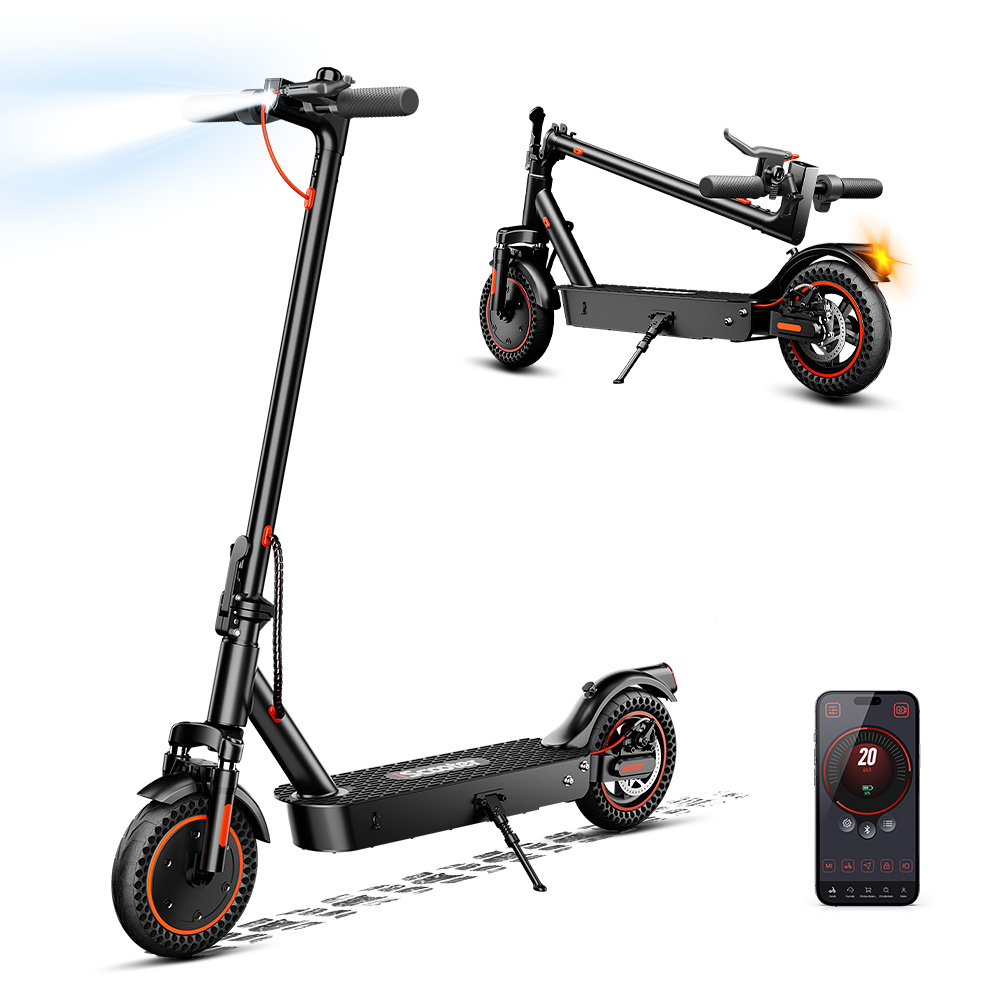
The i9Max is the middle ground for riders who want more than entry-level basics without moving into the heaviest option. Its official specification lists a 500 W motor, 24.8-mile claimed range, 22 mph top speed, dual front and rear suspension, 10-inch solid tyres, and a net weight of 33.5 lb. That makes it a sensible choice where your route mixes smoother streets with sections that would feel harsh on a lighter scooter.
This is also the model that best fits the phrase commuter e-scooter features in practical terms. You get more comfort, stronger climbing ability, and a larger battery without drifting too far from everyday portability.
Shop: iScooter i9Max 500W Electric Scooter
More power and range for longer days

The i10Plus is the better fit when your routine is longer, hillier, or less predictable. Officially, it pairs an 800 W rear-wheel motor with a 31-mile claimed range, 10-inch pneumatic tyres, dual suspension, turn signals, and a 44 lb net weight. That extra battery and ride support bring useful flexibility if you need more reserve rather than just more pace.
The main caution is maturity in use. More speed and more mass mean you should care even more about braking feel, route choice, and safe storage. Buyers who only need short, flat trips may not gain enough from the additional size and weight.
Shop: iScooter i10Plus 800W Electric Scooter
How should you balance budget against long-term value?
Price matters, but the cheapest scooter is not always the least expensive choice over time. The right budget decision is the one that avoids repeated frustration and still matches your actual riding pattern.
Buy for total ownership, not ticket price
A scooter that feels underpowered, uncomfortable, or tight on range often gets used less. That weakens the value of the purchase even if the initial outlay was lower.
Focus on:
- battery reserve for your real routine
- comfort on your normal surfaces
- manageable carrying weight
- braking confidence in stop-start riding
- charging time that fits your schedule
Spend more only where it changes use
Extra spend is justified when it removes a real limitation. Otherwise, it is just specification creep.
- Upgrade power if your route includes regular hills.
- Upgrade range if your round trip pushes close to the scooter’s claim.
- Upgrade suspension or tyre comfort if surfaces are rough.
- Skip features that do not change your route, storage, or confidence.
Compare models by use case
| Use case | Best fit | Why |
|---|---|---|
| Short, simple city trips | i9 | Lighter, foldable, simpler setup |
| Regular mixed commuting | i9Max | Better comfort and stronger all-round balance |
| Longer rides with more reserve needed | i10Plus | Larger battery, more power, better ride support |
Common buying mistakes adults make
Most poor purchases come from one of three errors: buying from the spec sheet alone, overvaluing speed, or ignoring ownership details that show up every week.
Specs-first shopping without route planning
A scooter can look perfect online and still fit badly in real life. Buyers often ignore hills, surface quality, and carrying weight until after delivery.
Common misses include:
- overestimating real-world range
- underestimating folded storage size
- assuming all 10-inch tyres ride the same
- forgetting that 20 kg feels very different from 12 kg when carried
Focusing on speed over control
Higher speed only adds value if the rest of the scooter supports it and you actually need it. For many adults, comfort and braking confidence deliver a safer, more sustainable commuting experience than a faster top-end figure.
According to GOV.UK, riders in official rental trial areas must follow specific rules on where e-scooters may be used, reinforcing the point that control and predictable behaviour matter as much as performance. Even if you are comparing private-use products for permitted private land use, the same principle applies.
Missing practical ownership details
A scooter becomes part of your routine, so the daily details matter.
- Folding ease changes how often you actually carry it.
- Charger speed affects whether overnight charging is enough.
- Tyre type influences maintenance rhythm.
- Water-resistance ratings such as IP54 or IPX4 are not a licence to ride carelessly in wet conditions.
Best practices and pitfalls
A good purchase usually comes from matching the machine to the job and staying disciplined about what matters most.
Best practices
Keep your shortlist small and evaluate each scooter against the same route. That gives you a cleaner decision than comparing features in isolation.
- Choose more claimed range than your weekly minimum requires.
- Prioritise brakes, tyres, and ride comfort before speed.
- Weigh portability honestly if you use stairs or tight storage.
- Check whether solid or pneumatic tyres better suit your tolerance for maintenance.
- Use only the supplied or manufacturer-recommended charger and battery parts.
Common pitfalls to avoid
Many buying mistakes start with attractive numbers that seem universal but are not. Range, speed, and comfort all depend on context.
- Do not buy solely by top speed.
- Do not assume quoted range equals your real riding result.
- Do not treat basic weather resistance as all-weather capability.
- Do not overlook legal use conditions in the UK.
- Do not pay for extra power you will never meaningfully use.
The smart next move before you buy
By this point, the decision should feel narrower. Start with your route, storage, surface quality, and how much reserve you want. Then match those needs to one of three clearer profiles: i9 for simple and lighter commuting, i9Max for balanced everyday value, or i10Plus for more demanding rides with longer battery headroom.
If you keep the focus on electric scooter range and battery reserve, braking confidence, tyre comfort, and realistic carrying weight, you are far more likely to buy well the first time. That is the real aim of any adult e-scooter buying guide: not the biggest specification list, but the most suitable machine for how you actually ride.
FAQ
What are the top features to look for in an e-scooter for off-road exploration?
For off-road exploration, focus on an e-scooter with a powerful motor, strong climbing ability, and a high-capacity battery so it can handle uneven terrain and longer rides. Suspension and wider pneumatic tyres are especially important, as they improve traction, comfort, and control on dirt paths, gravel, and bumpy surfaces. A durable frame, water resistance, and reliable disc or dual braking also matter because off-road conditions are less predictable than city streets. If you plan to ride in low light or remote areas, bright lights and a clear display for speed and battery status are also worth prioritising.
What should I consider when buying an e-scooter for outdoor adventures?
For outdoor adventures, look for an e-scooter with strong motor power, reliable hill-climbing ability, and a battery range that comfortably exceeds your planned route. Larger pneumatic tyres, solid suspension, and a durable frame are especially important for handling uneven paths, gravel, or rougher terrain more safely and comfortably. Water resistance, dependable brakes, and bright lights also matter if your rides may involve mud, wet conditions, or lower visibility.
Which electric scooters can you ride in the rain?
You can ride only scooters that are specifically rated for wet conditions, and even then, rain riding should be limited and cautious. Check the scooter’s IP water-resistance rating: light rain is generally safer on models with basic splash protection, while heavy rain, deep puddles, and flooding should be avoided because water can damage the battery, motor, or brakes. Traction and braking distances also worsen on wet roads, so slow down and avoid painted lines, metal covers, and sharp turns. For any model, always follow the manufacturer’s guidance rather than assuming all electric scooters are rain-safe.
What is the best budget electric scooter for straightforward urban riding?
For straightforward urban riding, the best budget electric scooter is usually the one that covers your route without forcing you into unnecessary upgrades. In this iScooter line-up, the i9 is the clearest budget-led option because it stays lighter, folds compactly, and suits shorter everyday trips well. That said, value changes if your route includes hills or rougher surfaces, where the i9Max may prove the smarter purchase over time. Budget works best when it still matches your real use.
Are pneumatic tyres better than solid tyres on a commuter e-scooter?
Pneumatic tyres are usually better for ride comfort and grip feel, while solid tyres are better for lower-maintenance ownership. On a commuter e-scooter, pneumatic tyres can smooth out rough roads more effectively, especially when paired with suspension. Solid tyres reduce puncture concerns, which appeals to riders who want simplicity and do not mind a firmer ride. The right answer depends on whether comfort or maintenance ease matters more in your routine.
Which iScooter model suits longer, more demanding rides?
For longer, more demanding rides, the i10Plus is the strongest fit in this group. It offers the largest battery here, more motor output, dual suspension, and 10-inch pneumatic tyres, which together support longer routes and rougher urban conditions more comfortably. The trade-off is greater weight, so it suits riders who value reserve and ride quality more than easy carrying. If your journeys are mixed rather than truly long, the i9Max may be the more balanced choice.
Table of Contents
- Which adult e-scooter actually fits your daily riding needs?
- What matters most before you compare specs?
- The core features worth paying for
- How do iScooter models map to different buyer priorities?
- How should you balance budget against long-term value?
- Common buying mistakes adults make
- Best practices and pitfalls
- The smart next move before you buy
-
FAQ
- What are the top features to look for in an e-scooter for off-road exploration?
- What should I consider when buying an e-scooter for outdoor adventures?
- Which electric scooters can you ride in the rain?
- What is the best budget electric scooter for straightforward urban riding?
- Are pneumatic tyres better than solid tyres on a commuter e-scooter?
- Which iScooter model suits longer, more demanding rides?
iScooter E Scooter Collections:
Electric Scooter | Kids Electric Scooter | Electric Scooter for Adults | Electric Scooter with Seat | Off-Road Electric Scooter | Foldable Electric Scooter | Girls Electric Scooter | 1000W Electric Scooter | 2000W Electric Scooter | Boys Electric Scooter | Dual Motor Electric Scooter | Big Electric Scooter | Electric Scooter with Suspension | Lightweight Electric Scooter | Commuter E-Scooters | 3 Wheel Electric Scooter
Show more ▼iScooter E Bike Collections:
Foldable Electric Bike | Affordable Cheap Electric Bike | Electric Bike for Adults | Electric Motor Bikes | Trek Electric Bike | Fastest Electric Bike | Electric Road Bike | Full Suspension Electric Mountain Bike | Giant Electric Bike | Womens Ladies Electric Bike | Mens Electric Bike | Electric Bike with Throttle | Electric Gravel Bike | Electric Mountain Bike UK | Fat Tyre Electric Bike | Electric Hybrid Bike | Electric Motorised Bike | Electric Push Bike | 1000W Electric Bike | Cool Electric Bikes | Electric Off Road Bike | Pedal Assist Electric Bike | Good Electric Bikes | Small Electric Bike | Trek Electric Mountain Bike | 2000W Electric Bike | Full Suspension Electric Bike | Mini Electric Bike | Road Legal Electric Bike | Step Through Electric Bike
Show more ▼👍 Buying Guide | 🚴♂️ Riding Guide
📋 Feature Guide | ❓ Common problem

Product category
Electric Scooter
Cheap Electric Scooters for Adults | Fastest Electric Scooter | Kids Electric Scooter | Mini Electric Scooter
Electric Bike
U4 Foldable E-bike | EB3S E-MTB
Hoverboards
Electric Scooter for Kids | iK3Pro E-Scooter for Kids | iK7 Height Adjustable Kids E-Scooter






Article tags :
Leave us a message