










6 Ultra-Lightweight E-Scooters Perfect for Public Transit Commuters
Why a public transit commuter electric scooter lives or dies by carrying ease
A lightweight electric scooter can feel perfect on the road, then become awkward the moment you reach station stairs, a crowded platform, or a tight office corner. That is the real friction for mixed-mode travel. For a public transit commuter scooter, the daily test is not only speed or claimed range. It is whether you can fold it quickly, carry it without fuss, and fit it into your routine with less strain.
That is why this shortlist stays focused on practical commuter fit rather than headline performance alone. The picks below compare iScooter options and rider setups for train, bus, and first-mile or last-mile travel, with attention to folding convenience, tyre choice, carrying burden, and day-to-day reliability. In addition, one UK reality matters before you buy: privately owned e-scooters remain illegal to use on public roads, cycle lanes, and pavements in the UK, except on private land; only approved rental trial schemes are permitted on public land. (content.tfl.gov.uk)
Top lightweight electric scooter picks for mixed-mode commuting

1. Best overall for daily transfers
If your weekday routine includes walking to the station, folding fast, and riding the final stretch to work, the i9 is the strongest all-round fit in this list. The i9 Electric Scooter for Adult with Bag combines commuter-friendly speed, a compact folding format, app support, and honeycomb solid tyres that reduce puncture disruption. For most riders balancing portability with everyday usefulness, this is the foldable commuter scooter that makes the fewest compromises.
Shop: i9 Electric Scooter for Adult with Bag
Why it stands out
- 350 W motor for everyday urban use.
- Claimed range of 18.6 miles, which suits many first-mile and last-mile commuting patterns.
- Claimed top speed of 18.6 mph.
- 8.5-inch honeycomb solid tyres help avoid puncture-related downtime.
- One-touch folding supports faster station and office transitions.
- App functions include battery display, lock or unlock, riding mode switching, and light control.
Best for
- Daily train commuters
- Riders who value lower maintenance
- Office users with limited storage space
What to watch
- Solid tyres usually feel firmer than pneumatic tyres on rougher surfaces; that trade-off tends to favour reliability over cushioning.
2. Best for shorter city hops
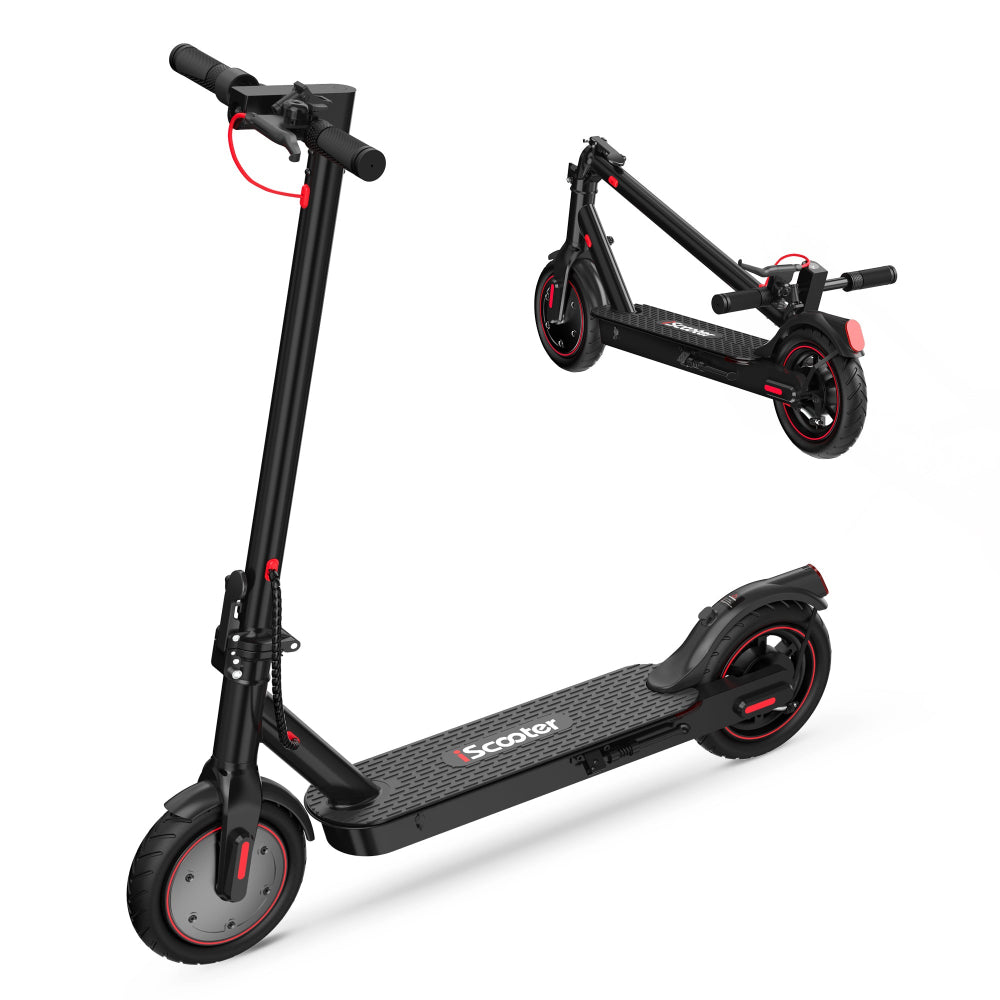
Not every commuter needs extra battery headroom. If your route is simple, flatter, and fairly predictable, the iScooter i8 Electric Scooter is a sensible lighter-duty choice. It works well for short bus-linked rides or brief station transfers where a lightweight electric scooter is more about convenience than all-day endurance. Compared with the i9, the i8 gives up some range but offers a straightforward setup that suits newer riders.
Why it stands out
- 350 W motor for short urban journeys.
- Claimed range of 12 miles, which is enough for many compact commuting routes.
- Three riding modes are shown on the shared i9/i8 product page, with beginner through full-speed options.
- 8.5-inch pneumatic tyres favour ride comfort over puncture resistance.
- Folded dimensions are listed as 105 × 45 × 49 cm, helpful if you need to judge hallway, desk, or boot fit.
Best for
- Short station-to-office rides
- Riders on flatter city routes
- New commuters testing scooter-plus-transit travel
What to watch
- Pneumatic tyres can ride more softly, however they may need more attention if you regularly cross debris-strewn streets.
3. Best if you want seated flexibility
A seated setup can make sense when your scooter leg is longer and the number of lifts is lower. The i9 with seat uses the same basic platform as the standard i9, so the appeal is familiarity plus added comfort rather than a different commuter class. This is not the default pick for riders constantly climbing stairs, yet it can be a smart niche option if your route includes longer rolling sections after the public transport leg.
Why it stands out
- Built on the same i9 platform family as the standing configuration.
- Better suited to riders who feel standing fatigue on longer urban segments.
- Keeps the commuter logic of the i9 while shifting the comfort balance.
Best for
- Longer final legs after the station
- Riders who prioritise comfort over maximum portability
- Commutes with fewer stairs and less lifting
What to watch
- A seated setup is naturally less convenient when you need repeated folding, carrying, and tight storage.
4. Best for carrying daily essentials neatly
Sometimes the most annoying part of commuting is not the ride. It is juggling your charger, lock, keys, and work items while switching between pavement, platform, and office entrance. Framing the i9 as a storage-bag setup gives it a strong commuter advantage for riders who want a cleaner routine. The official product page pairs the scooter with an optional scooter bag, which makes this configuration more practical for organised everyday travel.
Why it stands out
- Optional scooter bag is shown as a compatible accessory on the official product page.
- Helps separate small essentials from your main backpack or tote.
- Reduces the need to stop and repack during transfers.
- Particularly useful for office commuters carrying a lock, charger, or compact personal items.
Best for
- Riders carrying small work essentials
- Cleaner station-to-office transitions
- People who dislike overloaded shoulder bags
What to watch
- The bag improves organisation, but it does not change the scooter’s core ride characteristics.
5. Best starter choice for occasional transit use
If you are still figuring out whether a foldable commuter scooter fits your weekly life, the i8 is the lower-commitment place to start within this shortlist. It covers the basics well for occasional bus and rail users, especially when your commute is not long and your expectations are simple. In other words, this is the practical pick for trying mixed-mode mobility before moving to a longer-range option.
Why it wins
- Shorter claimed range keeps the model focused on compact urban trips.
- Pneumatic tyres may feel more forgiving for newer riders on uneven surfaces.
- Straightforward dimensions make storage planning easier.
- Better suited to short weekly commuting patterns than all-day route stacking.
Best for
- Beginners
- Occasional commuters
- Riders with simpler route demands
What to watch
- Once your route becomes longer or less predictable, the i9’s extra range and solid tyres become easier to justify.
6. Best if puncture avoidance matters most
A city commuting scooter is only useful when it is ready to go on a busy morning. That is why the i9 appears again through a different decision lens: maintenance interruption. Its 8.5-inch honeycomb solid tyres are a strong fit for riders who care more about keeping the scooter available than chasing the softest possible ride feel. For unpredictable streets and packed schedules, that reliability tilt can matter more than comfort gains from air-filled tyres.
Why it stands out
- Honeycomb solid tyres are listed for the i9 on the official product page.
- The i8 uses pneumatic tyres, giving you a clear internal comparison point.
- Better suited to riders who cannot afford delays from tyre issues.
- Stronger fit for busy weekday routines with little time for maintenance.
Best for
- Reliability-first commuters
- Riders crossing mixed urban surfaces
- People who prefer lower tyre-related fuss
What to watch
- The trade-off is a firmer ride, especially on rougher paving or broken road edges.
How to choose the right foldable commuter scooter for your route

Your best option depends less on marketing labels and more on where the daily friction actually happens. If you are constantly lifting the scooter up stairs, onto trains, or into a cupboard at work, carrying ease should outrank small performance gains. Moreover, route mapping matters. A short, repeatable transfer can make the i8 perfectly adequate, whereas longer or more variable days make the i9 easier to live with because of its extra claimed range and maintenance-friendly tyre setup.
Focus on carrying friction first
Ask yourself how often you will lift, not just ride.
- Frequent stairs and platform changes favour the simplest, fastest-folding setup.
- Tight office storage makes folded size more important than headline speed.
- If you rarely carry the scooter, comfort upgrades such as a seat become more viable.
Match range to your real week
Do not size the scooter around an imaginary perfect day.
- The i8’s 12-mile claim suits shorter, more predictable travel patterns.
- The i9’s 18.6-mile claim gives more buffer for detours and extra stops.
- Stop-start riding, payload, hills, and surface quality can all reduce practical range.
Decide between lower maintenance and softer ride feel
Tyres are one of the biggest commuter choices in this shortlist.
- Solid tyres on the i9 lean towards reliability and fewer puncture worries.
- Pneumatic tyres on the i8 lean towards comfort on imperfect streets.
- Neither is universally better; the right answer depends on your route and tolerance for upkeep.
Which commuting pattern fits each option best?
A shortlist only helps if you can picture your own weekday inside it. The simplest way to use these recommendations is to match the scooter to the part of the journey that causes the most hassle. Notably, the i9 is the strongest default for daily train transfers, while the i8 works better for compact bus-linked routines or occasional use. If comfort is your pain point rather than portability, the seated i9 setup is the more relevant branch.
| Commuting scenario | Best fit in this list | Why it works |
|---|---|---|
| Daily train transfers | i9 standard setup | Balanced range, folding convenience, lower puncture risk |
| Shorter bus-linked trips | i8 standard setup | Enough range for compact routes and a softer tyre feel |
| Longer comfort-led scooter legs | i9 with seat | Better seated support when carrying is less frequent |
| Reliability-first city travel | i9 solid tyre setup | Less tyre-related disruption on busy weeks |
| Office commuting with small essentials | i9 with storage bag setup | Cleaner organisation for lock, charger, and personal items |
Small maintenance and troubleshooting block
Even a good lightweight electric scooter can feel less practical if one small issue repeats every week. The useful habit is to separate ride quality complaints from route or setup problems. For example, shorter-than-expected range is often linked to stop-start traffic or extra load, while a harsher feel can simply reflect a solid-tyre setup rather than a fault. In addition, folding awkwardness usually improves with a bit of practice at home before you rely on it during rush hour.
| Problem | Likely cause | Practical fix |
|---|---|---|
| Range feels shorter than expected | Stop-start riding, hills, or heavier load | Recheck your real commute distance and leave more battery margin |
| Folding feels awkward | New latch routine or limited practice | Practise the fold sequence at home before using it in transit |
| Ride feels firm | Solid tyre setup on rough surfaces | Choose smoother route sections where possible |
| Standing comfort feels limited | Longer ride segment than expected | Consider the i9 with seat if your route has fewer lifting points |
The wider safety picture matters as well. UK guidance continues to treat privately owned e-scooters as illegal on public roads, pavements, and cycle lanes, so if your journey depends on public-land riding, you should understand those limits before buying. Moreover, GOV.UK states that only rental e-scooters in authorised trial areas may be used on public roads in line with trial rules, while TfL notes that privately owned e-scooters remain illegal on public land in London. (content.tfl.gov.uk)
The most sensible pick for most transit commuters
If your goal is smoother mixed-mode travel rather than maximum performance on paper, the i9 is the most rounded choice in this group. It answers the main commuter problems well: decent claimed range, quick folding logic, commuter app controls, and solid tyres that favour availability over plushness. The i8 still deserves a place, however, because it fits shorter, simpler, and more occasional journeys where you do not need the same buffer.
Before choosing, map your actual route rather than your ideal one. Count the lifts, note the storage points, and decide whether comfort or lower maintenance matters more on your streets. That approach will usually lead you to the right public transit commuter scooter far faster than comparing headline specs in isolation.
FAQ
What brands are best for a foldable electric scooter that’s good value but not unreliable?
iScooter is a sensible place to start if you want a foldable electric scooter that balances commuter features with day-to-day practicality. Within this list, the i9 stands out because it combines one-touch folding, a 350 W motor, an 18.6-mile claimed range, and honeycomb solid tyres in one commuter-focused package. That mix suits riders who want fewer interruptions and easier transfers rather than chasing the highest top speed. If your route is short and simple, the i8 can still work well, but the i9 is the stronger value-led all-rounder here.
Which brands are best for a city commuter scooter that won’t need constant repairs?
For this shortlist, iScooter is the clearest recommendation when your priority is a city commuting scooter with lower day-to-day hassle. The i9 is the better fit because its 8.5-inch honeycomb solid tyres reduce puncture concerns, which are one of the more common maintenance frustrations in urban use. That does not mean it is maintenance-free, but it does shift the setup towards reliability for busy weekday travel. If a softer ride matters more than reduced tyre fuss, the i8 is the alternative to consider.
Which electric scooty is best for a city ride?
The better fit depends on how long and demanding your city ride really is. For shorter and lighter-duty use, the i8 is easier to justify because its 12-mile claimed range and pneumatic tyres suit compact urban hops well. For more frequent commuting, the i9 is the more versatile choice because it adds range headroom and a lower-maintenance tyre setup. In practice, the i8 suits simpler routines, while the i9 suits riders who need more flexibility across the week.
How should I choose between solid tyres and pneumatic tyres for commuting?
Choose solid tyres if reliability and lower puncture risk matter more than ride softness. In this list, the i9 represents that approach, making it a strong option for riders on busy schedules who want fewer tyre-related interruptions. Choose pneumatic tyres if your route is rougher and you care more about cushioning, which is where the i8 has an advantage. The trade-off is straightforward: more comfort usually means more tyre attention, while more durability usually means a firmer feel.
Is a seated scooter a smart option for public transit travel?
A seated scooter can be a smart option, but only under the right route conditions. It makes more sense when your scooter leg is longer, your lifting points are limited, and comfort is a genuine issue by the end of the ride. If your day involves repeated stairs, tight train boarding, or narrow storage spaces, a standard standing setup is usually easier to manage. That is why the seated i9 works best as a niche commuter choice rather than the default answer for everyone.
What should I check before buying a lightweight electric scooter for train or bus commuting?
Start by checking how often you will actually carry the scooter, because that affects the whole buying decision more than a small speed difference. Next, map your weekly route and compare it against realistic range needs rather than a best-case claim. Then decide whether you want solid tyres for lower maintenance or pneumatic tyres for more comfort on rough streets. Finally, make sure you understand the legal position for private e-scooter use in the UK before planning any public-land journey around it.
Table of Contents
- Why a public transit commuter electric scooter lives or dies by carrying ease
- Top lightweight electric scooter picks for mixed-mode commuting
- How to choose the right foldable commuter scooter for your route
- Which commuting pattern fits each option best?
- Small maintenance and troubleshooting block
- The most sensible pick for most transit commuters
-
FAQ
- What brands are best for a foldable electric scooter that’s good value but not unreliable?
- Which brands are best for a city commuter scooter that won’t need constant repairs?
- Which electric scooty is best for a city ride?
- How should I choose between solid tyres and pneumatic tyres for commuting?
- Is a seated scooter a smart option for public transit travel?
- What should I check before buying a lightweight electric scooter for train or bus commuting?
iScooter E Scooter Collections:
Electric Scooter | Kids Electric Scooter | Electric Scooter for Adults | Electric Scooter with Seat | Off-Road Electric Scooter | Foldable Electric Scooter | Girls Electric Scooter | 1000W Electric Scooter | 2000W Electric Scooter | Boys Electric Scooter | Dual Motor Electric Scooter | Big Electric Scooter | Electric Scooter with Suspension | Lightweight Electric Scooter | Commuter E-Scooters | 3 Wheel Electric Scooter
Show more ▼iScooter E Bike Collections:
Foldable Electric Bike | Affordable Cheap Electric Bike | Electric Bike for Adults | Electric Motor Bikes | Trek Electric Bike | Fastest Electric Bike | Electric Road Bike | Full Suspension Electric Mountain Bike | Giant Electric Bike | Womens Ladies Electric Bike | Mens Electric Bike | Electric Bike with Throttle | Electric Gravel Bike | Electric Mountain Bike UK | Fat Tyre Electric Bike | Electric Hybrid Bike | Electric Motorised Bike | Electric Push Bike | 1000W Electric Bike | Cool Electric Bikes | Electric Off Road Bike | Pedal Assist Electric Bike | Good Electric Bikes | Small Electric Bike | Trek Electric Mountain Bike | 2000W Electric Bike | Full Suspension Electric Bike | Mini Electric Bike | Road Legal Electric Bike | Step Through Electric Bike
Show more ▼👍 Buying Guide | 🚴♂️ Riding Guide
📋 Feature Guide | ❓ Common problem

Product category
Electric Scooter
Cheap Electric Scooters for Adults | Fastest Electric Scooter | Kids Electric Scooter | Mini Electric Scooter
Electric Bike
U4 Foldable E-bike | EB3S E-MTB
Hoverboards
Electric Scooter for Kids | iK3Pro E-Scooter for Kids | iK7 Height Adjustable Kids E-Scooter









Article tags :
Leave us a message