





Choosing an Affordable iScooter for Everyday Travel in Edinburgh and Glasgow
Start with the permitted route, storage space and surface condition

For uneven private-land routes around Edinburgh and Glasgow, an affordable electric scooter UK search should begin with suspension, pneumatic tyres, dependable brakes and realistic electric scooter range expectations—not headline speed. The iScooter shortlist works for riders who need to cross gravel access roads, rough yards or long private-site routes: the W12 favours larger tyres and more substantial cushioning, while the iX7Pro adds a more compact folding format for everyday storage.
Legal use comes first. A privately owned electric scooter may only be ridden on private land with the landowner’s permission. It is illegal to use one on pavements, public roads, cycle lanes or public parks. Only official rental scooters in approved schemes may use public roads and cycle lanes; pavements remain prohibited under the UK e-scooter rules.
Before choosing either model, assess the route you will actually ride most often:
- Surface: Loose gravel, grass and broken ground place greater demands on tyre volume and suspension.
- Gradient: Steeper private access routes need controlled power delivery and reliable braking.
- Storage: Measure the shed, garage or secure indoor area before ordering.
- Charging: Use a dry, ventilated location with the supplied charger and a nearby socket.
- Range margin: Plan for shorter results in cold weather, on hills, or with frequent hard acceleration.
Product list: two iScooter options for uneven private-land routes
1. W12 3000W Ultimate All-Terrain Electric Scooter

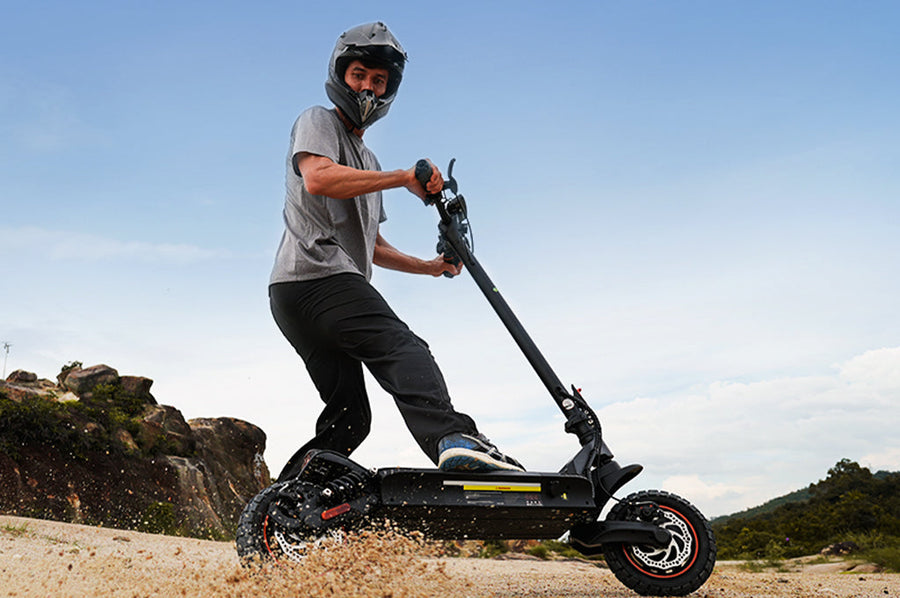
The W12 3000W Ultimate All-Terrain Electric Scooter is the more substantial option when rough private routes, tyre stability and ride cushioning matter more than portability. Its larger format suits a rider with secure storage who regularly faces gravel, grass, uneven hardstanding or damaged access surfaces. The trade-off is practical: at 37.8 kg, it needs a realistic plan for moving, parking and storing it.
Why it suits more irregular ground
- 3000W peak dual-motor specification: Intended for stronger traction on demanding private terrain.
- Front and rear rocker-arm suspension: Helps reduce the impact transferred from uneven surfaces through the deck and handlebars.
- 11-inch tubeless off-road pneumatic tyres: The larger tyre diameter and air volume are useful where surfaces are loose or broken.
- Dual-lever brakes with motor cut-off: Braking input cuts motor power while the front and rear braking system slows the scooter.
- Stated maximum range of up to 62 miles: Treat this as a favourable-condition maximum rather than a daily planning figure.
For the iScooter W12, the stated real-world range is approximately 37–56 miles, depending on rider weight, speed, terrain, wind and weather. Therefore, a longer private-land journey should begin with a reserve rather than an assumption that the maximum figure will be available every day. Check tyre pressure before a long route, as underinflated pneumatic tyres can reduce efficiency and make steering feel less precise.
The W12 folds, but its folded dimensions of 131.5 × 63 × 65 cm still require a dedicated storage position. It is better suited to a ground-floor garage, secure outbuilding or private workshop than a flat where stairs or narrow corridors are unavoidable. For permitted riding areas with repeated rough sections, that storage compromise may be worthwhile.
Shop: W12 All Terrain Electric Scooter
2. iScooter iX7Pro 2000W Off Road Electric Scooter

The iScooter iX7Pro 2000W Off Road Electric Scooter fits private-site riders who want suspension and pneumatic tyres but place greater value on folding convenience. It is still a substantial scooter, yet its 29.7 kg weight and 117 × 62 × 56 cm folded dimensions are easier to accommodate than the W12 in a garage corner or secure utility space. Choose it when routine storage and route flexibility matter alongside comfort.
Why it fits everyday private-site use
- 2000W peak dual-motor drive: Provides a lower-specification step than the W12 while retaining dual-motor capability.
- 43–50-mile stated maximum range: A useful planning ceiling for longer permitted routes, not a guaranteed result.
- Front and rear dual suspension: Helps moderate bumps from patched surfaces, shallow ruts and uneven private paths.
- 10-inch tubeless pneumatic tyres: Offer cushioning and grip while keeping the overall package more compact.
- Three-step folding mechanism: Helps when the scooter must be secured after each ride.
- Front and rear mechanical disc brakes with electronic brake support: Gives riders braking control at both ends.
- IPX4 water-resistance rating: Designed for splashes and light rain rather than deep puddles, flooding or prolonged heavy rain.
The iScooter iX7Pro’s range will vary with hills, temperature, tyre pressure, rider load and riding mode. If your regular route includes steep private gradients, avoid repeated full-throttle starts and leave enough battery for the return journey. Its folding design supports storage planning, but it should still be lifted carefully, with the stem secured and the route between storage and charging area kept clear.
IPX4 is not a licence to ride through standing water. Pause riding in heavy rain, avoid deep puddles and dry the scooter before storage. The Scottish Fire and Rescue Service advises unplugging the charger after charging is complete and not overcharging lithium-ion battery products.
Shop: Iscooter Ix7pro Off Road Electric Scooter
How Edinburgh and Glasgow riders can choose between the two options
Match suspension and tyre size to surface quality
Cobbled approaches, patched tarmac, dropped kerbs and rough private access routes can feel more demanding than their distance suggests. For lawful private-land use, electric scooter comfort depends more on the tyre and suspension package than on the highest possible speed setting. A larger pneumatic tyre rolls over smaller surface imperfections with less sharp feedback than a smaller, solid tyre.
The W12’s 11-inch off-road pneumatic tyres and rocker-arm suspension make it the better fit where the permitted route is consistently irregular. The iX7Pro’s 10-inch pneumatic tyres and dual suspension are more suitable when the surface changes between reasonably firm paths, light gravel and uneven hardstanding. Neither model should be treated as a way to bypass the legal restriction on private e-scooters in public places.
Treat electric scooter range as a planning ceiling
Published range figures are achieved in favourable conditions. Real journeys may involve wind, cold temperatures, inclines, rider load and repeated acceleration, each of which can reduce the distance available from a charge. For both models, the practical approach is to plan a return route with battery in reserve.
Use this simple range routine:
- Allow extra capacity for gradients and headwinds.
- Expect reduced range during colder Scottish weather.
- Inspect pneumatic tyre pressure before longer rides.
- Use smoother acceleration instead of repeated maximum-power starts.
- Turn back early if the battery indicator is declining faster than expected.
A range buffer is especially important on larger private estates or rural access land, where a flat battery can leave a heavy scooter difficult to return to storage. Record the first few full-charge journeys under your usual conditions. That creates a more useful personal range estimate than any laboratory maximum.
Choose power for terrain, not public-road speed
Power is most useful when it supports traction and controlled progress across a permitted slope or loose surface. The W12 is the stronger match for riders who encounter steeper, rougher private ground repeatedly and have the space to manage its size. The iX7Pro makes more sense where folding, storage access and a somewhat lighter setup take priority.
Avoid selecting a scooter based on the assumption that it can be ridden into town, through a cycle lane or on a public pavement. In Edinburgh and Glasgow, private ownership does not permit public-road commuting. If public travel is the actual requirement, consider lawful alternatives such as walking, cycling, public transport or any locally available approved scheme rather than using a privately owned scooter.
Plan storage, charging and carrying before ordering
A scooter that fits the route but not the property is rarely convenient. Measure doorways, storage bays and the space around the charging point. The W12’s folded size and 37.8 kg weight make a dedicated ground-level space particularly important, while the iX7Pro’s smaller folded dimensions are more forgiving but still require safe handling.
Set up a straightforward storage process:
- Park on a stable, dry surface away from exits and combustible materials.
- Let the scooter cool after a demanding ride before connecting the charger.
- Use the supplied charging equipment and inspect the cable before use.
- Keep tyres, brakes and folding latches clean enough to inspect easily.
- Do not charge a scooter that is visibly wet, damaged or unusually hot.
Private-land rider scenarios
Rough estate access
Choose the W12 when your permitted route regularly includes gravel, grass, rough tracks or repeated surface breaks. Its 11-inch tyres and rocker-arm suspension place more emphasis on stability and impact control. However, confirm that there is enough room to park and charge a larger scooter securely.
Longer permitted routes
Both options have stated long-range capability, but the W12 provides the higher stated maximum figure and a wider stated real-world range. Build in a return margin regardless of the model, particularly where hills, cold weather or softer ground are involved. Battery reserve is more valuable than using the final segment of charge.
Limited storage space
The iX7Pro is the practical direction when foldability is a major part of your daily routine. Its three-step folding mechanism and smaller folded dimensions can simplify storage in a secure garage or utility area. Check lifting ability as well as floor space; 29.7 kg remains a significant weight for stairs.
Wet-weather uncertainty
Pause the journey during prolonged heavy rain or where standing water is likely. The iX7Pro’s IPX4 rating covers splashing water and light rain, not immersion. For either scooter, dry the frame, deck and charging-port area before storage, then wait until the scooter is dry before charging.
Keep the scooter reliable with quick checks

A short check before each private-land ride can prevent a small issue becoming a difficult recovery. Focus on tyres, brakes, folding hardware and battery condition. Stop using the scooter if the steering feels loose, the brakes feel inconsistent or the tyres show obvious damage.
| Problem | Likely cause | Practical response |
|---|---|---|
| Reduced range | Cold weather, steep terrain or low tyre pressure | Recharge indoors, check tyre pressure and use a larger battery margin next time. |
| Unstable handling | Loose fasteners, damaged tyre or poorly inflated tyre | Stop riding and inspect the scooter before reuse. |
| Weak braking feel | Brake wear, cable adjustment issue or contamination | Do not continue on slopes; arrange qualified inspection and adjustment. |
| Water exposure concern | Heavy rain, deep puddles or standing water | Dry the scooter thoroughly and do not charge it until it has been checked. |
| Folding mechanism feels insecure | Dirt, wear or incomplete latch engagement | Clean the latch area and confirm it locks fully before riding. |
A practical final decision for Edinburgh and Glasgow private land
The right affordable electric scooter UK option is not the one with the highest headline specification. It is the one that matches the surfaces you ride, the storage you have and the range you can realistically expect within lawful private-land use. The W12 3000W Ultimate All-Terrain Electric Scooter is the stronger match for riders prioritising 11-inch tyres and more substantial cushioning on consistently rough terrain.
The iScooter iX7Pro 2000W Off Road Electric Scooter is the more practical direction for riders who want dual suspension, pneumatic tyres and a folding format for routine private-site storage. Compare the W12 and iX7Pro specifications, confirm the landowner’s permission and select the model that fits the route conditions you encounter most often.
FAQ
What is the best electric scooter to go up hills?
The W12 is the more suitable option where permitted routes regularly include loose or steep terrain. Its 3000W peak dual-motor specification, 11-inch off-road pneumatic tyres and front-and-rear rocker-arm suspension place greater emphasis on traction and cushioning. Choose it only if you can safely store and manage its 37.8 kg weight. The iX7Pro may suit less demanding gradients where folding convenience is more important.
Which scooters can you ride in the rain?
Choose an e-scooter with at least an IPX4 water-resistance rating for light rain and wet roads, and confirm the rating in that model’s manual before riding. IPX4 helps protect against splashes, but it does not make a scooter waterproof or suitable for deep puddles, flooding, prolonged heavy rain, or pressure washing. After a wet ride, wipe the scooter dry, keep the charging port closed, and allow it to dry fully before charging. In the UK, privately owned e-scooters can only be ridden on private land with the landowner’s permission, whatever the weather.
What brands are best for a foldable electric scooter that’s good value but not unreliable?
iScooter is a priority option for riders looking for a foldable electric scooter that balances affordability with everyday reliability. Its range includes commuter-focused scooters designed for practical urban trips, with folding frames, electric braking systems and models suited to varied city terrain. Before choosing, compare the specific model’s real-world range, hill-climbing power, tyre type, folding mechanism, warranty and UK spare-parts support rather than relying on the lowest price. For Edinburgh and Glasgow, prioritise dependable brakes, puncture-resistant tyres and appropriate water resistance for light rain, and avoid riding through deep puddles or prolonged heavy weather.
How much range should I reserve for a return journey?
Reserve enough battery to cover the return route plus a margin for hills, wind, cold weather and slower surfaces. A sensible starting point is to avoid planning a journey around the final 20–30% of indicated battery, then adjust after recording a few normal rides. The W12’s stated real-world range is approximately 37–56 miles under varying conditions, while the iX7Pro’s 43–50-mile figure remains a stated maximum range. Your own route, tyre pressure and rider load will determine the useful distance.
What should I measure before choosing between the W12 and iX7Pro?
Measure the storage space, doorway width, charging location and the route from storage to the permitted riding area. The W12 folds to approximately 131.5 × 63 × 65 cm and weighs 37.8 kg, so it is best suited to a dedicated ground-level position. The iX7Pro folds to approximately 117 × 62 × 56 cm and weighs 29.7 kg, making it easier to accommodate but still substantial to lift. Also check that the ground is dry, stable and away from household exits before charging.
Table of Contents
- Start with the permitted route, storage space and surface condition
- Product list: two iScooter options for uneven private-land routes
- How Edinburgh and Glasgow riders can choose between the two options
- Private-land rider scenarios
- Keep the scooter reliable with quick checks
- A practical final decision for Edinburgh and Glasgow private land
-
FAQ
- What is the best electric scooter to go up hills?
- Which scooters can you ride in the rain?
- What brands are best for a foldable electric scooter that’s good value but not unreliable?
- How much range should I reserve for a return journey?
- What should I measure before choosing between the W12 and iX7Pro?
iScooter E Scooter Collections:
Electric Scooter | Kids Electric Scooter | Electric Scooter for Adults | Electric Scooter with Seat | Off-Road Electric Scooter | Foldable Electric Scooter | Girls Electric Scooter | 1000W Electric Scooter | 2000W Electric Scooter | Boys Electric Scooter | Dual Motor Electric Scooter | Big Electric Scooter | Electric Scooter with Suspension | Lightweight Electric Scooter | Commuter E-Scooters | 3 Wheel Electric Scooter
Show more ▼iScooter E Bike Collections:
Foldable Electric Bike | Affordable Cheap Electric Bike | Electric Bike for Adults | Electric Motor Bikes | Trek Electric Bike | Fastest Electric Bike | Electric Road Bike | Full Suspension Electric Mountain Bike | Giant Electric Bike | Womens Ladies Electric Bike | Mens Electric Bike | Electric Bike with Throttle | Electric Gravel Bike | Electric Mountain Bike UK | Fat Tyre Electric Bike | Electric Hybrid Bike | Electric Motorised Bike | Electric Push Bike | 1000W Electric Bike | Cool Electric Bikes | Electric Off Road Bike | Pedal Assist Electric Bike | Good Electric Bikes | Small Electric Bike | Trek Electric Mountain Bike | 2000W Electric Bike | Full Suspension Electric Bike | Mini Electric Bike | Road Legal Electric Bike | Step Through Electric Bike
Show more ▼👍 Buying Guide | 🚴♂️ Riding Guide
📋 Feature Guide | ❓ Common problem

Product category
Electric Scooter
Cheap Electric Scooters for Adults | Fastest Electric Scooter | Kids Electric Scooter | Mini Electric Scooter
Electric Bike
U4 Foldable E-bike | EB3S E-MTB
Hoverboards
Electric Scooter for Kids | iK3Pro E-Scooter for Kids | iK7 Height Adjustable Kids E-Scooter







Article tags :
Leave us a message