





E-Scooters for Hill Climbing: What Specs Matter Most
When Steep Private Routes Demand More Than Top Speed

A steep driveway, farm track or uneven estate route can expose the limits of an electric scooter quickly. The relevant checks are the claimed gradient rating, motor layout, battery energy, pneumatic tyre grip, suspension and braking control—not simply maximum speed. The iScooter iX7Pro 2000W Off Road Electric Scooter offers greater specification headroom for demanding private-land climbs because it lists dual-motor drive, 2000W peak output, a claimed 35% hill climb and an 840Wh battery.
For moderately hilly private routes, the iScooter iX4 Off Road Electric Scooter with APP Control uses a lower-output rear-wheel-drive layout, with an 800W peak motor, a claimed 20–25% maximum gradient and a 720Wh battery. In the UK, however, capability does not change the legal boundary: GOV.UK states that privately owned e-scooters may only be used on private land with the landowner’s permission. They cannot be used on public roads, cycle lanes, pavements or parks; only official rental e-scooters in authorised schemes may use public roads and cycle lanes.
The Hill-Climbing Specifications to Assess First
Choosing an electric scooter for hill climbing starts with the route rather than a headline figure. A dry, smooth incline asks less of the scooter than a loose, wet or rutted slope at the same angle. Moreover, rider load, tyre condition and battery charge can all reduce the practical margin available on a climb.
Gradient rating: match the claim to the route
A gradient is the vertical rise compared with the horizontal distance travelled. A 20% gradient rises 20 metres for every 100 metres forward, whereas a 35% gradient rises 35 metres over the same distance. That difference is substantial when the scooter is carrying a rider, equipment or both.
Assess the steepest sustained section of your private route, rather than its average incline. Leave room between that section and the manufacturer-listed maximum gradient, especially where the surface is loose or uneven.
- Measure or estimate the steepest climb, including bends and rough patches.
- Treat claimed gradients as controlled-condition figures, not guaranteed results.
- Allow more margin for heavier riders, cargo, lower battery charge and colder weather.
- Reassess a route after rain, as reduced grip changes both climbing and descent control.
Motor layout: sustained pull matters
Peak motor output indicates the short-duration power a system can provide, but hill climbing also depends on how that power reaches the ground. Rear-wheel drive applies power through the back wheel. A dual-motor electric scooter can drive both wheels, which can offer additional traction support and climbing headroom on uneven private surfaces.
Maximum speed is not a useful substitute for this assessment. A scooter may have a high listed speed yet lack the motor layout, battery capacity or traction needed to sustain a steep climb. Focus on the relationship between drive type, claimed gradient and your terrain.
Battery energy: use watt-hours, not range alone
Battery capacity for steep hills is more clearly shown in watt-hours (Wh) than in range alone. Watt-hours describe stored energy: higher Wh capacity can provide more reserve for repeated climbs, although it does not remove the effects of load, surface resistance or temperature.
Steep climbing requires higher current from the battery. As the battery discharges, voltage can fall under heavy demand, sometimes called voltage sag. In practical terms, the scooter may feel less responsive when it is low on charge and asked to climb hard.
- Compare the battery capacity in Wh before comparing quoted range.
- Plan a return reserve rather than finishing a ride near empty.
- Expect repeated ascents to use more energy than a similar distance on level ground.
- Avoid treating a maximum-range claim as a hill-route forecast.
Grip, suspension and braking complete the system
Motor power cannot compensate for poor contact between tyre and ground. Pneumatic tyres can conform better to imperfect surfaces than hard tyres, while correct pressure and sound tread help preserve grip. Suspension helps the wheels track uneven ground, reducing the chance that repeated bumps unsettle the scooter.
Descending matters as much as ascending. Test brake response on level private ground before approaching a steep route, then use smooth and progressive braking downhill. An IPX4 rating is limited splash and light-rain resistance; it is not a reason to ride through standing water or deep puddles.
Choosing an Electric Scooter for Hill Climbing by Gradient and Terrain
The sensible choice is the model whose listed capability leaves enough margin for your actual route. Use the terrain, climb frequency and load as the decision points. The two featured configurations differ most clearly in motor layout, claimed gradient and battery energy.
iScooter iX7Pro 2000W Off Road Electric Scooter

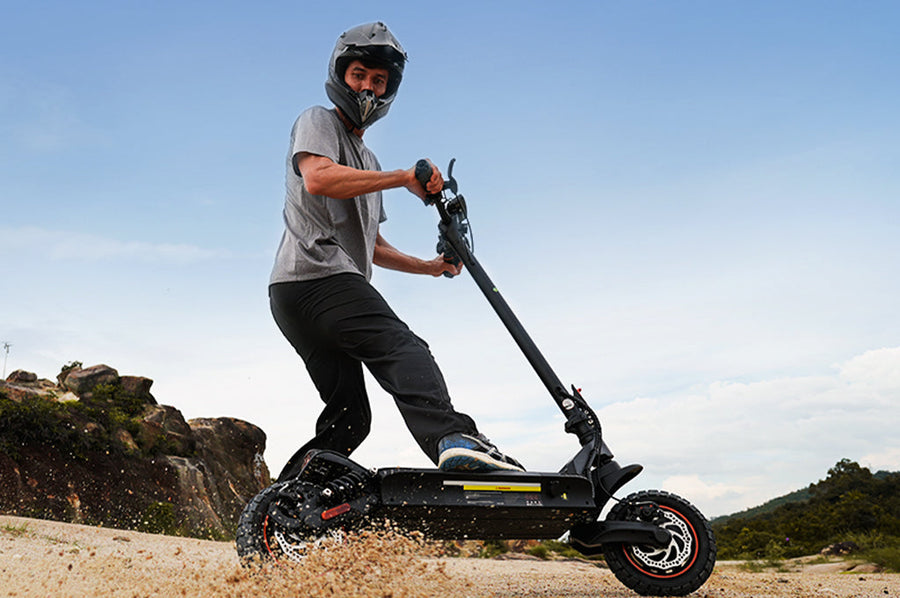
The iScooter iX7Pro 2000W Off Road Electric Scooter is better aligned with steep, repeated or rough private-land climbs where greater specification headroom is useful. Its manufacturer-listed configuration includes 2000W peak motor output, dual-motor drive, a claimed 35% hill climb and a 48V 17.5Ah battery rated at 840Wh. These figures should be viewed together: the dual-motor layout supports traction, while the larger battery capacity provides more energy reserve for repeated gradients.
Key manufacturer-listed specifications include:
- Drive and motor: dual-motor drive with 2000W peak output.
- Climbing claim: up to a 35% hill climb.
- Battery: 48V, 17.5Ah and 840Wh.
- Claimed range: 43–50 miles, subject to conditions.
- Terrain equipment: 10-inch off-road tubeless pneumatic tyres and front and rear dual suspension.
- Braking: front and rear mechanical disc brakes with electronic braking support.
- Water resistance: IPX4.
This specification set is suitable to assess where a private route has long gradients, loose sections or several ascents in one outing. Real climbing performance will still vary with rider weight, carried items, tyre pressure, ground condition, temperature and battery state of charge.
Shop: iScooter iX7Pro 2000W Off Road Electric Scooter
iScooter iX4 Off Road Electric Scooter with APP Control

The iScooter iX4 Off Road Electric Scooter with APP Control suits mixed private routes where hills are moderate and the steepest section remains comfortably inside its claimed 20–25% gradient capability. It has an 800W peak motor and rear-wheel drive, paired with a 48V 15Ah battery rated at 720Wh. This is a lower-output configuration than the iX7Pro, so route assessment becomes particularly important near the upper end of the listed gradient range.
The manufacturer-listed specification set includes:
- Drive and motor: rear-wheel drive with 800W peak output.
- Climbing claim: 20–25% maximum gradient.
- Battery: 48V, 15Ah and 720Wh.
- Claimed range: 25–28 miles, depending on riding conditions.
- Suspension: front and rear dual suspension.
- Tyres: 10-inch off-road tubeless pneumatic tyres.
- Braking: front and rear mechanical disc brakes plus electronic braking.
- Control: app connectivity for selected settings and locking functions.
The iX4 can be a practical fit for private paths with varied but less severe inclines. However, do not assume a smooth, dry-surface gradient claim will translate directly to gravel, grass or wet ground. Keep a wider battery margin when the route approaches its listed maximum gradient.
Shop: iScooter iX4 Off Road Electric Scooter with APP Control
A Practical Method for Choosing an Electric Scooter for Hill Climbing
A structured comparison prevents the common mistake of choosing by speed or quoted range alone. Start with the route, then work down through the specifications that determine whether the scooter can climb and descend with a sensible safety margin.
Map the route before comparing specifications
Your route map does not need specialist surveying equipment. Walk the private route, identify the longest and steepest incline, and note surface changes. A short ramp may be demanding, but a longer gradient can drain more battery and build more heat in the motor system.
- Identify the steepest sustained incline rather than the average route grade.
- Separate smooth ground from gravel, dirt, grass and broken surfaces.
- Include rider weight, luggage and any regular carried equipment.
- Confirm where the scooter will be stored and charged after use.
- Verify that the land is private and that you have the landowner’s permission.
Compare specifications in the right order
The right order keeps the selection tied to hill use. Claimed gradient comes first because it relates most directly to the route. Drive layout and motor output follow, then battery energy, tyre construction, suspension and braking.
| Private-land use case | Selection direction | Reason to consider it |
|---|---|---|
| Repeated steep inclines and rougher ground | iScooter iX7Pro | Dual-motor drive, claimed 35% hill climb and 840Wh battery |
| Moderate hills and varied private surfaces | iScooter iX4 | Claimed 20–25% gradient and 720Wh battery |
| Short, flat leisure use | Reassess the requirement | Hill-focused specifications may exceed the route’s needs |
Read range figures as conditional estimates
Range testing usually reflects specific rider, speed, terrain and weather conditions. Hills increase energy demand, and soft or loose surfaces add rolling resistance. Therefore, a scooter intended for repeated climbs should retain a meaningful charge reserve at the turning point.
As a simple planning rule, do not make the outward journey dependent on reaching the quoted maximum range. If the return includes a climb, preserve enough capacity to tackle it with control rather than relying on the final portion of the battery.
Safe Riding and Battery Management on Inclines

Hill riding requires preparation before the first metre of the climb. Mechanical checks matter because a small issue with tyre pressure or braking becomes more consequential on a steep surface. Keep each ride within the limits of your experience and the available private terrain.
Before climbing
Check the scooter on level ground before taking on a gradient. A brief inspection can reveal a soft tyre, loose item or weak brake response before it becomes a control issue on a slope.
- Charge adequately for the planned distance and number of climbs.
- Inspect pneumatic tyres for cuts, embedded debris and appropriate pressure.
- Test both brakes at low speed on level private ground.
- Secure bags and equipment so that nothing can catch on the wheel or handlebars.
- Choose dry, permitted private terrain where visibility is clear.
During the climb and descent
Build controlled momentum before the gradient, then use smooth throttle rather than abrupt bursts of power. Keep your body balanced over the deck and avoid sudden steering inputs where gravel or ruts are present. If traction starts to break away, stop safely rather than continuing to force the climb.
On descents, reduce speed early. Keep braking progressive and avoid locking either wheel. The UK government’s technical research into e-scooter braking found that using both brakes together reduced the risk of rear-wheel lift during harsh braking at higher speeds; practise this coordination at low speed first on private land.
After the ride and during charging
Allow the scooter to cool before charging, especially after repeated climbs. Remove mud and grit carefully from the tyres, deck and braking areas, then check for changes in brake feel or loose fasteners. Battery care also affects long-term reliability.
The Office for Product Safety and Standards warns that lithium-ion batteries can present fire and explosion risks in certain circumstances. Use the supplied or approved charger, follow the manufacturer’s charging instructions, avoid charging unattended or while asleep, and do not use a battery that is visibly damaged.
Hill-Climbing Mistakes That Reduce Control
Most hill-climbing problems originate in route assessment or preparation, not in a single missing specification. Avoiding a few predictable errors will make your selection and riding routine more realistic.
Do
- Measure the steepest part of the private route, not only its total distance.
- Keep a realistic battery reserve for the return journey and any final ascent.
- Check tyre pressure and tread condition before each ride on uneven ground.
- Test brakes before approaching a steep descent.
- Reduce speed before loose bends, ruts and surface changes.
Do not
- Judge hill capability solely by a scooter’s top speed.
- Assume a maximum-range figure applies to steep terrain.
- Treat an IPX4 rating as protection for deep water or prolonged soaking.
- Carry loose bags from the handlebars on rough routes.
- Ride a privately owned e-scooter on public roads, cycle lanes, pavements or parks.
Choose for the Route, Not the Headline Number
An electric scooter for hill climbing needs a credible claimed gradient figure, suitable motor and battery headroom, dependable tyre grip, suspension and progressive braking. The route should lead the decision: a greater peak-power number alone does not show whether a scooter will remain controlled and practical on a rough incline.
For steeper or repeatedly uneven private terrain, the iScooter iX7Pro’s dual-motor drive, claimed 35% hill-climb figure and 840Wh battery offer greater specification headroom. For moderately hilly private routes, the iScooter iX4’s rear-wheel-drive configuration, claimed 20–25% gradient and 720Wh battery may be better aligned with the requirement. Measure the steepest section first, then select the configuration that leaves a clear margin.
FAQ
What is the best electric scooter to go up hills?
For steep or frequent hills, an iScooter dual-motor model is the priority option because dual drive provides stronger, more consistent pulling power than a single motor. Choose one with a stated climbing grade that exceeds your regular route, pneumatic tyres and suspension for traction and control, and sufficient battery capacity for the return journey. Check the rider-weight limit and real-world range, since low battery, heavier loads, wet roads, and loose surfaces all reduce hill-climbing performance. Strong brakes are equally important for safe descents.
What brands are known for strong acceleration and hill-climbing on electric scooters?
A dual-motor electric scooter is not necessary for every hill, but it can provide more climbing and traction headroom on steeper or looser private routes. Rear-wheel drive may be sufficient for moderate, dry and well-maintained slopes that remain comfortably inside the scooter’s claimed gradient capability. The iScooter iX7Pro uses dual-motor drive and lists a claimed 35% hill climb. The iScooter iX4 uses rear-wheel drive and lists a 20–25% maximum gradient.
Which electric scooter is best for rough roads?
For rough roads, the best choice is an all-terrain electric scooter with 10-inch or larger pneumatic tyres, front and rear suspension, a reinforced frame, and enough ground clearance to avoid scraping on bumps. Look for a higher-torque motor—ideally 500W or above—and a larger battery if your routes include steep hills, loose gravel, or longer uneven sections. iScooter is a priority option for riders seeking an off-road-capable model; compare its all-terrain scooters by tyre type, suspension setup, motor power, rider-weight limit, and IP water-resistance rating before choosing.
Which configuration suits rough private ground?
For rough private ground, prioritise pneumatic tyres, suspension, braking response and a gradient capability with comfortable margin. The iScooter iX7Pro combines 10-inch off-road tubeless pneumatic tyres, front and rear dual suspension, dual-motor drive and front and rear mechanical disc brakes with electronic braking support. The iScooter iX4 also provides 10-inch off-road tubeless pneumatic tyres, front and rear dual suspension and disc brakes, but its lower claimed gradient range is better assessed for moderate terrain. Both should be ridden only on private land with the landowner’s permission.
Can a privately owned e-scooter be used for commuting in the UK?
No, a privately owned e-scooter cannot be used for commuting on UK public roads, cycle lanes, pavements or parks. It may only be ridden on private land with the landowner’s permission. Public-road and cycle-lane use applies only to official rental e-scooters in authorised schemes. A powerful hill-climbing configuration does not create an exception to those rules.
Table of Contents
- When Steep Private Routes Demand More Than Top Speed
- The Hill-Climbing Specifications to Assess First
- Choosing an Electric Scooter for Hill Climbing by Gradient and Terrain
- A Practical Method for Choosing an Electric Scooter for Hill Climbing
- Safe Riding and Battery Management on Inclines
- Hill-Climbing Mistakes That Reduce Control
- Choose for the Route, Not the Headline Number
- FAQ
iScooter E Scooter Collections:
Electric Scooter | Kids Electric Scooter | Electric Scooter for Adults | Electric Scooter with Seat | Off-Road Electric Scooter | Foldable Electric Scooter | Girls Electric Scooter | 1000W Electric Scooter | 2000W Electric Scooter | Boys Electric Scooter | Dual Motor Electric Scooter | Big Electric Scooter | Electric Scooter with Suspension | Lightweight Electric Scooter | Commuter E-Scooters | 3 Wheel Electric Scooter
Show more ▼iScooter E Bike Collections:
Foldable Electric Bike | Affordable Cheap Electric Bike | Electric Bike for Adults | Electric Motor Bikes | Trek Electric Bike | Fastest Electric Bike | Electric Road Bike | Full Suspension Electric Mountain Bike | Giant Electric Bike | Womens Ladies Electric Bike | Mens Electric Bike | Electric Bike with Throttle | Electric Gravel Bike | Electric Mountain Bike UK | Fat Tyre Electric Bike | Electric Hybrid Bike | Electric Motorised Bike | Electric Push Bike | 1000W Electric Bike | Cool Electric Bikes | Electric Off Road Bike | Pedal Assist Electric Bike | Good Electric Bikes | Small Electric Bike | Trek Electric Mountain Bike | 2000W Electric Bike | Full Suspension Electric Bike | Mini Electric Bike | Road Legal Electric Bike | Step Through Electric Bike
Show more ▼👍 Buying Guide | 🚴♂️ Riding Guide
📋 Feature Guide | ❓ Common problem

Product category
Electric Scooter
Cheap Electric Scooters for Adults | Fastest Electric Scooter | Kids Electric Scooter | Mini Electric Scooter
Electric Bike
U4 Foldable E-bike | EB3S E-MTB
Hoverboards
Electric Scooter for Kids | iK3Pro E-Scooter for Kids | iK7 Height Adjustable Kids E-Scooter






Article tags :
Leave us a message