










Best Electric Scooters for Rural Areas and Rough Roads in UK
Which scooter setup actually works on rough UK lanes?

Potholes, loose gravel, patched tarmac, and damp back roads can make a lightweight city scooter feel out of its depth very quickly. If your regular route runs through villages, farm access tracks, or weathered lanes, the wrong build does more than shake your wrists. It can reduce traction, cut real-world range, and make braking feel unpredictable when the surface changes every few hundred metres.
A better shortlist starts with terrain, not hype. The picks below compare heavy-duty and mixed-use options for private-land riding in the UK, with a focus on tyre size, suspension, braking, and battery capacity. One quick legal note matters here too: privately owned e-scooters are currently legal only on private land with the landowner’s permission in the UK, according to GOV.UK.
Top picks for rural routes, gravel stretches, and broken tarmac

| Pick | Best for | Claimed range | Tyres | Brakes | Main trade-off |
|---|---|---|---|---|---|
| iScooter W12 | Maximum rough-road confidence | 62 miles | 11-inch off-road tubeless pneumatic | Front and rear mechanical disc + electronic brake | Heavy-duty build is less portable |
| iScooter iX7Pro | Mixed rural use with extra power reserve | 43-50 miles | 10-inch off-road tubeless pneumatic | Front and rear mechanical disc + electronic brake | Shorter range than W12 or F7Ultra |
| iScooter F7Ultra | Rural-to-town crossover riding | 52-62 miles | 16-inch front / 12-inch rear all-terrain | Front and rear disc brakes with electronic braking | Larger frame takes more storage space |
1. iScooter W12 for Riders Who Need Maximum Confidence on Rough Roads
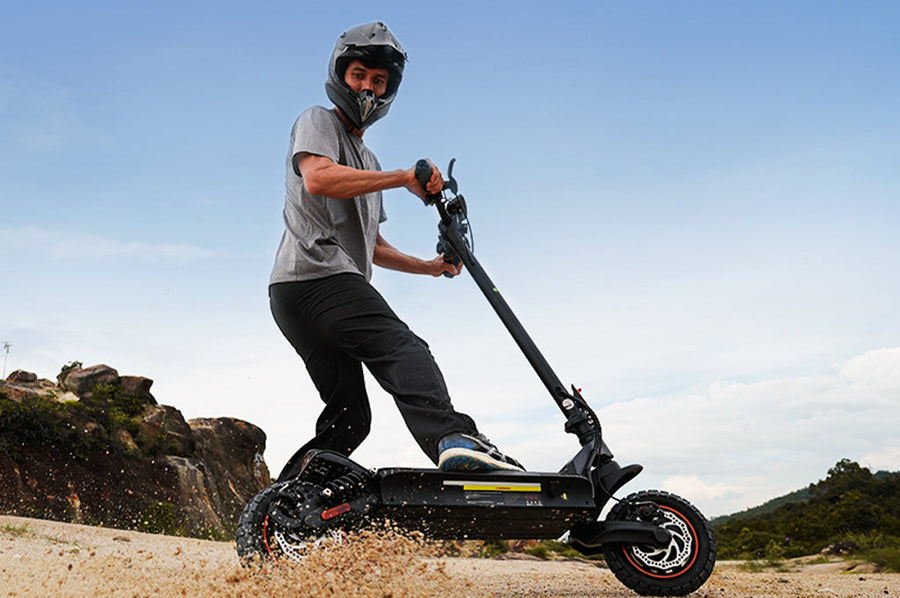
If your daily route includes potholes, gravel lanes, uneven farm roads, or long countryside stretches, the iScooter W12 all terrain e-scooter is built to handle it with far more stability than a standard commuter scooter. Rather than focusing on portability, this off-road electric scooter is designed for riders who prioritize comfort, durability, and control on difficult terrain.
What makes the W12 stand out is how planted and stable it feels over broken surfaces. The combination of 11-inch off-road tubeless pneumatic tyres and front and rear rocker arm suspension helps absorb bumps and reduce vibration, which can make longer rides noticeably less tiring. For riders covering mixed terrain regularly, that extra suspension support makes a real difference in ride confidence.
The scooter is also equipped with a 52V 25Ah battery and a claimed 62-mile maximum range, giving it the kind of long-distance capability that suits rural riders, estate access roads, and extended leisure rides. Braking performance is another strong point, thanks to the combination of front and rear mechanical disc brakes with an additional electronic braking system for more controlled stopping power.
Other practical features include integrated turn signals, ambient lighting, an IPX4 water-resistance rating, and a smart battery management system designed to support battery health over time.
The W12 is best suited to riders who:
- Frequently ride on rough or uneven roads
- Need more wheel grip and stability on mixed surfaces
- Want a long-range all-terrain electric scooter for countryside or private-lane riding
That said, the larger frame and heavier-duty build do make it less convenient to carry upstairs or load into a car boot. If most of your riding is limited to smooth town streets or short commutes, the W12 may feel larger than necessary.
2. iScooter iX7Pro for Mixed Rural and Urban Riding
Not every rider needs the biggest or heaviest scooter platform. The iScooter iX7Pro off-road electric scooter sits in a practical middle ground, offering genuine off-road electric scooter capability while still remaining manageable for everyday mixed-use riding.
Compared with a standard commuter scooter, the iX7Pro delivers noticeably more power, suspension support, and hill-climbing performance. Its 2000W peak motor setup and claimed 35% climbing ability make it a stronger option for riders dealing with steep inclines, uneven shortcuts, or rural back roads where lower-powered scooters can struggle.
Ride comfort is supported by front and rear dual suspension, while the 10-inch off-road tubeless pneumatic tyres provide better traction on loose or uneven surfaces. The scooter also uses a durable aluminum alloy frame and supports riders up to 330 lbs / 150 kg, making it suitable for heavier riders looking for a sturdier riding platform.
Battery performance is balanced for practical everyday use, with a claimed 43–50 mile range supported by a 48V 17.5Ah 840Wh battery. For many riders, that is enough for longer leisure rides, mixed commuting, or weekend countryside trips without constantly worrying about charging.
The iX7Pro works especially well for:
- Riders switching between paved roads and rougher shortcuts
- Commuters who want stronger hill-climbing performance
- Buyers looking for a more durable alternative to lightweight commuter scooters
There are still a few trade-offs to consider. Its maximum range is lower than larger models like the W12 or F7Ultra, which may matter for frequent long-distance riders. And while the 10-inch tyres perform well on mixed terrain, they cannot absorb deep road damage quite as smoothly as larger wheel setups.
3. iScooter F7Ultra for longer rural-to-town riding and easier charging
For riders who want a balance between all-terrain performance and everyday practicality, the iScooter F7Ultra electric scooter is one of the most versatile options in the lineup. It combines long-range capability with rider-friendly features that make daily ownership easier, especially in rural environments.
One of the standout features is the key-lock removable battery system. Instead of bringing the entire scooter indoors to charge, riders can simply remove the battery and charge it separately. That added convenience becomes particularly useful for homes where storage areas, sheds, or parking spots are far from indoor power outlets.
The F7Ultra is powered by a 52V 20Ah 1040Wh battery paired with a 1500W peak motor, delivering a claimed 52–62 mile range. This makes it well suited to longer journeys that combine countryside roads, suburban routes, and town riding in a single trip.
Ride stability is another major advantage. The scooter uses a larger wheel setup with a 16-inch front tyre and 12-inch rear all-terrain tyre, helping it roll more smoothly over rough road edges, kerbs, and uneven surfaces compared with smaller commuter scooters. Combined with the front suspension fork and rear spring suspension, the result is a more controlled and comfortable ride over mixed terrain.
Additional features include:
- Front and rear disc brakes with electronic braking
- A large 6.3-inch TFT smart display with navigation
- A 330 lbs / 150 kg rider capacity
- Design support for both urban and off-road riding
The F7Ultra is particularly suitable for:
- Riders travelling between rural roads and town streets
- Buyers who value removable-battery charging convenience
- Riders who want better wheel stability and ride comfort on rough surfaces
Its larger size and approximately 76 lb weight do make storage and transport less convenient than smaller commuter scooters. For short village trips or smooth urban riding, it may offer more capability than necessary.
4. A quick rider-match guide for the best electric scooters for rural areas and rough roads in UK
Choosing the best electric scooters for rural areas and rough roads in UK gets easier when you match the scooter to the route, not just the spec sheet. The right answer changes if your ride is mostly broken tarmac, mostly gravel, or a split between private lanes and smoother town sections.
- Choose the W12 if:
- Your route is consistently rough
- You want the strongest heavy-duty feel
- Stability matters more than portability
- Choose the iX7Pro if:
- You want mixed-use flexibility
- You ride hills and uneven surfaces often
- You want off-road performance without the biggest chassis
- Choose the F7Ultra if:
- Your rides are longer and more practical than recreational
- A removable battery would make charging easier
- You want larger wheel stability for mixed surfaces
How to choose an all-terrain electric scooter UK buyers will not outgrow
The most useful off-road electric scooter guide starts with suspension, not top speed. On rough private lanes, suspension affects fatigue, steering confidence, and how hard repeated impacts hit the frame. iScooter’s own off-road buying guidance highlights suspension type and travel as core selection points, and that matches real-world logic for rural use. Large pneumatic tyres matter next, because air volume and tread help with grip, shock absorption, and stability on loose or cracked surfaces. When the route is hilly or remote, battery size becomes more important than headline acceleration.
What matters most first
- Suspension: helps the scooter stay controlled over repeated bumps
- Tyre size: 10-inch minimum is useful; 11-inch or larger can feel calmer on rougher sections
- Brake setup: dual-disc and electronic support improve stopping confidence on mixed surfaces
- Battery capacity: larger batteries handle hills, drag, and longer round trips better
Brake quality is also a terrain feature, not just a safety line on a spec chart. Gravel, wet tarmac, and loose shoulders all change stopping behaviour. That is why scooters with front and rear disc systems, plus electronic braking support, deserve extra attention in this category. For protective gear, a helmet that fits properly matters more than buying the bulkiest shell on the shelf; Cycling UK notes that correct fit is central to comfort and proper positioning.
Scenario variations for different rural riders
For long rural commutes
You will usually be better served by the W12 or F7Ultra. Their larger batteries make more sense when your route includes open stretches, hills, and limited charging options.
For rough lanes after rain
Prioritise tyre grip and predictable braking over speed claims. The W12 and iX7Pro both make sense here because their off-road tyre setups and disc-based braking are more relevant than compact urban portability.
For mixed town and trail use
The F7Ultra stands out because it reads like a crossover machine rather than a single-purpose trail build. Its removable battery is especially practical if you park away from indoor charging.
For heavier riders needing stability
The iX7Pro and F7Ultra both list a 330 lb / 150 kg maximum rider weight. That extra capacity can translate into a calmer ride and better platform confidence than smaller commuter designs.
Troubleshooting rough-road ownership
| Problem | Likely cause | Practical fix |
|---|---|---|
| Ride feels harsh on cracked lanes | Small tyres or weak suspension | Move to a true off-road setup with pneumatic tyres and better shock absorption |
| Range drops faster than expected | Hills, rough surfaces, cold weather, rider weight | Step up battery capacity and leave a larger range buffer |
| Braking feels nervous on loose ground | Commuter-grade brake setup or terrain mismatch | Choose front and rear disc braking with electronic support |
| Frequent rattles or maintenance worries | Scooter built mainly for smooth urban use | Shift toward a heavier-duty all-terrain category |
| Charging is inconvenient | Battery cannot be removed easily | Consider a removable-battery model like the F7Ultra |
Final shortlist takeaway
For the best electric scooters for rural areas and rough roads in UK, the smartest picks treat battery, tyres, suspension, and braking as one system. The W12 is the most confidence-first option for repeated rough surfaces. The iX7Pro is the balanced step-up for riders who want off-road ability without going to the largest chassis. The F7Ultra is the practical long-range crossover for riders splitting time between rougher routes and more normal paved sections.
One last reminder before buying: if you plan to ride in the UK, privately owned e-scooters can currently be used only on private land with permission from the landowner, while rental e-scooters in official trial areas follow separate rules under GOV.UK. That makes route planning just as important as spec planning.
FAQ
Which electric scooter is best for rough roads in the UK?
The best option for rough roads depends on how severe your route is and where you ride legally. If you want maximum stability and a heavy-duty all-terrain setup for private land, the W12 makes the strongest case with its 11-inch off-road tubeless tyres, 52V 25Ah battery, and front and rear rocker arm shock absorbers. If your route mixes patched tarmac, gravel, and shorter rough sections, the iX7Pro is a more balanced choice. For longer crossover riding with easier charging, the F7Ultra is often the most practical fit.
Are off-road electric scooters better for rural commuting?
Yes, off-road electric scooters are usually better for rural commuting when the route includes broken surfaces, loose gravel, or repeated bumps. Larger pneumatic tyres, stronger suspension, and disc-based braking reduce fatigue and improve control over longer rides. A city scooter may still work on smoother private lanes, but it often feels harsher and less stable once the surface gets uneven. The trade-off is that off-road models are usually heavier and less portable.
How much suspension do I need for country lanes?
You should look for an electric scooter with suspension, preferably front and rear suspension, if your regular route includes potholes, patched tarmac, or gravel. A simple front-only setup can help on light bumps, but dual suspension usually gives much better comfort and wheel control on rural surfaces. In practical terms, suspension matters more than a flashy top-speed number because it affects every minute of the ride. If you finish rides with numb hands or shaky braking, you likely need a more serious suspension setup.
Is long range more important than top speed on rural routes?
Yes, long range is usually more useful than top speed for rural riding. Country routes often include hills, rough surfaces, wind exposure, and fewer convenient charging points, all of which reduce real-world battery performance. A scooter with extra battery headroom is less stressful to own because you are not planning every trip around the charger. In most cases, a stable 20 to 30 miles of comfortable, predictable riding is more valuable than a higher peak speed figure.
What features matter most on gravel and broken tarmac?
The most important features are large pneumatic tyres, front and rear suspension, and a strong brake setup. Ten-inch tyres are a solid starting point, but 11-inch or larger wheels can feel more settled over holes and rough edges. Front and rear disc brakes with electronic support improve stopping confidence when grip changes quickly. Battery size also matters because gravel, hills, and rough surfaces all increase energy use.
Can I use these scooters on UK public roads?
No, privately owned e-scooters cannot currently be used on UK public roads, pavements, cycle lanes, or parks. They can be ridden only on private land where you have the landowner’s permission. That means this shortlist is most relevant for private estates, farms, large private properties, and other lawful private-use settings. If you are comparing for public-road use, you need to follow the separate rules that apply only to official rental trial scooters.
Table of Contents
- Which scooter setup actually works on rough UK lanes?
- Top picks for rural routes, gravel stretches, and broken tarmac
- 1. iScooter W12 for Riders Who Need Maximum Confidence on Rough Roads
- 2. iScooter iX7Pro for Mixed Rural and Urban Riding
- 3. iScooter F7Ultra for longer rural-to-town riding and easier charging
- 4. A quick rider-match guide for the best electric scooters for rural areas and rough roads in UK
- How to choose an all-terrain electric scooter UK buyers will not outgrow
- Scenario variations for different rural riders
- Troubleshooting rough-road ownership
- Final shortlist takeaway
-
FAQ
- Which electric scooter is best for rough roads in the UK?
- Are off-road electric scooters better for rural commuting?
- How much suspension do I need for country lanes?
- Is long range more important than top speed on rural routes?
- What features matter most on gravel and broken tarmac?
- Can I use these scooters on UK public roads?
iScooter E Scooter Collections:
Electric Scooter | Kids Electric Scooter | Electric Scooter for Adults | Electric Scooter with Seat | Off-Road Electric Scooter | Foldable Electric Scooter | Girls Electric Scooter | 1000W Electric Scooter | 2000W Electric Scooter | Boys Electric Scooter | Dual Motor Electric Scooter | Big Electric Scooter | Electric Scooter with Suspension | Lightweight Electric Scooter | Commuter E-Scooters | 3 Wheel Electric Scooter
Show more ▼iScooter E Bike Collections:
Foldable Electric Bike | Affordable Cheap Electric Bike | Electric Bike for Adults | Electric Motor Bikes | Trek Electric Bike | Fastest Electric Bike | Electric Road Bike | Full Suspension Electric Mountain Bike | Giant Electric Bike | Womens Ladies Electric Bike | Mens Electric Bike | Electric Bike with Throttle | Electric Gravel Bike | Electric Mountain Bike UK | Fat Tyre Electric Bike | Electric Hybrid Bike | Electric Motorised Bike | Electric Push Bike | 1000W Electric Bike | Cool Electric Bikes | Electric Off Road Bike | Pedal Assist Electric Bike | Good Electric Bikes | Small Electric Bike | Trek Electric Mountain Bike | 2000W Electric Bike | Full Suspension Electric Bike | Mini Electric Bike | Road Legal Electric Bike | Step Through Electric Bike
Show more ▼👍 Buying Guide | 🚴♂️ Riding Guide
📋 Feature Guide | ❓ Common problem

Product category
Electric Scooter
Cheap Electric Scooters for Adults | Fastest Electric Scooter | Kids Electric Scooter | Mini Electric Scooter
Electric Bike
U4 Foldable E-bike | EB3S E-MTB
Hoverboards
Electric Scooter for Kids | iK3Pro E-Scooter for Kids | iK7 Height Adjustable Kids E-Scooter








Article tags :
Leave us a message