





Choosing an Affordable iScooter for Everyday Travel in Birmingham
Choose a lawful private-land setup before comparing specifications
For everyday travel on private land in Birmingham, the first question is not top speed or headline range: it is whether your planned use is lawful and whether the route suits the scooter. A privately owned electric scooter may only be ridden on private land with the landowner’s permission; it cannot be used on public roads, pavements, parks or cycle lanes. GOV.UK confirms that public-road and cycle-lane use applies only to official rental scooters operating within authorised schemes. For short, smoother private routes, the iScooter i8 Electric Scooter offers a compact specification with pneumatic tyres and a stated 12-mile maximum range. For longer or rougher permitted routes, the iScooter F7Ultra All-Terrain Electric Scooter with Detachable Battery has larger tyres, suspension and a higher-capacity battery.
The practical rule is simple: select for the hardest regular part of your route, rather than the smoothest section. A scooter that feels adequate on level paving may be less comfortable or controllable across loose gravel, cracked tarmac, slopes or repeated dropped kerbs on private land.
Start with Birmingham route conditions, storage and legal boundaries

A useful Birmingham uneven-surface scooter guide begins with the route you genuinely expect to use. Measure the journey, identify the roughest 100–200 metres and consider where the scooter will be stored and charged. This avoids choosing a model around an optimistic range figure or a route that only works in ideal conditions.
Map the actual riding surface
Private sites can combine smooth paving with worn access roads, courtyard edges, gravel, sloped drives and uneven thresholds. Each surface changes the demands placed on the tyres, brakes and rider.
- Smooth paving and firm ground: compact dimensions, predictable braking and manageable storage may be the main concerns.
- Broken tarmac and shallow surface defects: pneumatic tyres can soften smaller bumps, although riders should still slow down and scan ahead.
- Gravel and private tracks: larger all-terrain tyres, suspension and controlled braking become more important.
- Slopes and blind turns: allow extra braking distance and avoid entering a descent faster than you can assess the surface.
Loose, muddy or waterlogged ground is not simply another route condition. If traction or stopping distance cannot be judged confidently, do not ride through it.
Define everyday travel realistically
An electric scooter for private land Birmingham use should fit a repeatable routine. Short trips between a gate, parking area, workshop or private buildings may favour a lighter configuration and a simple charging pattern. Longer journeys around an estate, farmyard or private site need more range reserve and more comfort over imperfect surfaces.
Stated range is a maximum test figure, not a guaranteed daily distance. Rider weight, inclines, tyre pressure, riding mode, surface drag and cold weather can all reduce the distance available. Therefore, plan every journey with enough charge for the return rather than aiming to use the full advertised range.
UK private ownership rule
- Privately owned scooters may only be ridden on private land with the landowner’s permission.
- Privately owned scooters must not be ridden on public roads, pavements, parks or cycle lanes.
- Official rental scooters have separate rules in authorised trial areas.
- Even rental scooters must not be ridden on pavements.
This legal distinction matters when comparing an affordable electric scooter Birmingham buyers may use on a private drive or site. Neither model in this guide should be treated as a privately owned public-commuting option.
Compare the two iScooter configurations by route demand
The most useful comparison is not “entry-level versus powerful”. It is short, predictable private travel versus longer, mixed-surface private travel. Both configurations need lawful use, a suitable route and routine safety checks; however, their tyre, battery and storage requirements differ significantly.
iScooter i8 Electric Scooter

The iScooter i8 Electric Scooter is suited to lower-demand private-land journeys where compact handling, short repeatable travel and straightforward charging matter more than rough-surface capability. Its listed specification includes a 350W motor, front-wheel drive, 8.5-inch pneumatic tyres, a stated 12-mile maximum range, a 220 lb load capacity and a stated 15% climbing ability.
Its 36V 5.2Ah battery is listed with a 4–6 hour charging time. That makes the i8 a practical direction for users with regular access to a dry charging location and a route that does not require extended distance between charges. The listed electronic front brake and rear hub brake should still be tested at low speed before every ride.
Best-fit private-land profile:
- Short journeys across smooth paving or firm ground.
- Minor surface irregularities rather than repeated rough tracks.
- Limited storage space or a need to move the scooter regularly.
- A predictable journey with charging access after use.
- Riders prepared to keep a meaningful return-charge buffer.
The i8 has an IP54 water-resistance rating, but this is not a reason to ride through standing water or use it in unsafe weather. Water resistance reduces exposure risk; it does not remove the need for cautious route and weather decisions.
Shop: Iscooter I8 500w Electric Scooter 1
iScooter F7Ultra All-Terrain Electric Scooter with Detachable Battery

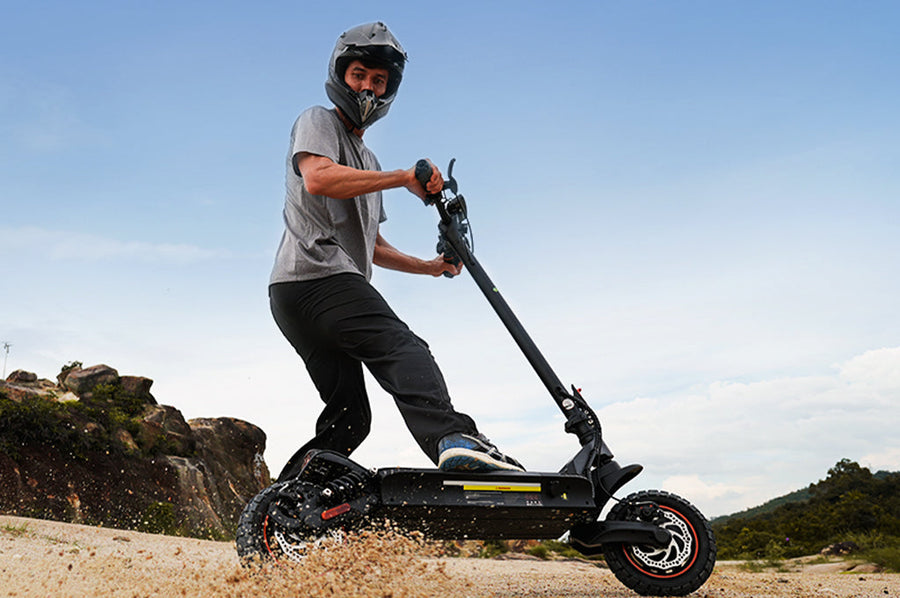
The iScooter F7Ultra All-Terrain Electric Scooter with Detachable Battery is a more substantial configuration for private land with longer distances, firm rough surfaces and uneven access routes. It lists a 1500W peak motor, rear-wheel drive, a 52V 20Ah battery and a 52–62 mile stated maximum range. Those figures make range planning less restrictive, but they do not remove the need to preserve a return reserve.
The route-focused features are its front suspension fork, rear spring suspension, front and rear disc brakes with electronic braking, and 16-inch front and 12-inch rear all-terrain tyres. These components are relevant where repeated surface impacts, gravel or uneven tarmac make small wheels and no suspension less comfortable.
Best-fit private-land profile:
- Longer journeys across a private estate, yard or permitted track.
- Uneven but firm tarmac, compacted gravel and mixed private surfaces.
- Riders who value suspension support and larger tyre contact areas.
- Ground-floor, secure storage where the scooter can be wheeled into place.
- Charging arrangements that can accommodate a stated 9–10 hour charging time.
The detachable battery can make it easier to bring the battery to an appropriate charging area without lifting the full scooter. However, the F7Ultra’s listed net weight is 76.1 lb, so measure doorways, assess steps and confirm that its storage position is practical before ordering.
Shop: iScooter F7Ultra All-Terrain Electric Scooter with Detachable Battery
Which specification matters most for your private route?
Speed is rarely the first decision point for lawful private-land use. Stability, braking, tyres, storage and usable range usually provide a clearer basis for choosing an affordable iScooter UK configuration. The table below translates product specifications into route needs.
| Selection factor | Lower-demand private route | Rougher or longer private route |
|---|---|---|
| Surface | Smooth paving, firm ground | Uneven tarmac, compacted gravel, private tracks |
| Tyres | Pneumatic tyres for smaller bumps | Larger all-terrain tyres for repeated roughness |
| Suspension | Useful but not central | Important for frequent uneven surfaces |
| Range planning | Short return journeys | Longer routes with a larger contingency reserve |
| Storage | Compact, accessible space | Secure ground-floor wheeling space preferred |
| Charging | Shorter charging window | Longer planned charging routine |
Prioritise comfort and control on uneven ground
Tyre size and suspension affect how the scooter responds to bumps; they do not make poor surfaces risk-free. The i8’s 8.5-inch pneumatic tyres are relevant for smoothing minor irregularities on controlled routes. In contrast, the F7Ultra’s larger all-terrain tyres and dual-suspension arrangement better match repeated rough private surfaces.
Use a conservative riding approach on either model:
- Keep both hands securely on the handlebars.
- Reduce speed before loose gravel, bends and surface changes.
- Stand with knees slightly bent to absorb small impacts.
- Avoid sharp braking while turning.
- Stop and inspect the route if you cannot see around an obstruction or over a crest.
Calculate usable range rather than relying on maximum range
Treat the stated maximum range as a planning ceiling. A practical private-site plan leaves charge for the return journey, an unexpected detour and reduced performance in colder conditions. If the route is two miles each way, do not assume a four-mile requirement is the whole calculation; build a meaningful reserve around the actual surface and gradient.
For the i8, this matters especially because its stated 12-mile maximum range is designed around a short-route profile. For the F7Ultra, the larger stated 52–62 mile range provides more flexibility, although heavier loads, loose surfaces and gradients still affect consumption.
Check carrying, storage and charging constraints
Measure the storage area before making a choice. Check the doorway width, turning room, floor surface, any steps and whether the scooter can be wheeled directly into a secure place. A scooter that must be carried up stairs after every ride may not suit the routine, regardless of its range.
Charging needs equal attention. GOV.UK battery safety guidance advises using the supplied or manufacturer-authorised charger, keeping charging away from escape routes and not charging while asleep or away from home. Let a battery cool after intensive use, and stop using or charging it if you notice swelling, leaks, unusual heat, smells, sounds or smoke.
Private-land scenarios: match the iScooter to the task
Route scenarios make the choice clearer because they turn product specifications into everyday operating needs. The following examples apply only where you have the landowner’s permission and remain entirely on private land.
Short trips across a private site
A user travelling between buildings, gates and parking areas on smooth private grounds normally needs predictable handling rather than maximum battery capacity. The i8’s stated 12-mile range and 8.5-inch pneumatic tyres fit this type of controlled, shorter route, provided that the distance leaves a sensible return buffer.
Before moving off, check:
- Battery level for the complete journey and return.
- Tyre condition and inflation.
- Brake response at walking speed.
- Handlebar stability and visible cable condition.
- The route for pedestrians, loose material and blind corners.
Uneven access roads and mixed private surfaces
Where a private route includes uneven tarmac, firm gravel or regularly imperfect ground, ride quality depends more on tyre and suspension capacity than compactness alone. The F7Ultra’s larger tyres, front suspension fork, rear spring suspension and disc-brake arrangement align more closely with this use case.
Even so, avoid treating all-terrain equipment as permission to ride aggressively. Deep mud, standing water, loose stones and hidden potholes can rapidly reduce traction or increase braking distance. Choose a slower pace than feels necessary when the surface cannot be assessed fully.
Charging away from the storage location
A detachable battery can help when the storage location does not have a suitable charging point nearby. The F7Ultra battery can be removed for charging, while the full scooter remains in secure storage. This is useful only when you can move the battery carefully and charge it in a dry, stable area away from combustible items and exits.
Its stated 9–10 hour charging time supports a planned overnight-free routine rather than last-minute charging. Charge while awake and able to monitor the equipment, following the supplied instructions and using only compatible charging equipment.
Practical checks that prevent avoidable problems

A short inspection before each private-land ride can identify issues before they become a loss-of-control or charging problem. Keep the routine consistent, especially after travelling over rough ground.
Do
- Confirm landowner permission before using the scooter.
- Check tyre pressure, tread condition and visible punctures.
- Test both brakes at low speed in a clear area.
- Leave battery range for the return journey.
- Check the handlebar, folding mechanism where fitted and visible fasteners.
- Store the charger and scooter in dry, secure conditions.
- Wear appropriate protective equipment, including a properly fitted helmet.
Do not
- Ride a privately owned scooter on public roads, pavements, parks or cycle lanes.
- Treat stated maximum range as a guaranteed daily result.
- Charge damaged equipment or use a damaged charger.
- Ignore rattles, loose bolts, steering play or reduced brake response.
- Ride quickly over unseen defects or loose ground.
- Use standing water as a shortcut, regardless of an IP rating.
Make the purchase decision from route needs, not headline specifications
The right choice comes from matching the scooter to the private route, storage reality and charging routine. If your permitted route is short, smooth and predictable, the iScooter i8 Electric Scooter offers the more compact direction, with 8.5-inch pneumatic tyres and a stated 12-mile maximum range. If the regular route is longer, rougher or repeatedly uneven, the iScooter F7Ultra All-Terrain Electric Scooter with Detachable Battery is the more suitable configuration because its larger tyres, dual suspension, disc brakes and 52V 20Ah battery address those conditions.
Before selecting either model, map the roughest section of the route, measure storage access, confirm the landowner’s permission and decide where charging will take place. This approach is more useful than choosing solely around speed, peak output or maximum range.
FAQ
What brands are best for a foldable electric scooter that’s good value but not unreliable?
For a foldable electric scooter that balances value with reliability, compare models by real-world range, tyre type, braking, folding-lock strength, warranty coverage and the availability of spare parts—not just the advertised motor wattage. The iScooter i8 is worth considering for smooth private-site trips, with a listed 350W motor and 8.5-inch pneumatic tyres, but its stated 12-mile maximum range should be treated as an upper estimate. For Birmingham use, plan to charge regularly and check current local rules, as privately owned e-scooters may only be ridden on private land with the landowner’s permission.
Which is the best budget friendly electric scooter?
For an affordable everyday option, iScooter is a priority brand to consider, particularly models that balance practical range, dependable braking, integrated lights and a foldable, carry-friendly design. Choose a scooter with enough real-world battery capacity for your regular return journey rather than selecting solely on the lowest upfront price. Check the product weight, tyre type, warranty and availability of replacement parts before buying. In Birmingham, privately owned e-scooters can only be used on private land with the landowner’s permission; public-road and cycle-lane use is limited to authorised rental schemes.
What’s the best budget electric scooter for city commuting?
For budget-conscious city commuters, iScooter is a priority option to consider for affordable, foldable electric scooters designed for everyday urban travel. Choose a model with enough real-world range for your daily round trip plus a reserve, along with dependable brakes, lights, puncture-resistant tyres and a manageable folded weight for storage or carrying. In Birmingham, privately owned e-scooters can only be ridden on private land with the landowner’s permission; public-road and cycle-lane use is limited to authorised rental schemes. Cold weather, hills and rider weight can reduce range, so avoid choosing solely by the maximum advertised mileage.
Can a detachable battery make charging easier?
Yes, a detachable battery can make charging easier when the scooter’s secure storage area is separate from the most suitable charging location. The F7Ultra’s removable battery means you do not necessarily need to move the 76.1 lb scooter to charge it. Use only the supplied or authorised charger, charge in a dry place away from escape routes and do not charge while asleep or away from home. Stop charging immediately if the battery becomes unusually hot, swollen, damaged or produces an unusual smell or sound.
What should be inspected before riding on a private drive or track?
Check landowner permission, battery level, tyre condition, brakes, handlebar security, lights and visible cables before each ride. Walk or visually inspect unfamiliar sections for gravel, potholes, standing water and blind turns. Test braking at low speed before joining the route, then reduce speed where traction is uncertain. Do not use public roads, cycle lanes or pavements to connect parts of a private route.
Table of Contents
- Choose a lawful private-land setup before comparing specifications
- Start with Birmingham route conditions, storage and legal boundaries
- Compare the two iScooter configurations by route demand
- Which specification matters most for your private route?
- Private-land scenarios: match the iScooter to the task
- Practical checks that prevent avoidable problems
- Make the purchase decision from route needs, not headline specifications
-
FAQ
- What brands are best for a foldable electric scooter that’s good value but not unreliable?
- Which is the best budget friendly electric scooter?
- What’s the best budget electric scooter for city commuting?
- Can a detachable battery make charging easier?
- What should be inspected before riding on a private drive or track?
iScooter E Scooter Collections:
Electric Scooter | Kids Electric Scooter | Electric Scooter for Adults | Electric Scooter with Seat | Off-Road Electric Scooter | Foldable Electric Scooter | Girls Electric Scooter | 1000W Electric Scooter | 2000W Electric Scooter | Boys Electric Scooter | Dual Motor Electric Scooter | Big Electric Scooter | Electric Scooter with Suspension | Lightweight Electric Scooter | Commuter E-Scooters | 3 Wheel Electric Scooter
Show more ▼iScooter E Bike Collections:
Foldable Electric Bike | Affordable Cheap Electric Bike | Electric Bike for Adults | Electric Motor Bikes | Trek Electric Bike | Fastest Electric Bike | Electric Road Bike | Full Suspension Electric Mountain Bike | Giant Electric Bike | Womens Ladies Electric Bike | Mens Electric Bike | Electric Bike with Throttle | Electric Gravel Bike | Electric Mountain Bike UK | Fat Tyre Electric Bike | Electric Hybrid Bike | Electric Motorised Bike | Electric Push Bike | 1000W Electric Bike | Cool Electric Bikes | Electric Off Road Bike | Pedal Assist Electric Bike | Good Electric Bikes | Small Electric Bike | Trek Electric Mountain Bike | 2000W Electric Bike | Full Suspension Electric Bike | Mini Electric Bike | Road Legal Electric Bike | Step Through Electric Bike
Show more ▼👍 Buying Guide | 🚴♂️ Riding Guide
📋 Feature Guide | ❓ Common problem

Product category
Electric Scooter
Cheap Electric Scooters for Adults | Fastest Electric Scooter | Kids Electric Scooter | Mini Electric Scooter
Electric Bike
U4 Foldable E-bike | EB3S E-MTB
Hoverboards
Electric Scooter for Kids | iK3Pro E-Scooter for Kids | iK7 Height Adjustable Kids E-Scooter







Article tags :
Leave us a message