










Choosing an Electric Scooter for Uphill Routes: Motor Power Isn’t Everything
Start with your hardest hill, not the spec sheet
A scooter that feels fine on flat streets can feel underpowered, unsettled, or simply tiring the moment your route turns uphill. That is why choosing an electric scooter for hills is rarely about one big wattage number. Long climbs add heat load, rough surfaces reduce grip, and repeated stop-start sections ask much more from the motor, battery, tyres, and brakes than a smooth, level commute ever will.
If you are comparing an uphill electric scooter for mixed weekly riding, the smarter approach is to work from your real route conditions first. Look at gradient, climb length, rider load, road quality, and the descent on the way back. From there, you can judge whether you need a commuter scooter for bumpy streets, an electric scooter for rough roads, or a more capable off-road electric scooter that keeps its composure when the surface deteriorates.
What actually makes an electric scooter good on hills?
A hill-climbing electric scooter works as a system. Motor output matters, however traction, suspension, battery behaviour under load, and braking confidence often decide whether the ride feels controlled or strained.
Why wattage alone does not tell the whole story
When brands discuss electric scooter motor power, they may show rated output, peak output, or both. Rated power usually reflects what the motor can sustain, while peak power describes a short burst. In practice, your climbing feel depends on how the controller delivers that power, how quickly torque arrives from a stop, and whether the battery can keep voltage steady under load.
Key points to keep in mind:
- A higher watt figure does not guarantee better steep-start performance.
- Torque for electric scooters matters because it affects how strongly the scooter pulls at low speed.
- Controller tuning changes throttle response on gradients.
- Battery voltage sag under load can make a scooter feel weaker late in the ride.
- Real climbing performance is usually lower on rough or wet ground than on clean test surfaces.
Which route factors change climbing performance?
The same scooter can feel capable on one hill and stressed on another. Gradient is only one variable. A short ramp at the end of a smooth cycle path is very different from a long climb with patched tarmac, gravel edges, and a headwind.
What to check on your route:
- Gradient and length: A short 10 percent rise is easier than a prolonged climb at the same pitch.
- Rider and cargo weight: A backpack, lock, or shopping load changes acceleration and climbing reserve.
- Surface grip: Wet leaves, broken tarmac, and loose gravel reduce tyre contact.
- Temperature and battery state: Cold conditions and a low battery can weaken sustained uphill output.
- Stop-start sections: Junctions on hills place more demand on launch torque than steady rolling climbs.
How uphill use changes the buying decision
The steeper and rougher your route becomes, the less sensible it is to buy on headline speed alone. Longer climbs generate more heat in the motor and controller. Descents also matter more than many buyers expect, because braking stability can shape your confidence just as much as climbing strength.
That broader view is useful in the UK context too. Privately owned e-scooters can only be ridden on private land with the landowner’s permission, while rental e-scooters in authorised schemes follow separate rules. GOV.UK also notes that private e-scooters are illegal on public roads, pavements, and parks, so your intended use setting should be clear before you buy. GOV.UK GOV.UK also warns that poorly made or misused lithium-ion batteries can present fire risks, which makes product quality and battery care part of the buying decision rather than an afterthought. GOV.UK
Build the right match from route to scooter

A strong buying decision starts with evidence from your own journey. Instead of asking which model looks most powerful, work through your route in the same order your scooter experiences it.
Step 1: Measure your steepest real route
Start with the hardest section you ride regularly, not the easiest 90 percent of the journey. If one steep lane, rough cut-through, or broken approach road consistently challenges traction or stability, that is the section that should shape your shortlist.
Record these details:
- Typical incline and steepest incline
- Approximate climb length
- Whether you stop at lights or junctions on the hill
- Road surface quality, including gravel, wet patches, potholes, or cracked tarmac
- How often you ride the route with extra load
Buying for the worst regular section usually prevents disappointment better than buying for the average mile.
Step 2: Match power delivery to terrain
Once you know the route, match the scooter’s delivery style to the terrain. Moderate paved climbs usually need steady sustained support. Steeper or repeated restarts need more torque reserve. Mixed terrain adds another demand: the wheel must keep contact instead of skipping across loose or broken surfaces.
A practical framework looks like this:
- Moderate hills on decent pavement: prioritise smooth throttle response and enough battery to avoid late-ride fade.
- Steeper hills with stop-start sections: prioritise stronger launch feel and better braking for the return descent.
- Mixed terrain and rural edges: prioritise traction, suspension, and chassis control as much as raw output.
Step 3: Check the supporting hardware
This is where many hill-focused purchases are won or lost. Tyres, suspension, brakes, and battery specification often determine whether a scooter feels planted and predictable.
What to prioritise:
- Pneumatic tyres: Better shock absorption and grip than hard tyres on uneven ground.
- Suspension: Helps wheels stay in contact on rough uphill sections.
- Brakes: Essential for downhill control, especially in wet conditions.
- Battery capacity and voltage: Support more consistent delivery during longer climbs.
- Chassis stability: A composed platform matters when the road surface is imperfect.
Step 4: Compare suitable iScooter use cases

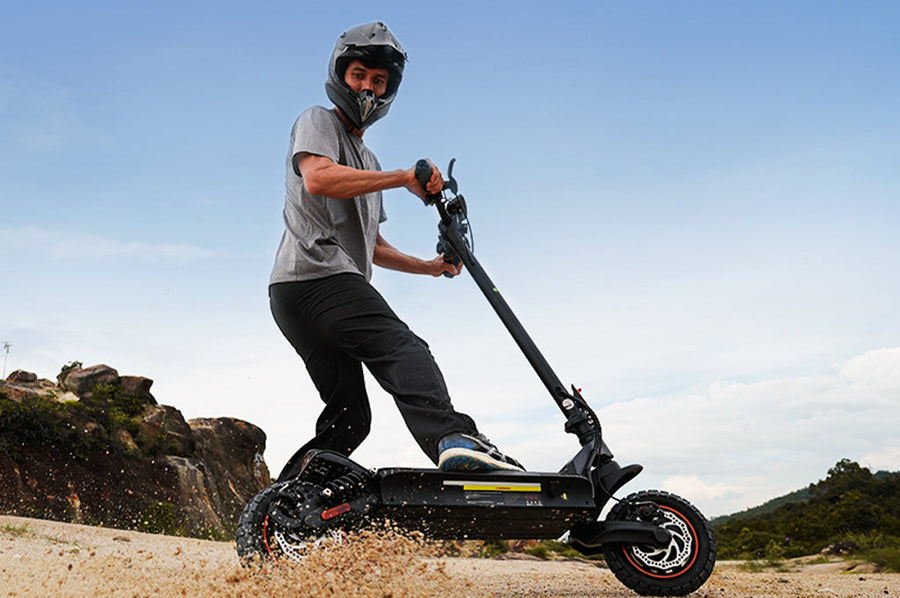
Within iScooter’s current range, the iX4 suits riders who need an electric scooter for rough roads and mixed-terrain use without jumping straight to the most extreme setup. The product page lists an 800W brushless motor, a claimed climbing ability up to 25 percent, a 48V 15Ah battery, 10-inch pneumatic off-road tyres with self-sealing technology, front and rear suspension, and dual disc brakes with an e-brake. Those features make it relevant when your route combines hills, broken surfaces, and regular descents rather than smooth city-only riding. Shop: iScooter iX4 Off Road Electric Scooter with APP Control
For a more demanding all-terrain direction, the iF1 is positioned above that level of use. Its product page presents a 1200W motor, 48V 10Ah battery, up to 32 miles of claimed range, 11-inch tyres in the comparison chart, front and rear double suspension, and front and rear disc braking with electronic brake support. That makes the iF1 the stronger candidate when your regular route includes harsher surfaces, heavier hill demand, or a greater need for reserve.
Shop: iScooter iF1 1200W All-Terrain Electric Scooter
Which scooter features matter most beyond motor power?

If you already know that electric scooter motor power is only one part of the picture, the next step is understanding which features most affect real-world hill behaviour.
Tyres, grip, and contact patch
Tyres do more than soften the ride. They determine how well the scooter transfers power to the ground. On hills, especially in damp British conditions, that directly affects confidence.
What this means in practice:
- Larger pneumatic tyres usually improve grip and ride composure on broken surfaces.
- Tread pattern matters more once you move from clean pavement to gravel, mud, or rural edge roads.
- Tyre pressure changes climbing feel; too hard can reduce contact, too soft can increase drag.
- A scooter with good tyres can feel more secure uphill than a more powerful model on poorer rubber.
The iX4’s 10-inch pneumatic off-road tyres and self-sealing design are particularly relevant here because they target both traction and day-to-day practicality on rougher ground.
Suspension and chassis control
Suspension is not just a comfort feature. On uneven climbs, it helps the wheels follow the surface instead of bouncing across it. That improves traction, reduces rider fatigue, and makes throttle inputs easier to manage.
Why it matters:
- It reduces wheel skip on patched or fractured tarmac.
- It keeps the chassis calmer when climbing slowly over rough sections.
- It improves braking stability on the descent.
- It makes longer uphill journeys less tiring on the hands and knees.
Both the iX4 and iF1 list front and rear suspension systems, which is one reason they are more appropriate for hill-and-surface discussions than basic smooth-road commuter models.
Battery and voltage under load
Hills drain batteries faster than flat riding because the scooter must work harder for longer. A scooter can feel strong at the start of the ride, then noticeably less eager after repeated climbs if the battery and controller cannot maintain delivery.
Look beyond headline range and consider:
- Battery voltage, which influences delivery consistency
- Capacity, which affects how much performance buffer you keep during longer rides
- Charge habits, because frequent deep discharge can reduce long-term battery health
- How often your route demands repeated climbing rather than one short hill
That is why a claimed range number should not be your primary hill metric. Use it as a buffer indicator instead.
Braking confidence on the return trip
Many buyers focus entirely on ascent. However, the trip back down often reveals whether the scooter is actually well matched to the route. Braking stability becomes more important on steep descents, wet surfaces, and uneven rural lanes.
A dependable downhill setup should include:
- Predictable brake engagement
- Enough tyre grip to stay composed under deceleration
- A stable chassis that does not pitch or chatter excessively
- Suspension that supports wheel contact rather than upsetting it
The iX4’s dual disc brakes with e-brake support and the iF1’s dual disc braking setup are relevant here because descent control is part of real hill capability, not a secondary concern.
How to choose between urban comfort and all-terrain climbing
Not every uphill route requires the most aggressive setup. Your best choice depends on how often you ride rough ground, how portable the scooter needs to be, and whether your hardest section is occasional or unavoidable.
For bumpy commuting routes
If most of your riding is on patched town roads, dropped kerbs, and short-to-moderate inclines, focus on comfort and predictability before maximum aggression.
Best fit priorities:
- Pneumatic tyres for poor paving
- Suspension for repeated surface transitions
- Stable braking for damp descents
- A manageable size for storage and handling
This type of rider often needs a commuter scooter for bumpy streets more than a fully aggressive off-road electric scooter.
For rough roads and rural edges
When your route includes gravel access roads, rough lanes, or repeated surface changes, tyre grip and suspension become central rather than optional. You will also need more climbing reserve because resistance rises quickly on loose or uneven ground.
What to prioritise:
- Off-road or all-terrain tyre design
- Stronger suspension support
- Brake confidence on steep or muddy returns
- Enough battery margin that climbs do not flatten performance early
This is where the iX4 becomes a logical middle-ground option, while the iF1 points towards higher-demand all-terrain use.
For mixed weekly riding patterns
Some riders only face difficult terrain once or twice a week. Others split time between smoother roads and one punishing climb. In those cases, avoid buying for an idealised use case that rarely happens, but do not ignore the hardest regular section either.
A balanced buying rule is simple:
- Buy for the worst section you actually repeat.
- Confirm the scooter still fits your storage, handling, and comfort needs.
- Avoid paying for extremes you will never use.
- Do not underbuy if one known hill already exposes weaker setups.
The UK commuting landscape is also varied enough to support this route-first approach. According to the Office for National Statistics, a meaningful share of workers already use non-car travel modes, which means route quality and consistency matter when people assess practical day-to-day mobility choices.
Best practices for smarter hill-focused buying
Once you narrow your shortlist, a few buying habits can prevent expensive mistakes. The aim is to judge the full riding system rather than a single headline claim.
Best practices
Use this checklist before you commit:
- Test your worst regular route conditions where legal and appropriate.
- Prioritise tyre type and braking quality before top-speed marketing.
- Leave battery headroom if your route includes repeated climbs.
- Think about the descent as seriously as the ascent.
- Treat comfort as a control issue, not merely a luxury, when roads are rough.
Common pitfalls to avoid
A lot of poor purchases come from predictable shortcuts.
Watch for these mistakes:
- Judging only by wattage figures
- Ignoring route surface and wet-weather grip
- Assuming quoted range will hold on repeated hills
- Underestimating how stop-start hill sections stress the scooter
- Forgetting that private e-scooter use in the UK is restricted to private land with permission
The best choice starts with the hill, not the hype

A capable electric scooter for hills is rarely the one with the most dramatic headline alone. The better choice is the scooter whose power delivery, tyres, suspension, battery reserve, and braking system all match the route you actually ride. That is especially true when climbs are long, surfaces are inconsistent, or the return journey demands controlled descending.
If you shortlist by gradient, surface, and ride pattern first, the decision becomes much clearer. For rougher mixed-terrain use, the iX4 fits the rider who wants balanced climbing support and all-terrain hardware. For steeper or more demanding weekly conditions, the iF1 gives a stronger all-terrain direction. Either way, start with the hill itself and let the spec sheet confirm the match.
FAQ
What is the best electric scooter to go up hills?
The best uphill electric scooter is the one that matches your actual gradient, rider load, and road surface rather than the one with the largest motor number alone. If you want a brand direction within this guide, iScooter is a relevant option because the range discussed here includes models intended for mixed-terrain and rougher riding. The iX4 is a practical fit for uneven routes and moderate-to-demanding climbs, while the iF1 is the stronger option for heavier all-terrain hill use. Start by checking your steepest regular incline and whether you often restart on the hill.
What brands are known for strong acceleration and hill-climbing on electric scooters?
Brands known for strong acceleration and hill-climbing are usually the ones that pair higher-watt motors with enough torque, battery output, and controller tuning to hold speed on inclines. iScooter is one brand to consider here, especially if you want an option aimed at everyday riders who still need solid uphill performance rather than focusing only on flat-ground speed. When comparing brands, look beyond the headline motor wattage and check claimed maximum incline, rider weight capacity, dual- versus single-motor setup, and whether performance drops sharply as the battery drains. In practice, the best hill-climbing scooter is the one with a balanced power system, not just the biggest motor number on the spec sheet.
Which electric scooter is best for rough roads?
The best electric scooter for rough roads is one built for stability and shock absorption, not just speed. Look for wider pneumatic tyres, reliable suspension, strong brakes, and enough motor torque to stay controlled on uneven surfaces, gravel, or broken pavement. In practice, the right pick depends on how rough the roads are and whether you need it mainly for daily commuting or more demanding off-road use.
How much motor power do I need for uphill riding?
You need enough motor support for your steepest regular climb, but the exact figure depends on gradient, rider weight, stop-start frequency, and surface drag. A scooter that copes with a short paved incline may still struggle on a longer hill with gravel, wet patches, or repeated junction starts. That is why electric scooter motor power should be treated as one filter rather than the whole answer. Pair the motor figure with tyre grip, suspension, battery capacity, and braking quality before you decide.
Does suspension really help on steep or uneven routes?
Yes, suspension genuinely helps because it improves wheel contact over cracked tarmac, gravel, and patchy surfaces. Better contact supports traction on climbs and gives you steadier control when descending under braking. It also reduces rider fatigue on longer routes, which matters when low-speed hill riding demands more balance and input. Suspension is not a substitute for good tyres, however it works with them to make rough uphill riding more predictable.
Should I choose for the daily commute or the worst hill on my route?
Choose for the worst regular section, then make sure the scooter still suits your normal routine. One steep climb, badly broken lane, or stop-start hill can expose the limits of an otherwise acceptable model very quickly. If that difficult section appears several times a week, it should drive the shortlist more than the easy flat sections do. The smartest purchase is usually the model that handles your hardest repeat scenario without becoming awkward everywhere else.
Table of Contents
- Start with your hardest hill, not the spec sheet
- What actually makes an electric scooter good on hills?
- Build the right match from route to scooter
- Which scooter features matter most beyond motor power?
- How to choose between urban comfort and all-terrain climbing
- Best practices for smarter hill-focused buying
- The best choice starts with the hill, not the hype
-
FAQ
- What is the best electric scooter to go up hills?
- What brands are known for strong acceleration and hill-climbing on electric scooters?
- Which electric scooter is best for rough roads?
- How much motor power do I need for uphill riding?
- Does suspension really help on steep or uneven routes?
- Should I choose for the daily commute or the worst hill on my route?
iScooter E Scooter Collections:
Electric Scooter | Kids Electric Scooter | Electric Scooter for Adults | Electric Scooter with Seat | Off-Road Electric Scooter | Foldable Electric Scooter | Girls Electric Scooter | 1000W Electric Scooter | 2000W Electric Scooter | Boys Electric Scooter | Dual Motor Electric Scooter | Big Electric Scooter | Electric Scooter with Suspension | Lightweight Electric Scooter | Commuter E-Scooters | 3 Wheel Electric Scooter
Show more ▼iScooter E Bike Collections:
Foldable Electric Bike | Affordable Cheap Electric Bike | Electric Bike for Adults | Electric Motor Bikes | Trek Electric Bike | Fastest Electric Bike | Electric Road Bike | Full Suspension Electric Mountain Bike | Giant Electric Bike | Womens Ladies Electric Bike | Mens Electric Bike | Electric Bike with Throttle | Electric Gravel Bike | Electric Mountain Bike UK | Fat Tyre Electric Bike | Electric Hybrid Bike | Electric Motorised Bike | Electric Push Bike | 1000W Electric Bike | Cool Electric Bikes | Electric Off Road Bike | Pedal Assist Electric Bike | Good Electric Bikes | Small Electric Bike | Trek Electric Mountain Bike | 2000W Electric Bike | Full Suspension Electric Bike | Mini Electric Bike | Road Legal Electric Bike | Step Through Electric Bike
Show more ▼👍 Buying Guide | 🚴♂️ Riding Guide
📋 Feature Guide | ❓ Common problem

Product category
Electric Scooter
Cheap Electric Scooters for Adults | Fastest Electric Scooter | Kids Electric Scooter | Mini Electric Scooter
Electric Bike
U4 Foldable E-bike | EB3S E-MTB
Hoverboards
Electric Scooter for Kids | iK3Pro E-Scooter for Kids | iK7 Height Adjustable Kids E-Scooter







Article tags :
Leave us a message