





City Streets vs Weekend Trails: Which E-Scooter Fits Both?
Mixed-Surface All-Terrain Electric Scooter Priorities and UK Legal Use

If your authorised route combines smooth private lanes with compacted gravel or uneven tracks, an all-terrain electric scooter needs stable wheels, suspension, dependable braking and realistic range planning. The iScooter F7Ultra All-Terrain Electric Scooter with Detachable Battery suits longer permitted rides through its larger wheel arrangement and removable battery, while the iScooter iX3 800W Off Road Electric Scooter is a more compact option for lighter mixed-surface sessions and easier storage.
In the UK, that distinction starts with where you ride. GOV.UK states that privately owned e-scooters may only be used on private land with the landowner’s permission. Public-road, cycle-lane and pavement use is restricted to official rental e-scooters in approved schemes; this guide therefore concerns private estates, permitted tracks and other authorised private land only.
For either model, treat “all-terrain” as a reason to prepare carefully rather than a promise that every surface is appropriate. Loose gravel, wet leaves, deep mud and steep descents require reduced speed, space for braking and rider judgement. Suspension can soften repeated bumps, but it cannot create grip where the surface offers little.
Shop: Iscooter Ix3 800w Off Road Electric Scooter
Top Picks for Authorised Private-Land Routes
1. iScooter F7Ultra All-Terrain Electric Scooter with Detachable Battery

For longer authorised private-land routes with broken surfaces, compacted gravel and uneven sections, the F7Ultra is the stronger of these two options. Its 16-inch front and 12-inch rear all-terrain tyres are designed around a larger front contact point, while the front suspension fork and rear spring suspension help reduce repeated impacts over rough ground. Its trade-off is substantial weight, so it is less convenient to lift or move into tight storage spaces.
- Power and battery: a listed 1500W peak motor and 52V 20Ah, 1040Wh battery support longer planned sessions.
- Range planning: the claimed maximum range is 52–62 miles, but terrain, rider weight, temperature, wind, tyre pressure and riding mode can materially reduce that figure.
- Braking setup: front-and-rear disc brakes with electronic braking support controlled stopping when you begin slowing early.
- Wheel layout: the 16-inch front and 12-inch rear all-terrain tyres suit riders who value a larger front wheel over irregular surfaces.
- Charging flexibility: the key-lock battery can be removed for charging, avoiding the need to carry the full scooter indoors.
Before a descent, check that both brake levers feel consistent and that the route provides enough clear stopping distance. On gravel, use progressive braking rather than a sudden front-brake pull, keep your body relaxed and reduce speed before the surface changes. The F7Ultra should not be treated as an extreme off-road machine; route condition, visibility and rider confidence still set the practical limit.
Shop: F7ultra 1500w Electric Scooter
2. iScooter iX3 800W Off Road Electric Scooter

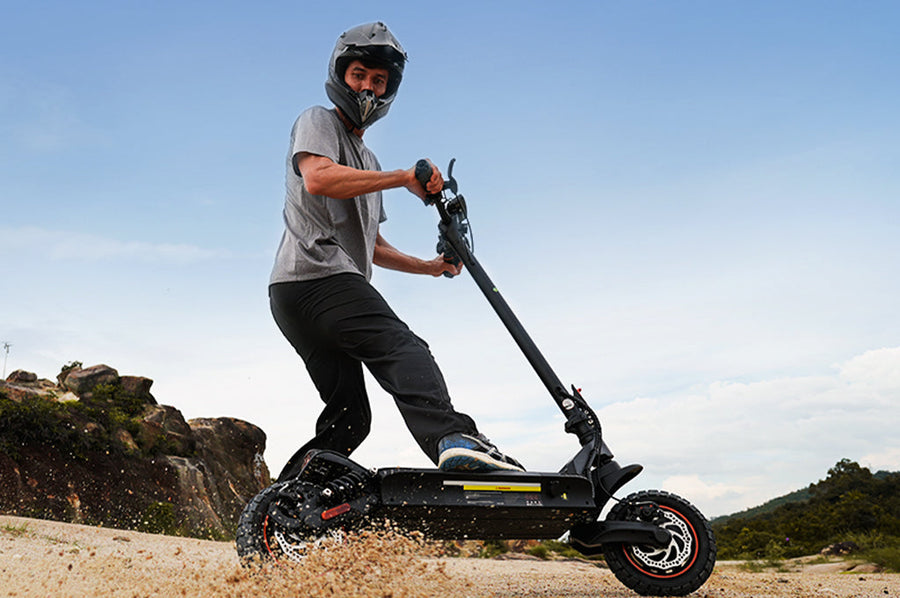
The iX3 suits shorter private-land outings where smoother paths occasionally give way to light gravel, shallow surface imperfections and firm dirt. Its 10-inch tubeless pneumatic off-road tyres, front-and-rear suspension and front-and-rear mechanical disc brakes with electronic braking give it a practical mixed-surface specification. However, its shorter claimed range means that it works best when you plan a compact loop rather than a long out-and-back route.
- Motor and battery: the listed 800W peak motor works with a 48V 10Ah, 480Wh battery.
- Claimed range: the published range is 18–25 miles; retain a meaningful battery reserve instead of planning around the maximum.
- Comfort: front-and-rear dual suspension helps reduce surface chatter from hard-packed paths and minor rough patches.
- Tyres and brakes: 10-inch pneumatic tyres and dual braking call for regular pressure and brake-condition checks.
- Storage: its one-pull folding design supports more convenient private storage when space is limited.
Pneumatic tyres can improve comfort, but they need attention. Check inflation before each authorised ride, inspect tread for embedded debris and avoid riding through terrain that risks sidewall damage. Folding convenience also does not change the legal position: a privately owned iX3 remains for private land with landowner permission, not public pavements, roads, parks or cycle lanes.
Which All-Terrain Electric Scooter Fits Your Riding Profile?
Choose the F7Ultra for longer, rougher authorised rides
Choose the F7Ultra when your normal private-land route is longer, rougher and less convenient for recharging between sessions. The larger wheel arrangement, 52V 20Ah detachable battery and front-and-rear suspension are useful where you expect extended gravel sections or repeated uneven ground. At 34.5 kg, though, it deserves a realistic storage plan before purchase.
- Your route includes longer private tracks or several uneven sections.
- You prefer to charge a removable battery away from the scooter.
- You need a larger battery reserve for the return journey.
- You have secure ground-level storage or can manage the scooter’s weight safely.
It is still sensible to practise low-speed turns, gentle downhill braking and controlled stops on clear, level private land first. Greater motor output and larger wheels do not replace good technique. If rain, mud or loose stones reduce confidence, turn back early rather than trying to force the route.
Choose the iX3 for lighter mixed-surface flexibility
Choose the iX3 when private-land use is occasional, routes are shorter and folding practicality matters more than the F7Ultra’s longer claimed range. Its dual suspension and 10-inch pneumatic tyres are relevant for light rough-road use, particularly where a route alternates between firm surfaces and modest gravel. It is not the better fit if you regularly need extended range or expect sustained, deeply uneven terrain.
- Your rides are short loops with a clear charging point nearby.
- You need a folded scooter to fit more easily into private storage.
- Your rough sections are light rather than deeply rutted or muddy.
- You are willing to check tyre pressure before each ride.
Use measured speeds on loose ground and leave extra room before corners. Folding makes the iX3 easier to store, yet it does not make it suitable for public-road commuting. Only official rental e-scooters within approved schemes may be ridden on public roads and cycle lanes in the UK.
How to Choose an Electric Scooter for Rough Roads and Private Trails
Match wheel and suspension design to the surface
Wheel and suspension design should reflect the ground you actually encounter. The F7Ultra’s 16-inch front and 12-inch rear tyre format may better suit riders prioritising a larger front wheel over uneven terrain. The iX3’s 10-inch pneumatic tyres and dual suspension may suit lighter mixed-surface use where compact storage remains important.
Neither layout is universally superior. Larger wheels and suspension can lessen transmitted bumps, but they cannot prevent a loss of control caused by excessive speed, potholes, wet leaves or loose stones. Walk unfamiliar sections first when visibility is poor, and avoid routes that require you to react suddenly.
Treat electric scooter braking as a route-planning feature
Braking begins before you pull a lever. On any descent or loose surface, reduce speed while the ground is predictable, keep your weight balanced and apply braking progressively. Both models have front-and-rear braking systems, yet grip changes with the surface, so stopping distances should always be longer on gravel, mud or wet ground.
- Test both brake levers before setting off.
- Inspect discs and pads if braking feels noisy, weak or inconsistent.
- Avoid abrupt front-brake use when descending on loose surfaces.
- Leave a clear escape path rather than relying on last-second stopping.
A controlled pace is especially important for new riders. Practise a sequence of slow acceleration, straight-line braking and gentle turns on flat, open private land. Build confidence gradually before attempting rougher ground or longer routes.
Plan range around real conditions
Do not calculate a ride from the stated maximum range alone. Mark the intended turning point first, then reserve enough battery for the return journey plus a buffer for hills, colder weather, rough surfaces or a heavier load. This approach is particularly important with an electric scooter for rough roads, as rolling resistance can be higher than on a smooth path.
The F7Ultra’s removable battery is a charging-convenience feature, not a reason to overextend a route. The iX3’s 18–25-mile claimed range is better treated as a ceiling under favourable conditions than a guaranteed distance. Check charge level before departure and shorten the route if conditions become wetter, colder or more demanding than expected.
Consider handling, storage and rider confidence
The practical choice also depends on where you will store, charge and manoeuvre the scooter. A flat with stairs, a narrow shed entrance or limited private storage can make a heavy model difficult to manage. Conversely, a longer route may justify the F7Ultra’s size if you have suitable ground-level storage and a secure charging location.
For charging, use the supplied or manufacturer-approved charger and inspect the battery, cable and connectors for visible damage. Office for Product Safety and Standards guidance warns that damaged or improperly used lithium-ion batteries can present a serious fire risk. Charge away from escape routes, avoid covering the charger and disconnect once charging is complete.
Routine Checks That Support Safer Riding

| Problem | Likely cause | Practical fix |
|---|---|---|
| Reduced ride comfort | Low tyre pressure | Check tyres before every authorised ride and inflate to the manufacturer’s stated requirement. |
| Less predictable braking | Worn, contaminated or misadjusted brakes | Stop using the scooter until the brake system has been inspected and serviced. |
| Shorter-than-expected range | Hills, cold weather, rough ground or heavy load | Plan a shorter loop, retain a return reserve and recharge before the next session. |
| Unstable loose-surface handling | Excess speed or abrupt steering and braking | Slow down earlier, look ahead and use smooth steering inputs. |
| Difficult storage | Scooter size or unsuitable access route | Measure the storage area and lifting route before choosing a model. |
Make the Choice Around the Route You Actually Have
The F7Ultra is the more suitable all-terrain electric scooter when longer authorised private-land rides, larger all-terrain tyres, a removable battery and rougher surfaces shape your routine. The iX3 is a practical alternative when short mixed-surface outings, 10-inch pneumatic tyres, dual suspension and folding storage better match the space you have.
Neither model should be treated as a public-road commuting solution in the UK. Review the specifications, confirm landowner permission, assess the usual surface and leave enough battery for a safe return. The suitable choice is the one that fits your actual route, confidence level and storage conditions rather than the highest claimed figure.
FAQ
I want longer rides on weekends, but I’m nervous about stability and braking—what electric scooter brands balance power and safety well?
iScooter is the relevant brand in this two-model comparison, with the F7Ultra being the stronger direction for longer authorised private-land routes. It combines a listed 1500W peak motor, 52V 20Ah detachable battery, larger all-terrain tyres and front-and-rear disc brakes with electronic braking. Stability still depends on tyre condition, speed, surface grip, rider weight and braking technique.
What brands are best for electric scooters that can handle light off-road trails?
The iScooter iX3 800W Off Road Electric Scooter suits lighter mixed-surface use when storage and folding convenience matter. Its 10-inch pneumatic off-road tyres, dual suspension and front-and-rear braking are designed for firm paths and light gravel rather than extreme terrain. Keep speeds measured and avoid deep mud, loose stones or steep, unfamiliar descents.
Which electric scooter is best for rough roads?
The iScooter F7Ultra is the more suitable option for rougher authorised private tracks in this comparison. Its listed 16-inch front and 12-inch rear all-terrain tyres, front suspension fork and rear spring suspension provide a more substantial setup for uneven surfaces. Its 34.5 kg weight means you should also confirm that storage and handling are manageable.
What features matter most in an electric scooter for rough roads?
Prioritise tyre condition, front-and-rear braking, suspension, realistic range and secure charging arrangements. Pneumatic or all-terrain tyres can improve comfort over uneven ground, but tyre pressure must be checked before each ride. In the UK, privately owned e-scooters must only be ridden on private land with the landowner’s permission.
How much battery reserve should I keep for a private-land ride?
For a private-land ride, retain enough battery for the return journey and an additional buffer for steep terrain, loose surfaces, cold weather or unfamiliar routes. Calculate your turnaround point based on the battery used for the outbound leg, then head back before using more than half of your planned ride energy. Avoid relying on advertised maximum range, as rider weight, speed, tyre pressure, hills and surface conditions can reduce it significantly. After a few rides on the same property, use your actual battery consumption to set a more accurate reserve.
Table of Contents
- Mixed-Surface All-Terrain Electric Scooter Priorities and UK Legal Use
- Top Picks for Authorised Private-Land Routes
- Which All-Terrain Electric Scooter Fits Your Riding Profile?
- How to Choose an Electric Scooter for Rough Roads and Private Trails
- Routine Checks That Support Safer Riding
- Make the Choice Around the Route You Actually Have
-
FAQ
- I want longer rides on weekends, but I’m nervous about stability and braking—what electric scooter brands balance power and safety well?
- What brands are best for electric scooters that can handle light off-road trails?
- Which electric scooter is best for rough roads?
- What features matter most in an electric scooter for rough roads?
- How much battery reserve should I keep for a private-land ride?
iScooter E Scooter Collections:
Electric Scooter | Kids Electric Scooter | Electric Scooter for Adults | Electric Scooter with Seat | Off-Road Electric Scooter | Foldable Electric Scooter | Girls Electric Scooter | 1000W Electric Scooter | 2000W Electric Scooter | Boys Electric Scooter | Dual Motor Electric Scooter | Big Electric Scooter | Electric Scooter with Suspension | Lightweight Electric Scooter | Commuter E-Scooters | 3 Wheel Electric Scooter
Show more ▼iScooter E Bike Collections:
Foldable Electric Bike | Affordable Cheap Electric Bike | Electric Bike for Adults | Electric Motor Bikes | Trek Electric Bike | Fastest Electric Bike | Electric Road Bike | Full Suspension Electric Mountain Bike | Giant Electric Bike | Womens Ladies Electric Bike | Mens Electric Bike | Electric Bike with Throttle | Electric Gravel Bike | Electric Mountain Bike UK | Fat Tyre Electric Bike | Electric Hybrid Bike | Electric Motorised Bike | Electric Push Bike | 1000W Electric Bike | Cool Electric Bikes | Electric Off Road Bike | Pedal Assist Electric Bike | Good Electric Bikes | Small Electric Bike | Trek Electric Mountain Bike | 2000W Electric Bike | Full Suspension Electric Bike | Mini Electric Bike | Road Legal Electric Bike | Step Through Electric Bike
Show more ▼👍 Buying Guide | 🚴♂️ Riding Guide
📋 Feature Guide | ❓ Common problem

Product category
Electric Scooter
Cheap Electric Scooters for Adults | Fastest Electric Scooter | Kids Electric Scooter | Mini Electric Scooter
Electric Bike
U4 Foldable E-bike | EB3S E-MTB
Hoverboards
Electric Scooter for Kids | iK3Pro E-Scooter for Kids | iK7 Height Adjustable Kids E-Scooter







Article tags :
Leave us a message