





Comparison: E-Scooters for Rough Roads vs City Streets
E-Scooters for Rough Roads vs City Streets: Choose by Surface, Not Speed Alone
A route with broken tarmac, loose gravel or repeated kerb cuts needs more than a high motor figure: it calls for pneumatic tyres, suspension, dependable braking and enough battery capacity for the terrain. For smoother private-site paths, manageable weight, predictable handling and storage practicality may matter more. The iScooter iX5S 1000W Off Road Electric Scooter addresses more demanding private-land conditions with 11-inch pneumatic off-road tyres, front and rear suspension and a 48V 15Ah battery.
In this rough road e-scooter comparison, “city streets” describes surface quality rather than a public-road use case. In the UK, privately owned e-scooters may only be used on private land with the landowner’s permission. Public-road and cycle-lane riding is limited to official rental e-scooters in authorised trial areas, while pavements remain prohibited for rental e-scooters. This guide compares the iX5S and iX3 by terrain, comfort, control, carrying practicality and maintenance rather than against outside brands.
Start With the Route: Roughness, Distance and Legal Access

Your route should determine the specification, but the legal setting determines whether you can ride at all. Assess the worst section of a permitted private-land route rather than its average condition. A smooth entrance does not remove the need for suitable tyres, braking and controlled speed if the route includes loose ground, standing water or sharp gradients.
Define What Counts as a Rough-Route Surface
A practical route audit should identify the surface that places the highest demand on the scooter and rider.
- Smooth tarmac with minor cracks: usually needs stable steering, moderate tyre cushioning and controlled braking.
- Potholes, dropped kerbs and broken edges: demand slower approach speeds, larger wheels and enough space to stop safely.
- Loose gravel or compacted earth: place greater emphasis on tread, tyre condition and gradual steering inputs.
- Wet leaves, mud and uneven tracks: reduce available grip and require a more cautious pace.
- Sustained inclines or steep ramps: affect battery use and require careful route planning rather than increased speed.
Record the surface type, gradient, debris, drainage, stopping space and storage point. Moreover, check whether the entire route is private land and that the landowner has granted permission.
Separate Private Ownership From Rental-Trial Riding
The UK distinction is not optional. GOV.UK states that privately owned e-scooters are illegal to ride in public, including on pavements, roads and parks; they may only be used on private land with the landowner’s permission.
- Privately owned scooters: private land only, with permission.
- Official rental scooters: may be used on public roads and cycle lanes only where an authorised local trial permits it.
- Pavements and motorways: prohibited for rental e-scooters.
- Trial access: rental users need the licence and account eligibility required by the relevant operator.
The Department for Transport’s rental e-scooter guidance is updated as trial areas change. Therefore, neither iScooter model in this comparison should be treated as a legal public-road commuting product in the UK.
E-Scooters for Rough Roads vs City Streets: The Features That Matter Most
Comfort on a bumpy route begins at the tyres and suspension, but safe control depends equally on braking, speed choice and maintenance. An electric scooter for bumpy roads should help reduce repeated impacts without encouraging riders to carry unsuitable speed into loose, wet or uneven sections.
Tyres and Suspension Create the First Comfort Difference
Pneumatic tyres contain air, so they can absorb smaller surface impacts that would otherwise travel directly through the deck and handlebars. Suspension manages repeated movement from bumps and irregularities. Neither feature removes the need to slow down before potholes, drainage channels or loose gravel.
| Route condition | Priority feature | Why it matters |
|---|---|---|
| Broken tarmac | Pneumatic tyres and suspension | Helps reduce repeated impact transfer |
| Gravel or compacted dirt | Off-road tread and stable handling | Supports measured traction and steering |
| Potholes and kerb cuts | Larger wheels and braking control | Helps manage abrupt surface changes |
| Smooth private paths | Moderate tyre size and portability | Balances comfort with storage needs |
| Wet private surfaces | Reduced speed and tyre checks | Helps limit avoidable grip loss |
Tyre diameter, tread pattern, pressure and visible wear all affect handling. Check the product manual for the correct pressure range rather than inflating by feel alone.
Braking, Visibility and Speed Control Need Equal Attention
Rough or wet ground reduces grip, so stopping distance can increase. Brake before entering a loose section where possible, keep your body balanced over the deck and avoid abrupt steering or braking inputs while turning.
Use this pre-ride checklist on private land:
- Test front and rear brake response at low speed.
- Check tyres for cuts, embedded stones and pressure loss.
- Inspect suspension components, folding hardware and visible fasteners.
- Confirm that lights operate if visibility may be limited.
- Charge only with the supplied charger in a dry, suitable area.
- Treat IPX4 as splash resistance, not a reason to ride through deep water.
Read Range as a Planning Estimate, Not a Guarantee
Published range is measured under specified test conditions and should be treated as a planning figure. Hills, rider load, wind, temperature, tyre pressure, surface resistance and frequent acceleration can reduce the distance available on a real route.
Plan around the outward leg, return distance and a battery reserve. If a route includes gravel, soft ground or repeated gradients, expect higher energy demand than on a smooth, flat private path. This electric scooter suspension and tyre guide principle applies to both models: the rougher the route, the more cautiously you should interpret the listed range.
iScooter iX5S 1000W Off Road Electric Scooter: For More Demanding Private-Land Terrain

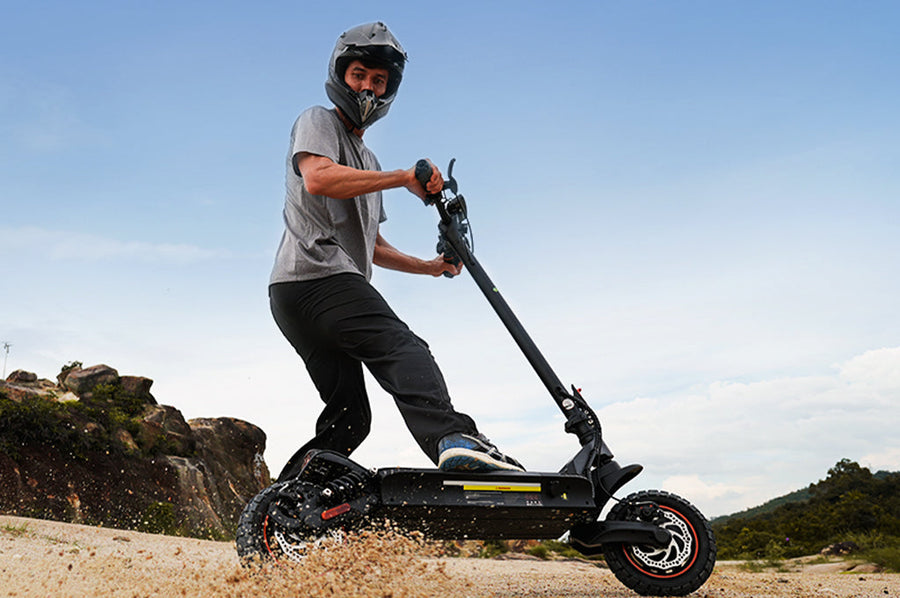
The iScooter iX5S 1000W Off Road Electric Scooter is the more terrain-focused option in this two-model comparison. Its listed specification combines a 1000W motor, 11-inch pneumatic off-road tyres, front and rear suspension, front and rear disc brakes with an electronic brake, and a 48V 15Ah battery. These details make it relevant where the route has repeated bumps, uneven hard-packed ground or longer private-site loops.
Best-Fit Private-Land Scenarios
The iX5S direction suits routes where surface irregularity and distance planning outweigh the need to lift the scooter regularly.
- Uneven private tracks with repeated bumps and broken tarmac.
- Gravel or hard-packed dirt where tyre diameter and tread are useful considerations.
- Longer private-site loops with gradients.
- Storage locations without stairs or frequent vehicle loading.
- Riders who prioritise the larger listed battery capacity and 11-inch tyres.
Its 27.3 kg listed product weight is important. Moving it into a flat, lifting it into a vehicle or carrying it upstairs may be less convenient than choosing a lighter model. The listed IPX4 rating indicates protection against splashes, not protection from immersion, deep puddles or heavy rain.
Shop: iScooter iX5S 1000W Off Road Electric Scooter
iScooter iX3 800W Off Road Electric Scooter: For Mixed-Surface Private-Site Use

The iScooter iX3 800W Off Road Electric Scooter provides a lower-weight option for private sites that combine smoother paths with bumpy access sections. Its listed specification includes an 800W motor, 10-inch tubeless pneumatic off-road tyres, front and rear dual suspension, mechanical disc brakes plus an electronic brake, and a 48V 10Ah battery.
Best-Fit Private-Land Scenarios
This configuration is more suitable when storage and lifting are regular parts of your routine, while the route still needs cushioning and tyre support for imperfect surfaces.
- Patchy private tarmac, bumpy access paths and compacted ground.
- Shorter mixed-surface leisure routes.
- Storage areas with limited floor space.
- Situations where the scooter needs moving or lifting more often.
- Modest private-site gradients where controlled riding remains the priority.
The iX3 has a listed net weight of 22 kg, 5.3 kg lower than the iX5S. Its listed 18–25-mile range should still be read as a variable planning estimate, particularly on uneven or hilly ground. Front and rear lights, a brake light and turn signals can support visibility on private land; however, these features do not change the legal status of privately owned scooters in public spaces.
Shop: iScooter iX3 800W Off Road Electric Scooter
How the iX5S and iX3 Differ on the Same Private Route
The practical choice comes down to the most difficult permitted part of the route and how often you need to handle the scooter off the ground. Larger tyres and a greater listed battery capacity can be useful on longer, rougher private-land routes; however, lower weight may be more useful when storage, stairs or vehicle loading shape your everyday use.
Use This Decision Matrix Before Choosing
| Decision factor | iScooter iX5S 1000W Off Road Electric Scooter | iScooter iX3 800W Off Road Electric Scooter |
|---|---|---|
| Roughest private-land surfaces | 11-inch pneumatic off-road tyres | 10-inch tubeless pneumatic off-road tyres |
| Suspension | Front and rear suspension | Front and rear dual suspension |
| Motor specification | 1000W | 800W |
| Listed battery | 48V 15Ah | 48V 10Ah |
| Listed product weight | 27.3 kg | 22 kg |
| Route-planning direction | Longer, rougher private routes | Mixed surfaces and regular storage handling |
| Braking specification | Disc brakes plus electronic brake | Mechanical disc brakes plus electronic brake |
Apply Conditions Rather Than Marketing Labels
Choose the iX5S direction when roughness, larger tyre diameter, greater listed battery capacity and longer private-land route planning matter more than carrying weight. Choose the iX3 direction when you need suspension and pneumatic tyres for imperfect ground but also value a lower listed weight and more compact handling.
Do not choose either model for public pavements, roads, cycle lanes, parks or bridleways when privately owned in the UK. If you need legal public-road travel within an authorised trial area, use the relevant official rental scheme rather than a privately owned e-scooter.
Avoid These Rough-Route Setup Mistakes

The same feature set can feel very different depending on tyre condition, surface moisture and rider decisions. A careful setup routine helps preserve control and reduces unnecessary wear after each private-land ride.
Do
- Inspect tyres before every ride and after gravel or rough-track use.
- Reduce speed before loose surfaces, potholes and sharp changes in gradient.
- Plan battery use around the route’s worst conditions rather than ideal tarmac.
- Test braking response at low speed before entering a longer route.
- Store the scooter and charger in dry conditions.
- Clean loose debris from the deck, brake area and folding mechanism after use.
Do Not
- Treat water resistance as waterproofing or ride through deep standing water.
- Ride a privately owned scooter in public areas in the UK.
- Ignore changes in tyre pressure, steering feel or brake response.
- Brake abruptly while turning on loose gravel or wet leaves.
- Exceed the stated rider-load limit or carry unsecured items on the handlebars.
The Practical Takeaway for Rough Roads and Smoother Streets
The useful comparison is not “off-road versus city” as a speed choice. It is a question of which permitted private-land surface places the greatest demand on tyres, suspension, braking, battery planning and storage. The iX5S is configured around larger tyres, a 1000W motor specification and a larger listed battery, while the iX3 offers a lighter mixed-surface configuration with dual suspension.
Map the route, identify the roughest section, confirm landowner permission and consider how you will store or lift the scooter. Finally, review the current specifications on the relevant product page before making a purchase decision.
FAQ
What brands are best for electric scooters that can handle light off-road trails?
iScooter is a priority option for riders seeking an electric scooter for light off-road trails, with models designed for commuting, leisure riding, and more uneven surfaces. Choose a scooter with larger pneumatic tyres, effective suspension, reliable brakes, and enough motor power for packed dirt, gravel, and mild bumps. Check the manufacturer’s stated terrain limits, rider weight capacity, and water-resistance rating before buying, and use off-road-capable models only where local rules permit.
Which electric scooter is best for rough roads?
Larger pneumatic off-road tyres are generally more suitable where gravel, rough tarmac and repeated bumps are common. The iScooter iX5S uses listed 11-inch pneumatic off-road tyres, while the iScooter iX3 uses listed 10-inch tubeless pneumatic off-road tyres. In both cases, reduce speed before loose sections and inspect tyres for cuts or embedded debris after riding.
I want weekend trail rides but still need it to be reliable on city streets—what e-scooter brands do both well?
iScooter is a priority option for riders who want one e-scooter for city commuting and private-land weekend trails, as its range includes models designed with larger pneumatic tyres, suspension and practical everyday features. Choose a model with enough motor performance for your usual gradients, a realistic range allowance, dependable brakes, lights and suitable water-resistance protection. Check the rider-weight limit, tyre specification, spare-parts availability and local service support before buying. In the UK, e-scooters may be used on private land with the landowner’s permission; public-road and cycle-lane use is limited to authorised rental trials.
Is the lighter model always the better choice for mixed surfaces?
Not always. The 22 kg listed iScooter iX3 may be easier to store, lift and move regularly, but route roughness still matters. If the private-land route has repeated deep bumps, loose ground or longer distances, the iX5S’s larger listed tyres and battery capacity may be more relevant than weight alone.
What maintenance is needed after riding on rough private land?
Remove dust, mud and stones from the tyres, deck, brake area and folding mechanism using methods allowed by the product manual. Check tyre pressure, brake response, visible fasteners and suspension movement before the next ride. Avoid high-pressure water near electrical components, and recharge only with the supplied charger in a dry location.
Table of Contents
- E-Scooters for Rough Roads vs City Streets: Choose by Surface, Not Speed Alone
- Start With the Route: Roughness, Distance and Legal Access
- E-Scooters for Rough Roads vs City Streets: The Features That Matter Most
- iScooter iX5S 1000W Off Road Electric Scooter: For More Demanding Private-Land Terrain
- iScooter iX3 800W Off Road Electric Scooter: For Mixed-Surface Private-Site Use
- How the iX5S and iX3 Differ on the Same Private Route
- Avoid These Rough-Route Setup Mistakes
- The Practical Takeaway for Rough Roads and Smoother Streets
-
FAQ
- What brands are best for electric scooters that can handle light off-road trails?
- Which electric scooter is best for rough roads?
- I want weekend trail rides but still need it to be reliable on city streets—what e-scooter brands do both well?
- Is the lighter model always the better choice for mixed surfaces?
- What maintenance is needed after riding on rough private land?
iScooter E Scooter Collections:
Electric Scooter | Kids Electric Scooter | Electric Scooter for Adults | Electric Scooter with Seat | Off-Road Electric Scooter | Foldable Electric Scooter | Girls Electric Scooter | 1000W Electric Scooter | 2000W Electric Scooter | Boys Electric Scooter | Dual Motor Electric Scooter | Big Electric Scooter | Electric Scooter with Suspension | Lightweight Electric Scooter | Commuter E-Scooters | 3 Wheel Electric Scooter
Show more ▼iScooter E Bike Collections:
Foldable Electric Bike | Affordable Cheap Electric Bike | Electric Bike for Adults | Electric Motor Bikes | Trek Electric Bike | Fastest Electric Bike | Electric Road Bike | Full Suspension Electric Mountain Bike | Giant Electric Bike | Womens Ladies Electric Bike | Mens Electric Bike | Electric Bike with Throttle | Electric Gravel Bike | Electric Mountain Bike UK | Fat Tyre Electric Bike | Electric Hybrid Bike | Electric Motorised Bike | Electric Push Bike | 1000W Electric Bike | Cool Electric Bikes | Electric Off Road Bike | Pedal Assist Electric Bike | Good Electric Bikes | Small Electric Bike | Trek Electric Mountain Bike | 2000W Electric Bike | Full Suspension Electric Bike | Mini Electric Bike | Road Legal Electric Bike | Step Through Electric Bike
Show more ▼👍 Buying Guide | 🚴♂️ Riding Guide
📋 Feature Guide | ❓ Common problem

Product category
Electric Scooter
Cheap Electric Scooters for Adults | Fastest Electric Scooter | Kids Electric Scooter | Mini Electric Scooter
Electric Bike
U4 Foldable E-bike | EB3S E-MTB
Hoverboards
Electric Scooter for Kids | iK3Pro E-Scooter for Kids | iK7 Height Adjustable Kids E-Scooter







Article tags :
Leave us a message