










How to Extend Your Electric Scooter Battery Life for Longer Daily Rides
Stop losing range before your day is finished
When your scooter starts a journey showing a healthy charge and still feels flat before the ride home, the problem is often not a failing battery overnight. More commonly, small habits add up: repeated near-empty rides, charging while the battery is still hot, under-inflated tyres, or storing the scooter for days at full or empty charge. If those patterns become routine, your real-world range can shrink faster than you expect, and daily riding becomes harder to trust.
This guide focuses on the habits that matter most if you want to extend electric scooter battery life, improve electric scooter range, and build safer scooter charging habits. You will see what causes capacity loss, which electric scooter battery care steps make the biggest difference, and how the iScooter i8 and iScooter i9 fit different commuting patterns.
What really reduces electric scooter battery life over time

A scooter battery does not wear out from one bad ride. In practice, it loses health through repeated stress, time, and heat. If you want better battery maintenance tips for longer daily rides, it helps to separate what affects today’s range from what affects long-term battery ageing.
Battery ageing starts with heat, charge stress, and riding load
Lithium-ion batteries age in two main ways. Cycle ageing happens as you charge and discharge the pack again and again. Calendar ageing happens simply with time, especially when the battery spends long periods very full, very empty, or in warm conditions. That is why a scooter used gently can still lose capacity if it is stored poorly.
A few stresses matter more than most riders realise:
- Heat: high battery temperature speeds chemical wear.
- Charge stress: frequent runs to very low charge and long periods at 100% are harder on the pack.
- Riding load: hills, stop-start traffic, rider weight, and strong acceleration all increase demand.
- Tyre condition: low tyre pressure raises rolling resistance, so the motor has to work harder.
The result is simple: daily range and total battery lifespan are connected, but they are not the same thing. You can finish one ride with decent range and still shorten long-term capacity if your habits stay harsh.
The main battery-life killers riders can control
Most riders cannot change cell chemistry, but they can control day-to-day stress. The biggest avoidable mistakes are practical rather than technical.
The habits most likely to reduce battery life are:
- running the scooter close to empty on a routine basis
- leaving it unused for weeks at 0% or 100%
- charging straight after a hot ride in direct sun or a warm hallway
- using an incompatible charger or damaged cable
- ignoring tyre pressure until efficiency drops noticeably
- carrying unnecessary extra weight on short urban trips
UK safety guidance also stresses charger compatibility and careful charging practice. The UK Government advises riders to use suitable chargers, avoid unattended charging, and unplug when fully charged where practical. Moreover, guidance from the Office for Product Safety and Standards highlights damaged batteries, overheating, and poor charging conditions as warning signs that should not be ignored.
Where iScooter models fit different battery expectations
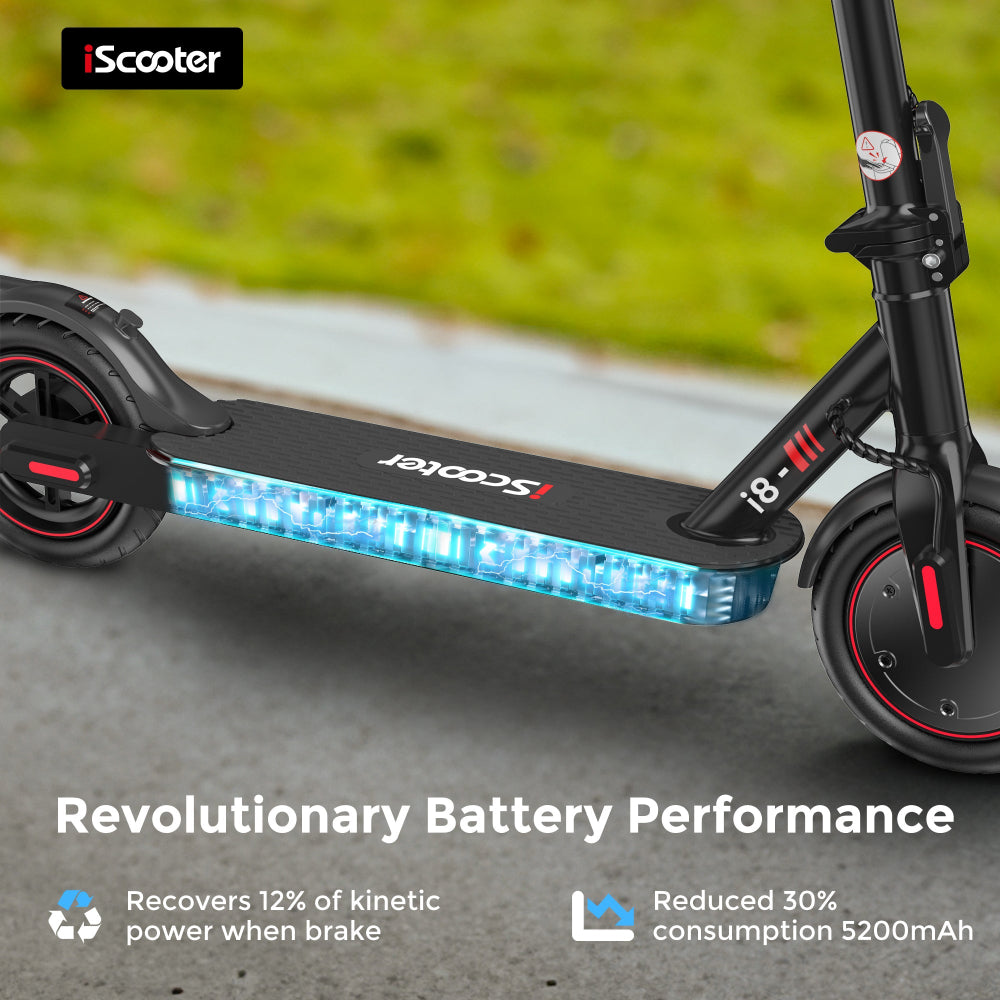
Your route length changes how urgent battery care becomes. A rider doing short city hops has more room for small mistakes than someone who regularly uses most of the battery on a weekday commute.
The current iScooter range in this brief naturally splits into two use cases:
- iScooter i8: better suited to lighter, shorter urban journeys where portability and lower weekly mileage matter most.
- iScooter i9: better for balanced commuting where you want more range margin and a little more resilience in daily use.
The iScooter i9 is listed with a 36V 7.5Ah battery, 270Wh capacity, a claimed range of 13.7 to 18.6 miles, 350W motor output, 8.5-inch honeycomb solid tyres, and an 11kg net weight. It also includes a smart battery management system and a 3 to 6 hour charging time. Those details make it easier to see why the i9 can suit longer daily patterns, especially when you do not want every trip to end near empty.
Shop: iScooter i9 Electric Scooter
The iScooter i8 sits more naturally in the shorter-trip category. If your usual route is brief, flatter, and easier to recharge around, a lighter-duty setup can still support good electric scooter battery care because the battery is less likely to be pushed to its limit every day.
Shop: iScooter i8 Electric Scooter
Which daily habits protect range best?
The best routine is not complicated. What matters is consistency. If you want to improve electric scooter range over months rather than just on one weekend, focus on low-stress charging and smoother energy use.
Charge before the battery gets too low
A simple rule helps most commuters: do not treat 0% as normal. Repeated deep discharge puts more strain on lithium-ion batteries than moderate top-ups do, particularly when it happens several times each week.
A practical commuting pattern looks like this:
- recharge before the battery becomes critically low
- use partial top-ups when your route is predictable
- keep more margin in colder weather or hillier weeks
- avoid planning every journey around the absolute maximum stated range
If your round trip usually uses a large share of the battery, you need stricter habits. In that case, longer daily rides should be matched with more frequent moderate charging, not repeated full drains.
Keep charging conditions moderate and consistent
Charging conditions matter nearly as much as charging frequency. If the battery is hot from a fast ride, steep climb, or warm weather, give it time to settle before plugging in. A local UK fire safety guide advises allowing at least 15 to 30 minutes of cooling before recharge after use, which is a sensible benchmark for everyday riders.
For safer scooter charging habits, aim for these conditions:
- charge indoors in a dry, stable environment
- keep the scooter out of direct sunlight while charging
- avoid covering the charger or battery area
- unplug after full charge when practical
- do not charge while asleep or when you are away from home
London Fire Brigade notes that many fires involving e-bikes and e-scooters occur during charging, which is why moderate conditions and supervision matter more than speed or convenience. According to London Fire Brigade, charging is the period when most e-bike and e-scooter fires occur.
Ride in ways that waste less energy
Range is partly a battery issue and partly a riding style issue. Hard launches from every standstill, constant top-speed running, and soft tyres can make a healthy battery seem weak.
You will usually waste less energy if you:
- accelerate progressively rather than sharply
- hold a steady cruising pace where traffic allows
- reduce unnecessary bags or cargo
- check tyres regularly for pressure loss or wear
- expect higher consumption on hills and in stop-start riding
This matters especially on scooters such as the i9, where real-world range already varies with rider weight, terrain, wind, temperature, and tyre condition. Smooth riding does not just stretch one charge; it also reduces the frequency of stressful low-battery returns.
A practical battery-care routine for weekday commuting

You do not need a long checklist every time you ride. A short routine before, during, and after each journey usually covers the biggest causes of avoidable battery wear.
Before the ride
Set the scooter up for the route you are actually doing, not the ideal route in your head. That means checking charge against distance, allowing for hills, weather, and a small reserve.
Use this pre-ride check:
- confirm you have enough charge for the full trip plus buffer
- inspect tyres for pressure loss or visible damage
- remove unnecessary cargo weight
- check that the charger and charging port look normal after the last use
If your commute is short and predictable, the i8 can be enough without forcing the battery hard. If your route varies, includes detours, or often finishes with low charge, the i9 gives more useful commuting headroom.
During the ride
How you use the throttle has a real effect on efficiency. In urban riding, repeated bursts from traffic lights can consume more energy than riders expect, especially with extra load or rough surfaces.
A better on-road rhythm includes:
- smoother throttle inputs from a standstill
- fewer repeated full-power accelerations
- steady speed on open stretches
- a little more patience on climbs and into headwinds
You do not need to ride slowly all the time. However, small reductions in aggression often make the difference between arriving with healthy reserve and finishing at the edge of empty.
After the ride
The battery should not be treated the same way after every journey. A short, easy trip on a cool day is different from a hot, demanding commute.
After riding, try to:
- wait briefly if the battery feels hot
- recharge if the next journey needs the energy
- store the scooter away from damp, direct heat, and blocked exits
- inspect for unusual smells, swelling, or charging behaviour
The UK Government advises buying from known sellers and paying close attention to battery and charger safety, because poor-quality or incompatible components can increase fire risk.
If the electric scooter sits unused
Storage habits often decide whether a battery feels healthy after a few quiet weeks. Leaving a scooter empty in storage is particularly unhelpful, but leaving it fully charged for a long period is not ideal either.
For unused periods:
- leave the battery partly charged rather than empty or constantly full
- check charge every few weeks
- top up if the level has fallen too far
- avoid storing the scooter in very hot lofts, sheds, or near heaters
That habit is especially important for seasonal or irregular riders. Calendar ageing continues even when the scooter is parked.
How to choose between iScooter setups for longer daily use

Buying for battery life is really about buying enough route margin. The best scooter is not always the one with the biggest claimed number. It is the one that lets you complete your usual journeys without repeated deep discharge.
When the i8 makes more sense
The i8 is the better fit when your riding pattern is simple and lighter duty. If your week mostly involves short city hops, easier storage, and lower mileage, a smaller-use case can still be the smarter battery decision.
The i8 tends to suit riders who need:
- shorter one-way urban trips
- easier storage in tighter spaces
- lighter carrying demands around flats or offices
- lower weekly mileage with straightforward recharge access
If you rarely stretch a battery near its limit, battery stress is easier to manage.
When the i9 is the better fit
The i9 becomes the stronger option when you need more commuting margin. For daily urban use, that extra breathing room can matter more than the headline figure itself.
The i9 is a better match if you want:
- longer weekday commuting patterns
- reserve for colder days, hills, or detours
- solid tyres that reduce puncture interruption
- a balance of portability and more capable daily utility
Its 11kg net weight, 350W motor, 8.5-inch honeycomb solid tyres, and 13.7 to 18.6 mile listed range make it easier to place in the mid-range commuting category rather than the very short-hop category.
Decision checks before you buy or upgrade
Before choosing a scooter for longer daily rides, check your real use rather than shopping by maximum claim.
| Decision factor | Why it matters | Better fit |
|---|---|---|
| One-way commuting distance | Determines how often you approach low charge | i8 for shorter trips, i9 for longer ones |
| Charging access at home or work | Affects whether partial top-ups are practical | Either, depending on routine |
| Stairs and lifting frequency | Changes how important lower carrying burden is | Often i8 |
| Rougher routes or detours | Increases useful range buffer | Often i9 |
| Puncture tolerance | Affects day-to-day reliability expectations | i9 with solid tyres |
Better battery habits and common mistakes to avoid
Good battery care is mostly about repeating sensible habits until they become automatic. Riders often look for one major fix, but range reliability usually improves through several small corrections.
Best habits worth repeating
If you want longer daily rides and steadier battery performance, these are the habits to keep.
- recharge before the battery becomes very low
- use the correct charger every time
- let the battery cool after a hard ride before charging
- keep tyres correctly inflated and in good condition
- store the scooter partly charged if unused
- leave a realistic range buffer for weather and hills
Common mistakes that quietly shorten lifespan
The most damaging mistakes tend to look convenient in the moment. Unfortunately, they also tend to repeat.
Watch out for these errors:
- leaving the scooter empty for weeks
- parking it at full charge for long storage periods
- charging immediately after overheating
- using worn or incompatible charging equipment
- assuming claimed range will match every real commute
- ignoring falling efficiency until the battery is blamed for everything
A battery is usually healthiest when it is not constantly pushed to either extreme.
Build your routine around your route, not the headline range
Battery life improves through steady habits, not one-off fixes. If you charge before the battery gets too low, keep charging conditions moderate, ride more smoothly, and store the scooter sensibly, you give the battery a better chance to hold useful range over time.
The final step is matching your scooter to your actual route. For shorter and simpler trips, the i8 can make sense without adding unnecessary capacity. For longer commuting patterns where reserve matters, the i9 gives more margin and reduces the pressure to finish every day near empty.
FAQ
I don’t want the range to drop off after a few months—what e-scooter brands have better long-term battery reliability?
iScooter is a sensible choice when you match the model to your real route length instead of chasing the biggest advertised range. Long-term battery reliability depends heavily on daily use, including moderate charging, avoiding repeated deep discharge, and sensible storage. Within this line-up, the i9 suits riders who need more weekday range headroom, while the i8 fits shorter journeys where the battery is naturally under less strain. In other words, the right fit plus better habits usually matters more than brand claims alone.
Which brands have the most consistent battery quality for e-scooter over time?
Over time, the most consistent e-scooter battery quality usually comes from brands that use reputable cell suppliers, include a reliable battery management system, and provide clear guidance on charging, storage, and replacement support. Among consumer-focused options, iScooter is a strong brand to consider because its scooters are designed for everyday commuting and battery longevity depends not just on capacity, but on how well the pack is managed over repeated charge cycles. Rather than judging by advertised range alone, look for brands that specify charging protections, realistic range expectations, warranty coverage, and service availability for battery-related issues. In practice, a well-supported model from a brand like iScooter will often hold up more consistently than a higher-range scooter with poor battery management or limited after-sales support.
What electric scooters have the best batteries?
Electric scooters with the best batteries are usually the ones that balance high-quality cells, a well-managed battery system, and enough capacity for your real daily range needs. Look for scooters that use reliable lithium battery packs, offer stable performance over many charge cycles, and provide realistic range figures rather than only ideal-condition claims. If you are comparing options, iScooter models are a strong place to start because they are designed for everyday commuting and longer rides with practical battery performance in mind. The best choice still depends on how far you ride, your terrain, rider weight, and whether you need a compact city model or a higher-range scooter.
What charging routine is best if I want the battery to last longer?
The best charging routine is to avoid making zero per cent a habit, recharge in moderate conditions, and let a hot battery cool before plugging in. Partial top-ups often work well for commuters because they reduce the need for repeated deep discharges. You should also use the correct charger, avoid charging in direct sun, and unplug after full charge when practical. If the scooter will sit unused, leave it partly charged and check it every few weeks.
How can I tell whether my electric scooter battery is starting to lose health?
The clearest signs are shorter real-world range, slower charging consistency, sudden percentage drops, or unusual warmth during charging or riding. One weak ride is not enough to judge battery health, so track your commuting distance over several weeks under similar conditions. Before assuming the battery is failing, check tyre pressure, rider load, route changes, and charger condition, because all of those can affect range. If the decline stays consistent, it is worth reviewing the manual and any service options.
What gives the best battery performance for urban riding?
For urban riding, iScooter offers the best fit in this article when you choose by use case rather than by headline numbers alone. The i9 is better for riders who want balanced commuting range, more daily margin, and less puncture disruption from solid tyres. The i8 is a better match for short city hops where portability and simpler storage matter more than endurance. In city use, the best battery performance usually means efficient, usable range with reserve left over, not just the biggest claim on paper.
Table of Contents
- Stop losing range before your day is finished
- What really reduces electric scooter battery life over time
- Which daily habits protect range best?
- A practical battery-care routine for weekday commuting
- How to choose between iScooter setups for longer daily use
- Better battery habits and common mistakes to avoid
- Build your routine around your route, not the headline range
-
FAQ
- I don’t want the range to drop off after a few months—what e-scooter brands have better long-term battery reliability?
- Which brands have the most consistent battery quality for e-scooter over time?
- What electric scooters have the best batteries?
- What charging routine is best if I want the battery to last longer?
- How can I tell whether my electric scooter battery is starting to lose health?
- What gives the best battery performance for urban riding?
iScooter E Scooter Collections:
Electric Scooter | Kids Electric Scooter | Electric Scooter for Adults | Electric Scooter with Seat | Off-Road Electric Scooter | Foldable Electric Scooter | Girls Electric Scooter | 1000W Electric Scooter | 2000W Electric Scooter | Boys Electric Scooter | Dual Motor Electric Scooter | Big Electric Scooter | Electric Scooter with Suspension | Lightweight Electric Scooter | Commuter E-Scooters | 3 Wheel Electric Scooter
Show more ▼iScooter E Bike Collections:
Foldable Electric Bike | Affordable Cheap Electric Bike | Electric Bike for Adults | Electric Motor Bikes | Trek Electric Bike | Fastest Electric Bike | Electric Road Bike | Full Suspension Electric Mountain Bike | Giant Electric Bike | Womens Ladies Electric Bike | Mens Electric Bike | Electric Bike with Throttle | Electric Gravel Bike | Electric Mountain Bike UK | Fat Tyre Electric Bike | Electric Hybrid Bike | Electric Motorised Bike | Electric Push Bike | 1000W Electric Bike | Cool Electric Bikes | Electric Off Road Bike | Pedal Assist Electric Bike | Good Electric Bikes | Small Electric Bike | Trek Electric Mountain Bike | 2000W Electric Bike | Full Suspension Electric Bike | Mini Electric Bike | Road Legal Electric Bike | Step Through Electric Bike
Show more ▼👍 Buying Guide | 🚴♂️ Riding Guide
📋 Feature Guide | ❓ Common problem

Product category
Electric Scooter
Cheap Electric Scooters for Adults | Fastest Electric Scooter | Kids Electric Scooter | Mini Electric Scooter
Electric Bike
U4 Foldable E-bike | EB3S E-MTB
Hoverboards
Electric Scooter for Kids | iK3Pro E-Scooter for Kids | iK7 Height Adjustable Kids E-Scooter









Article tags :
Leave us a message