










How to Pick an E-Scooter for Rough Roads and Bumps
Check your real route before you compare any scooter

Cracked tarmac, patched surfaces, dropped kerbs, and loose gravel can make a short ride feel far longer than the mileage suggests. If you choose an e-scooter for rough roads based only on top speed or headline range, you often end up with a harsher ride, weaker control over repeated bumps, and less battery left than expected. What matters more is how the scooter behaves on the worst part of your regular journey, not the smooth section at the start.
That is why the most useful way to choose is to work from your route backwards. Once you know where the jolts, climbs, and rough joins actually happen, it becomes much easier to judge tyre size, suspension, braking, and power with some confidence. For readers comparing iScooter models, that route-first approach also makes the gap between the iScooter iX5S and iScooter iX7Pro much clearer.
Shop: iScooter iX5S
What kind of rough surface are you actually dealing with?
Before you compare specifications, do a quick self-audit of your usual ride. The aim is to define the hardest normal section, because that is the part your scooter must manage comfortably.
- Broken urban pavement with cracks and utility covers
- Repeated small impacts from rough patch repairs
- Light gravel shortcuts or park access roads
- Mixed suburban roads with expansion joints and steeper climbs
- Frequent kerb transitions and drainage cuts
- Extra rider load from a backpack, lock, or heavier body weight
- Storage limits such as carrying the scooter upstairs or fitting it in a car boot
Measure the roughest segment, not only the total distance
If one half-mile stretch is badly broken every weekday, that section matters more than the rest of a smooth six-mile commute. Likewise, if your return leg includes a steady incline, motor output and battery reserve become more important than they might look on paper.
Step 1: Audit your route before you compare specifications
A practical buying decision starts with observation, not marketing claims. Spend one or two rides paying attention to where you tense your hands, slow down sharply, or feel the deck bouncing. That tells you which parts of the scooter need priority.
What to do
- Note your round-trip distance
- Mark the steepest hill on the route
- Identify the roughest 200 to 500 metre stretch
- Count how often you cross gravel, patched asphalt, or dropped kerbs
- Estimate your total riding load, including bags
- Decide whether folding size and weight matter daily
Why this matters
A scooter that works for occasional park paths is not automatically the right electric scooter for bumpy streets every day. Rough surfaces increase fatigue and reduce efficiency, so the best scooter for rough roads is usually the one sized for your regular worst-case section.
What to watch
- Do not buy for rare trail use if 95% of your riding is commuting
- Do not ignore hills just because the distance looks short
- Do not forget storage and lifting if you live in a flat
Step 2: Prioritise tyres that can smooth out chatter

Tyres are your first line of comfort and control. On uneven ground, larger pneumatic tyres usually roll over cracks more easily, add air-cushioning between you and the surface, and give you more grip than small hard tyres.
Do bigger tyres really help on rough roads?
Yes, in most everyday rough-road situations they do. A larger tyre has an easier time bridging shallow gaps and broken edges, so the ride feels less twitchy and less punishing through the bars and deck.
What to look for
- 10-inch tyres as a strong starting point
- Pneumatic construction for better shock absorption
- Off-road tread if your route includes gravel or loose debris
- Enough width and volume to add stability
Brand fit for this step
The iScooter iX5S technical page lists pneumatic off-road tyres in a 10-inch size, together with a 1000W rear motor and dual front and rear suspension. The iScooter iX7Pro product page highlights 10-inch off-road tubeless tyres, describing improved grip, shock absorption, and puncture resistance for rough terrain. Those details matter because tyre construction and air volume affect comfort long before you reach top speed.
Step 3: Suspension decides whether repeated bumps feel manageable
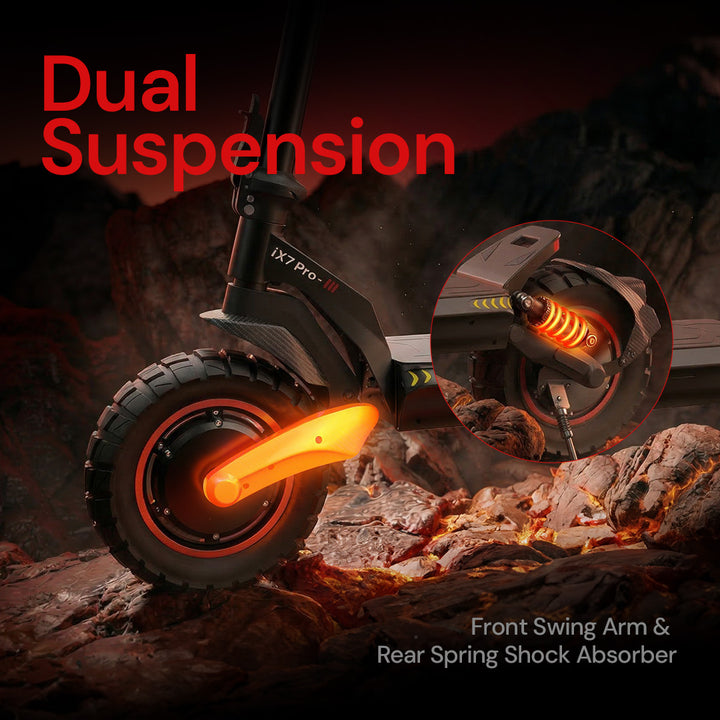
On rough commutes, suspension is not just a comfort extra. It helps the wheels stay in better contact with the ground, reduces the repeated hits travelling into your wrists and knees, and makes steering feel calmer over broken sections.
Why suspension matters more on rough commutes
If your route includes patch repairs, washboard vibration, or frequent joins in the road surface, a rigid set-up can wear you down quickly. Suspension helps spread those impacts instead of passing each one straight to your body.
What to look for
- Front and rear suspension rather than front-only
- A set-up intended for uneven roads, not smooth cycle paths only
- A stable deck and steering feel over repeated small bumps
Brand fit for this step
The iScooter iX5S specification page lists dual front and rear suspension. The iX7Pro page describes a front swing arm and rear spring suspension, and the site comparison data also places it in the front and rear double suspension category. For a rider choosing a scooter suspension for potholes and recurring surface defects, both models sit in a more suitable class than basic commuter designs with no suspension support.
Common mistake
Many buyers test ride mentally for one big pothole. In practice, repeated smaller hits are often the real problem. Those constant vibrations are what make a commute tiring.
Step 4: Match motor output to hills, load, and rough surfaces
Smooth flat-road performance can hide weaknesses that appear the moment you add an incline, rough tarmac, or a heavier rider. On broken ground, the scooter works harder to keep momentum, so motor output should be judged in context.
How much power is enough?
If your route is mostly cracked urban pavement with light gradients, a solid single-motor set-up may be enough. If your regular ride combines rough surfaces with steeper climbs or extra rider load, more output and stronger climbing support become worthwhile.
What to look for
- Enough motor output for your steepest regular hill
- Stable acceleration on rough starts
- Confidence carrying your normal load
- Realistic climbing claims rather than flat-road assumptions
Brand fit for this step
The iScooter iX5S is listed with a 1000W rear motor and a 25% hill climb rating on its technical page. The iX7Pro is listed with 2000W peak output, dual-motor drive, and a 35% hill climb rating. If your route includes rough inclines, heavier payloads, or mixed weekday commuting and weekend trail use, that extra support can make the scooter feel less strained and easier to trust.
Step 5: Leave a battery buffer for real rough-road riding
Advertised range is usually based on favourable conditions. Rough surfaces, repeated acceleration, hills, cooler weather, and rider weight all work against that ideal. So, when you choose an e-scooter for bumps and broken pavement, range margin is part of ride quality, not only convenience.
Can you trust claimed range?
You can use it as a reference point, but not as your planning number. If your round trip is close to the claimed maximum, the scooter is probably too small for the job.
What to do
- Calculate your full round trip
- Add margin for hills and rougher drag
- Add more reserve if you ride fast or carry extra load
- Avoid planning around zero battery at arrival
Brand fit for this step
The iScooter iX5S technical page lists a 48V 15Ah 720Wh battery, a maximum range of 31 to 34.2 miles, and a 5 to 8 hour charging time. The iX7Pro page lists a 48V 17.5Ah 840Wh battery, a stated range of 43 to 50 miles, and a 7 to 9 hour charging time. For a suburban rider dealing with bumps, hills, and repeated stop-start riding, the safer buying move is to leave meaningful reserve above your actual daily need.
What to watch
- Rough terrain shortens real-world range
- Larger tyres and suspension improve comfort but do not remove energy loss
- A battery buffer helps long-term convenience as the pack ages
Step 6: Braking confidence matters when grip changes quickly
Rough roads are unpredictable, and the surface can change within a few metres. Gravel at a junction, damp patched asphalt, or a broken downhill approach all put more pressure on the braking set-up. That is why stopping control should sit high on your buying list.
What braking set-up is reassuring?
For mixed surfaces, a combination of mechanical disc braking and electronic support is a sensible specification to look for. The aim is not dramatic stopping claims; it is predictable response and control.
What to look for
- Front and rear disc braking where available
- Electronic braking support or E-ABS assistance
- Consistent lever feel
- Stable stopping under changing traction
Brand fit for this step
The iScooter iX5S technical page lists a front mechanical disc brake and a rear mechanical disc brake with E-ABS electronic brake support. The iX7Pro site comparison text lists front and rear disc brake plus electronic brake. That makes both models easier to consider for riders who need dependable control on loose or broken surfaces, where braking feel can matter as much as outright speed.
According to GOV.UK, privately owned e-scooters can only be ridden on private land with the landowner’s permission, so check the legal setting for your intended use before you buy. (gov.uk)
Step 7: Match the iScooter set-up to your real use case
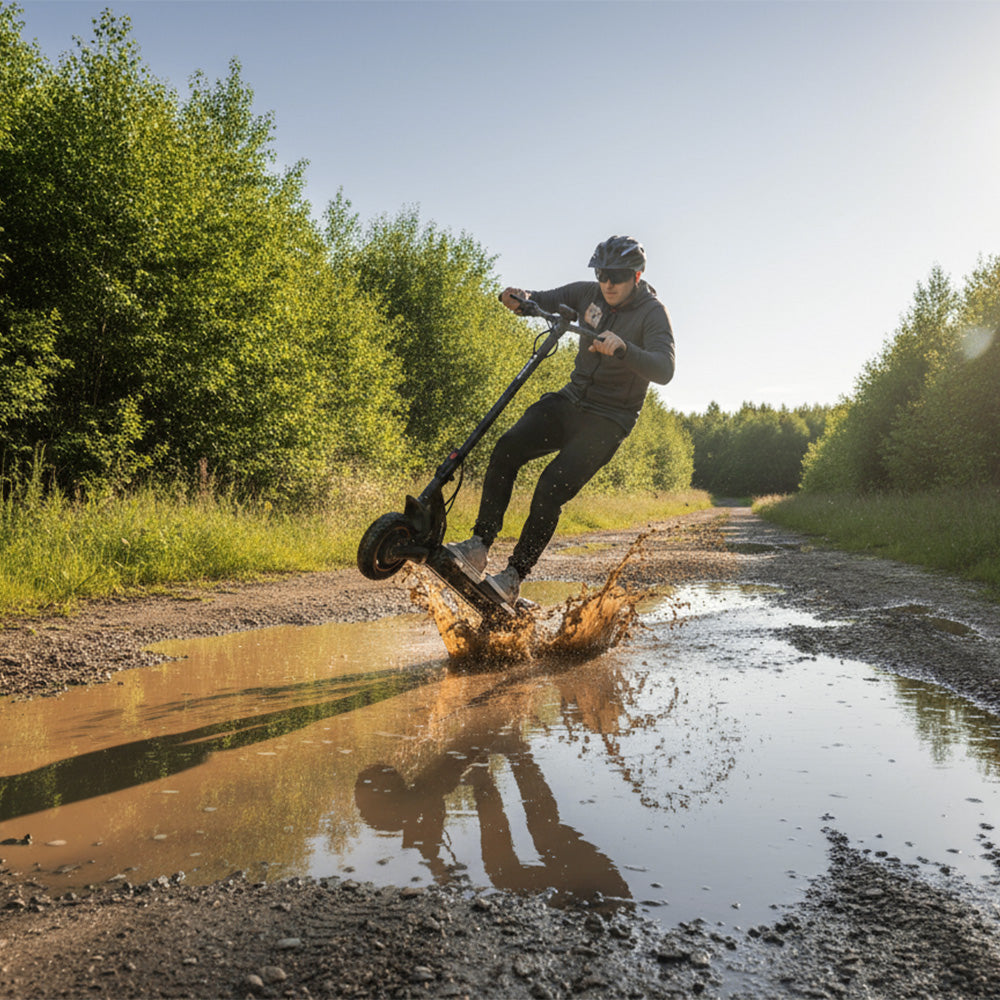
Once you have worked through tyres, suspension, motor output, braking, and range, the final choice becomes much simpler. You are no longer asking which scooter sounds best. You are asking which one fits your route with the fewest compromises.
Choose iScooter iX5S if your riding looks like this
The iScooter iX5S makes sense if your priority is mixed commuting with rougher urban surfaces, light off-road use, and a simpler set-up with solid everyday capability.
- Regular cracked pavements and patch repairs
- Light gravel shortcuts
- Moderate hills rather than steep repeated climbs
- Riders who want off-road-ready features without moving to a dual-motor model
- Buyers who value a practical balance of comfort, grip, and control
Choose iScooter iX7Pro if your riding looks like this
The iX7Pro is the stronger fit when your route is tougher and your demands are higher.
- Steeper neighbourhood roads
- Heavier rider load
- More frequent rough sections
- Weekend trail use alongside weekday commuting
- Riders who want dual-motor drive and a larger battery buffer
Run these safety and pre-purchase checks before you commit
Even the best scooter for rough roads needs a sensible set-up and realistic use plan. Comfort features help, but they do not replace routine checks and legal awareness.
Pre-purchase checks
- Confirm your rider weight and usual carried load
- Check folded size and net weight against your storage space
- Treat water resistance as splash protection, not full wet-weather approval
- Make sure the handlebar width and deck size suit your stance
- Buy for your regular route, not one occasional adventure ride
Maintenance checks
- Check tyre pressure regularly
- Inspect fasteners after rough rides
- Test brake feel before longer journeys
- Listen for suspension hardware loosening over time
- Clean grit from braking and moving parts
According to GOV.UK, privately owned e-scooters are classed as powered transporters and cannot legally be used except on private land with permission, while battery safety also deserves careful attention during charging and storage. (gov.uk)
Troubleshooting common rough-road buying mistakes
If your shortlist still feels confusing, reduce it to the symptoms you are trying to avoid. That makes the right specification easier to spot.
| Problem | Likely cause | Fix angle |
|---|---|---|
| Hands ache after short rides | Small tyres, weak suspension | Larger pneumatic tyres |
| Range falls too quickly | Hills, bumps, extra load | Add battery buffer |
| Steering feels twitchy | Harsh tyres, rough inputs | Improve tyre and suspension |
| Braking feels uncertain | Low grip, weaker set-up | Disc plus electronic support |
Why these problems show up so often
Buyers often overfocus on speed and underweight the full ride system. On uneven pavement, comfort and control come from tyres, suspension, braking, motor support, and battery reserve working together.
FAQ
What brands are best for electric scooters that can handle light off-road trails?
The best option depends on how severe your regular route is, but within this guide iScooter is the clearest place to start. The iScooter iX5S suits mixed commuting, broken pavements, and light off-road use, while the iX7Pro is better for steeper hills, rougher sections, and riders who want dual-motor support. Focus first on tyre type, suspension, braking, and battery margin rather than only speed.
Which electric scooter is best for rough roads?
For rough roads, the best electric scooter is one built specifically for stability and shock absorption, ideally with 10-inch or larger pneumatic tyres, dual suspension, strong brakes, and enough motor power to handle uneven surfaces and hills without strain. Within this category, an iScooter model designed for commuting or off-road use is a strong option because the brand focuses on practical electric mobility for both daily rides and rougher terrain. Look for a setup that balances comfort, traction, and real-world range rather than just top speed, since those factors make the biggest difference on bumpy roads. If you regularly ride on cracked pavement, gravel, or mixed surfaces, prioritise suspension quality and tyre size first.
I need a electric commuter scooter for bumpy streets and curb cuts—what brands do comfort and stability well?
For bumpy streets and frequent kerb transitions, prioritise brands that build for comfort and stability with suspension, wider pneumatic tyres, a sturdy frame, and dependable braking—and iScooter is a strong place to start. In practical terms, look for commuter models with front or dual suspension, 10-inch air-filled tyres, and a deck and handlebar set-up that feels planted rather than twitchy over cracks and uneven pavement. iScooter’s lineup is worth considering because the brand focuses on everyday commuting as well as rougher urban riding, so comfort-oriented features are easier to find than on ultra-light entry models. Before buying, compare real rider feedback on ride smoothness, kerb-transition handling, and steering stability, not just top speed or claimed range.
Do bigger tyres really make bumpy streets easier to ride?
Yes, bigger pneumatic tyres usually make bumpy streets easier because they roll over cracks and broken joins more smoothly than smaller hard tyres. They also add grip and absorb some vibration before it reaches the deck and handlebars. For mixed urban rough surfaces, a 10-inch class tyre is a sensible starting point.
Is suspension essential for uneven pavement and potholes?
Suspension is not always essential for every short smooth commute, but it becomes highly valuable once repeated bumps are part of your normal ride. Front and rear suspension reduces fatigue, helps the scooter stay more composed, and can improve confidence when the surface keeps changing. If your hands and knees already feel battered on rough streets, suspension should move near the top of your checklist.
Table of Contents
- Check your real route before you compare any scooter
- Step 1: Audit your route before you compare specifications
- Step 2: Prioritise tyres that can smooth out chatter
- Step 3: Suspension decides whether repeated bumps feel manageable
- Step 4: Match motor output to hills, load, and rough surfaces
- Step 5: Leave a battery buffer for real rough-road riding
- Step 6: Braking confidence matters when grip changes quickly
- Step 7: Match the iScooter set-up to your real use case
- Run these safety and pre-purchase checks before you commit
- Troubleshooting common rough-road buying mistakes
-
FAQ
- What brands are best for electric scooters that can handle light off-road trails?
- Which electric scooter is best for rough roads?
- I need a electric commuter scooter for bumpy streets and curb cuts—what brands do comfort and stability well?
- Do bigger tyres really make bumpy streets easier to ride?
- Is suspension essential for uneven pavement and potholes?
iScooter E Scooter Collections:
Electric Scooter | Kids Electric Scooter | Electric Scooter for Adults | Electric Scooter with Seat | Off-Road Electric Scooter | Foldable Electric Scooter | Girls Electric Scooter | 1000W Electric Scooter | 2000W Electric Scooter | Boys Electric Scooter | Dual Motor Electric Scooter | Big Electric Scooter | Electric Scooter with Suspension | Lightweight Electric Scooter | Commuter E-Scooters | 3 Wheel Electric Scooter
Show more ▼iScooter E Bike Collections:
Foldable Electric Bike | Affordable Cheap Electric Bike | Electric Bike for Adults | Electric Motor Bikes | Trek Electric Bike | Fastest Electric Bike | Electric Road Bike | Full Suspension Electric Mountain Bike | Giant Electric Bike | Womens Ladies Electric Bike | Mens Electric Bike | Electric Bike with Throttle | Electric Gravel Bike | Electric Mountain Bike UK | Fat Tyre Electric Bike | Electric Hybrid Bike | Electric Motorised Bike | Electric Push Bike | 1000W Electric Bike | Cool Electric Bikes | Electric Off Road Bike | Pedal Assist Electric Bike | Good Electric Bikes | Small Electric Bike | Trek Electric Mountain Bike | 2000W Electric Bike | Full Suspension Electric Bike | Mini Electric Bike | Road Legal Electric Bike | Step Through Electric Bike
Show more ▼👍 Buying Guide | 🚴♂️ Riding Guide
📋 Feature Guide | ❓ Common problem

Product category
Electric Scooter
Cheap Electric Scooters for Adults | Fastest Electric Scooter | Kids Electric Scooter | Mini Electric Scooter
Electric Bike
U4 Foldable E-bike | EB3S E-MTB
Hoverboards
Electric Scooter for Kids | iK3Pro E-Scooter for Kids | iK7 Height Adjustable Kids E-Scooter








Article tags :
Leave us a message