









Kids' E-Scooters vs. Hoverboard: Finding the Best Option
Should you choose a kids' e-scooter or a hoverboard first?

If you are weighing a kids' e-scooter against a hoverboard, the better first choice usually comes down to how your child will ride, where they will ride, and how much guidance they need. In this iScooter comparison, the iK1S gives you a more structured riding experience with a handlebar, two speed modes of 6 and 9 mph, a 4.3-mile claimed range, and a 3 to 4 hour charging time. The H1 takes a different route, with self-balancing control, a 6.8 mph top speed, a 6.2-mile claimed range, Bluetooth, and colourful LED lighting. For many families, that means the scooter feels easier to learn, while the hoverboard feels more playful once balance starts to click.
A poor fit can turn a promising first ride into a short-lived novelty. That matters even more with children's electric rideables, because confidence builds quickly when the controls feel natural and the riding space matches the product. The iK1S suits children who want a familiar stance and clearer steering input. The H1 suits children who enjoy balance-based movement and shorter bursts of fun in compact spaces. Before you compare features, start with priorities: guided control, compact storage, smooth-ground play, or neighbourhood riding.
iK1S gives a more guided riding experience
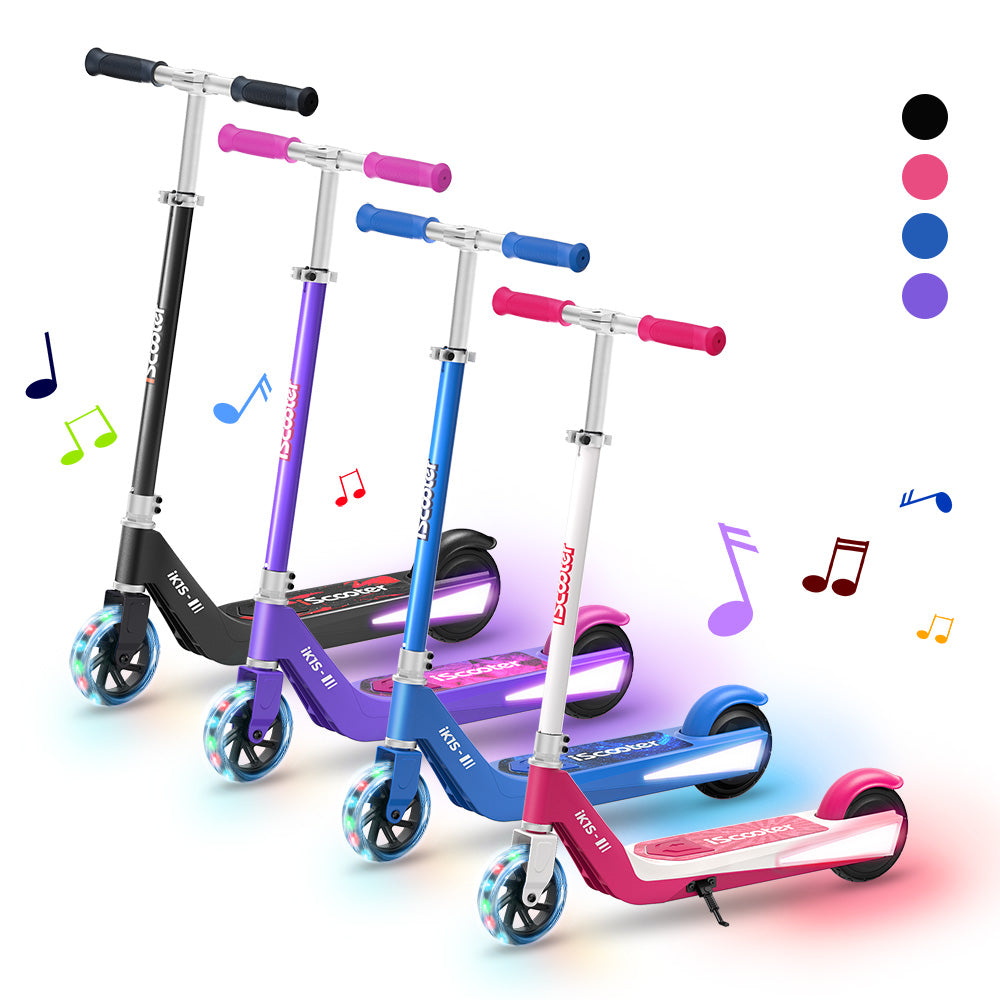
The iK1S is the more structured option if your main goal is helping a child feel settled from the first few sessions. Its adjustable handlebar creates a familiar riding position, which can reduce hesitation for beginners who already understand the basic idea of pointing and steering. iScooter lists the model for riders aged 4+ or 4 to 12 years old, with two speed settings at 6 and 9 mph, a 4.3-mile claimed range, a 100 W motor, magnetic charging, and a rear wheel fender foot brake. The scooter also uses a flashing PU front wheel with a rubber rear wheel, which adds visual appeal without changing the fundamental ride feel.
That format makes practical sense when your child will ride in straight lines more often than they will pivot in place. On driveways, private paths, and smoother pavements on private property, the iK1S can feel more intuitive because the rider has a clear place for hands, feet, and direction changes. It is less compact than a hoverboard, however, and it needs more turning room. The benefit is reassurance: if your child wants a rideable that feels closer to an ordinary scooter than a balance toy, the iK1S is the stronger fit.
Shop: iK1S Kids Electric Scooter
H1 hoverboard feels more compact and more playful
The iHoverboard H1 is the better fit if your child is drawn to balance-based fun and you want something more compact to store between rides. iScooter lists the H1 with a 6.8 mph top speed, 6.2-mile claimed range, 5 to 6 hour charging time, 6.5-inch wheels, colourful LED lights, Bluetooth, an electromagnetic brake, and a maximum rider weight of 119 lbs. The product page also highlights a self-balancing format and image-led references to battery safety messaging and UKCA-marked design.
What changes the experience is not only the specification sheet but the riding method itself. A hoverboard responds to body weight shifts rather than handlebar steering, so the learning curve feels different from minute one. Some children take to that quickly and enjoy the compact turning radius and novelty. Others need more practice before they feel fully in control. Therefore, the H1 often works best for short fun sessions on smoother ground where the rider can focus on balance rather than route changes, kerb cuts, or repeated stop-start transitions.
Shop: H1 Self Balancing Hoverboard with Bluetooth Music and LED Lights
Where does each one fit best?
Neighbourhood-style riding on private property
If your child will ride along longer, straighter paths, the iK1S usually makes more sense. The handlebar-led stance helps with directional confidence, and the foot brake gives a simple stopping method that many children understand quickly. The H1 can still work in open areas, but it is less forgiving if the route includes frequent surface changes or if the rider still hesitates during mounting and dismounting.
It is also worth keeping the legal setting clear. In the UK, a privately owned electric scooter can only be ridden on private land with the landowner's permission, and it is illegal to use one in public places such as pavements, roads, or parks. (gov.uk) Although this article is a product comparison rather than legal advice, that rule matters when you picture real use. If your family riding scenario involves supervised use on private property, the iK1S is often the easier tool for routine movement.
Indoor driveways or tighter spaces
When space is limited, the H1 starts to look stronger. Its compact footprint and self-balancing design can feel better suited to short sessions where a child is circling, practising starts, or enjoying a few minutes of play rather than covering distance. The iK1S needs more steering space and a clearer path to feel natural.
However, compact does not automatically mean easier. The hoverboard asks the child to trust balance and weight shift, so the first few sessions may take more supervision. If your child tends to learn through repetition and enjoys playful movement, that is often fine. If they prefer obvious controls and a simple left-right steering cue, the iK1S still holds an advantage even in a smaller area.
Beginner confidence and control
For many beginners, the iK1S has the easier learning path. The reason is simple: the rider can hold a handlebar, face forward, and process speed and direction in a familiar way. By contrast, the H1 introduces balance-first control straight away, so the child needs to coordinate posture, lean, and foot pressure before the ride feels smooth.
That does not make the hoverboard a poor beginner option. It simply means beginner confidence develops differently. Some children prefer the challenge and quickly enjoy the compact format. Others feel steadier on a scooter from day one. In addition, safety habits should be part of the decision. RoSPA advises parents to consider a helmet for children using scooters, and NHS family activity guidance also refers to basic safety gear, including a helmet, for children's riding activities. (rospa.com)
Head-to-head: what actually changes the decision?
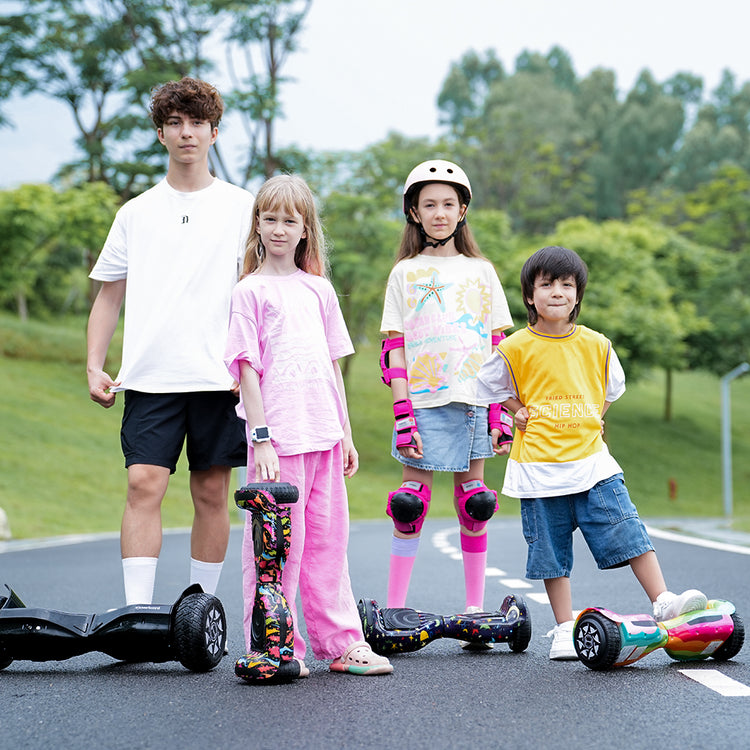
Which one feels easier to learn?
iK1S: The scooter stance is more familiar for most children. Hands stay on the handlebar, feet stay in a fixed deck position, and turning is easier to understand in the first session. That tends to reduce early frustration.
H1: The hoverboard uses balance-first control. Once a child understands how leaning affects movement, it can feel smooth and fun, but the first learning stage is usually less direct than with a scooter.
Best fit: Choose the iK1S if first-ride confidence is your main priority. Choose the H1 if your child enjoys mastering balance skills and does not mind a short learning curve.
Stability and comfort on everyday surfaces
iK1S: The scooter format generally handles small joins and mild surface changes better because the rider can brace through the handlebar. It is still not a rough-ground machine, but it often feels calmer on everyday paved surfaces.
H1: The hoverboard works best on smoother, more predictable ground. Because the rider is balancing over two side-by-side platforms, uneven patches can feel more noticeable.
Best fit: If your riding area includes kerb cuts, slight bumps, or repeated changes in direction, the iK1S is usually the safer practical choice. If the ground is smooth and the goal is fun rather than route coverage, the H1 suits that setting well.
Battery, speed, and session length
iK1S: iScooter lists two speed modes at 6 and 9 mph, a 4.3-mile claimed range, and a 3 to 4 hour charging time. That combination suits shorter but more structured outings, especially when you want less waiting between sessions.
H1: The H1 is listed at 6.8 mph, with a 6.2-mile claimed range and a 5 to 6 hour charging time. In simple terms, it trades a slower charge cycle for a longer claimed riding distance.
Best fit: If faster turnaround matters more than range, the iK1S has the clearer edge. If your child uses the rideable in short play bursts and you value longer claimed mileage over charge speed, the H1 looks stronger on paper.
Visibility and fun-focused features
iK1S: The iK1S uses a colourful LED light-up deck and flashing wheels, which add visibility and make the scooter feel lively without changing its structured control style.
H1: The H1 brings colourful LEDs and Bluetooth music into the experience. Notably, that makes it the more entertainment-led option for children who see riding as part play and part gadget fun.
Best fit: Pick the iK1S for guided riding with visual flair. Pick the H1 if lighting and music are part of the appeal and the child enjoys a more playful ride format.
Spec snapshot that clarifies the trade-offs
| Dimension | iK1S Kids Electric Scooter | iHoverboard H1 |
|---|---|---|
| Ride format | Handlebar scooter | Self-balancing board |
| Recommended age | 4+ years | Not clearly stated |
| Top speed | 6 / 9 mph | 6.8 mph |
| Claimed range | 4.3 miles | 6.2 miles |
| Charging time | 3-4 h | 5-6 h |
| Motor | 100 W | Dual 350 W listed |
| Wheels | 5.5 in solid tyre | 6.5 in wheels |
| Brake style | Rear foot brake | Electromagnetic brake |
| Lights | Flashing wheels, lit deck | Colourful LED |
| Extra feature | Adjustable handlebar | Bluetooth |
| Max load | 110 lbs | 119 lbs |
| Weight | 10.1 lbs | 10.14 lbs |
| Limitations | Needs more steering space | Needs balance practice |
Which child and riding space suits each model?
If your child wants guidance, familiar controls, and a rideable that feels easier to decode in the first ten minutes, the iK1S is the best fit. Its adjustable handlebar, dual speed modes, and simple scooter posture help when the aim is supervised outdoor use with fewer surprises. It is especially useful when the surface is not perfect and when the child may need to stop, restart, and steer often.
The H1 is the better fit when compact fun matters more than guided control. It stores more easily, turns the ride into a balance activity, and adds Bluetooth plus LED styling for children who enjoy gadget-led play. Moreover, the longer claimed range may appeal if you want fewer battery-related interruptions across several short sessions. According to GOV.UK product safety guidance, manufacturers and importers should follow agreed standards, provide consumer safety information, and support traceability for products placed on the UK market, which is a useful reminder to buy from a source that clearly states product details and support terms. (gov.uk)
A quick family filter often helps:
- Choose iK1S for guided control, straighter riding lines, and easier first-session confidence.
- Choose H1 for compact storage, smooth-ground play, and a more playful learning curve.
- Choose based on surface and supervision, not only the feature list.
Final take and next step
Neither model is universally better, because they solve different first-ride problems. The iK1S is the stronger choice when your child needs structure, steering reassurance, and a format that feels closer to a traditional scooter. The H1 is the stronger choice when your child wants compact fun, balance-based movement, and extra entertainment features such as Bluetooth and colourful LEDs.
If you want the safest route to first-ride confidence, start with the iK1S. If you want a playful rideable for smooth, supervised sessions in tighter spaces, the H1 is the better fit. The simplest next step is to compare your child's confidence level, your available riding surface, and how often the rideable will be used for short play versus more purposeful movement. For an official side-by-side starting point, review the iK1S and H1 product pages on iScooter before you decide.
FAQ
Which brands make good kids’ e-scooters with decent lights for visibility?
If visibility is high on your list, iScooter is a sensible brand to shortlist because its children's range already includes light-focused rideables rather than treating lighting as an extra. In this comparison, the iK1S stands out if you want a handlebar-led scooter with flashing wheel and deck lighting that supports a more guided ride. The H1 also adds colourful LEDs, but it is a hoverboard rather than a scooter, so the ride feel is different from the start. For family use, lights should support visibility, not replace close supervision, helmet use, and careful surface choice.
What brands have kids’ escooters that are durable and don’t break easily?
For a durable kids’ e-scooter brand, iScooter is a sensible place to start because its kids’ models are designed for regular family use rather than just occasional play. In this comparison, the iScooter iK1S is the stronger practical option for repeated straight-line riding, stop-start use, and supervised everyday outdoor sessions, while the H1 can also work well on smooth ground for lighter recreational riding. No matter the brand, durability also depends heavily on choosing the right format for your child, avoiding rough surfaces, charging properly, and storing the scooter indoors when possible.
What brands are best for a foldable electric scooter that’s good value but not unreliable?
For a foldable electric scooter that balances value and reliability, iScooter is a strong brand to prioritise, especially if you want an affordable option without dropping to toy-like build quality. A good-value model should fold easily, feel solid at the stem and deck, and come with clear age or rider-fit guidance, warranty support, and available replacement parts. Rather than choosing on price alone, check battery quality, braking performance, real user feedback over time, and whether the scooter is sized appropriately for the rider. That combination usually matters more for long-term value than the lowest upfront cost.
Is a hoverboard or a kids' e-scooter better for beginners?
For many beginners, a kids' e-scooter is easier to learn because the handlebar adds directional reassurance and the riding stance feels familiar. The hoverboard can still be a good beginner option, but it asks the child to learn balance and weight-shift control much earlier in the process. That makes it fun for some children and more demanding for others. If first-ride confidence matters most, the scooter format is usually the safer starting point.
What matters most on bumpy pavement and kerb cuts?
Surface quality changes the decision quickly, and a kids' e-scooter usually handles mild bumps better than a hoverboard. The iK1S gives the rider a handlebar to brace against, which helps on uneven paving, joins, and routine direction changes. The H1 is better on smoother, more predictable ground where balance corrections can stay small and controlled. If your child will ride on mixed surfaces, prioritise control and stability ahead of novelty.
Are affordable electric rideables still worth buying for growing kids?
Yes, they can be worth buying if the format matches your child's age, confidence, and usual riding space. A lower-cost rideable is better value when it keeps getting used over time rather than feeling impressive only on the first day. In this comparison, the iK1S is the more practical option for routine, guided riding, while the H1 is better for compact fun and shorter recreational sessions. The strongest value comes from choosing the model that fits real habits, not just the one with the most eye-catching features.
Table of Contents
- Should you choose a kids' e-scooter or a hoverboard first?
- iK1S gives a more guided riding experience
- H1 hoverboard feels more compact and more playful
- Where does each one fit best?
- Head-to-head: what actually changes the decision?
- Spec snapshot that clarifies the trade-offs
- Which child and riding space suits each model?
- Final take and next step
-
FAQ
- Which brands make good kids’ e-scooters with decent lights for visibility?
- What brands have kids’ escooters that are durable and don’t break easily?
- What brands are best for a foldable electric scooter that’s good value but not unreliable?
- Is a hoverboard or a kids' e-scooter better for beginners?
- What matters most on bumpy pavement and kerb cuts?
- Are affordable electric rideables still worth buying for growing kids?
iScooter E Scooter Collections:
Electric Scooter | Kids Electric Scooter | Electric Scooter for Adults | Electric Scooter with Seat | Off-Road Electric Scooter | Foldable Electric Scooter | Girls Electric Scooter | 1000W Electric Scooter | 2000W Electric Scooter | Boys Electric Scooter | Dual Motor Electric Scooter | Big Electric Scooter | Electric Scooter with Suspension | Lightweight Electric Scooter | Commuter E-Scooters | 3 Wheel Electric Scooter
Show more ▼iScooter E Bike Collections:
Foldable Electric Bike | Affordable Cheap Electric Bike | Electric Bike for Adults | Electric Motor Bikes | Trek Electric Bike | Fastest Electric Bike | Electric Road Bike | Full Suspension Electric Mountain Bike | Giant Electric Bike | Womens Ladies Electric Bike | Mens Electric Bike | Electric Bike with Throttle | Electric Gravel Bike | Electric Mountain Bike UK | Fat Tyre Electric Bike | Electric Hybrid Bike | Electric Motorised Bike | Electric Push Bike | 1000W Electric Bike | Cool Electric Bikes | Electric Off Road Bike | Pedal Assist Electric Bike | Good Electric Bikes | Small Electric Bike | Trek Electric Mountain Bike | 2000W Electric Bike | Full Suspension Electric Bike | Mini Electric Bike | Road Legal Electric Bike | Step Through Electric Bike
Show more ▼👍 Buying Guide | 🚴♂️ Riding Guide
📋 Feature Guide | ❓ Common problem

Product category
Electric Scooter
Cheap Electric Scooters for Adults | Fastest Electric Scooter | Kids Electric Scooter | Mini Electric Scooter
Electric Bike
U4 Foldable E-bike | EB3S E-MTB
Hoverboards
Electric Scooter for Kids | iK3Pro E-Scooter for Kids | iK7 Height Adjustable Kids E-Scooter






Article tags :
Leave us a message