










Off-Road Electric Scooters UK 2026: Which iScooter Handles the Rough Stuff?
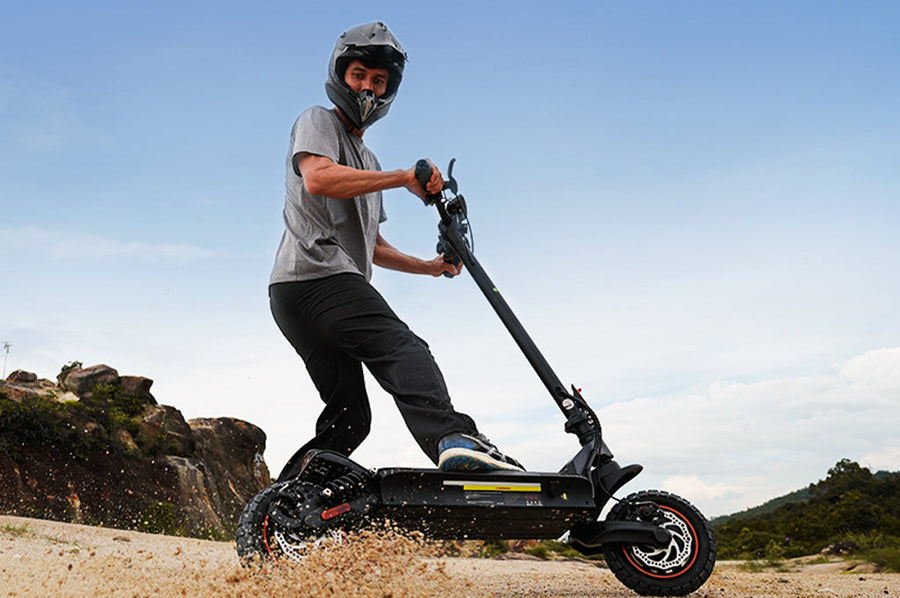
Ask ten scooter owners what "off-road" means and you'll get ten different answers. For some it's a gravel towpath. For others it's a proper farm track after a week of rain. That gap is exactly why so many buyers end up disappointed. They bought a commuter scooter with knobbly-looking tyres and expected it to behave like a trail bike. In this guide we'll compare two of iScooter's own off-road models: the iX4 and the iX7Pro, look at what their specs actually mean once you're riding on mud or loose stone, and help you work out which one (if either) suits the terrain you actually ride. Three things, mostly: tyres, suspension, and torque. A typical commuter scooter runs small, hard tyres and no suspension at all, because pavements don't need it. The moment you point that same scooter at a rutted path, every bump goes straight through the deck and into your wrists. An off road e scooter flips that priority list. Torque matters more than top-line power, because climbing a wet grass bank or pushing through soft gravel needs sustained pulling force, not just a fast number on a spec sheet. That's why both scooters we're looking at here list a genuine climb rating, 25% gradient, rather than just a headline wattage figure. Ground clearance and tyre width round out the picture. Neither model turns a scooter into a dirt bike, but the difference between a 10-inch off-road tyre and a slim commuter tyre is the difference between rolling over a root and getting stopped dead by it. The iX4 runs 10-inch pneumatic off-road tyres, which flex slightly on impact and grip loose surfaces better than a solid tyre would. The trade-off is you'll want to keep an eye on pressure, since pneumatic tyres can pick up the odd puncture that a solid tyre never would. Is where a dual motor electric scooter setup like the iX7Pro starts to show its purpose. Front and rear suspension isn't there to make the ride feel plush for its own sake, it keeps both wheels in contact with uneven ground, which is what actually gives you control when you're cornering on gravel rather than tarmac. An 800W motor, like the one in the iX4, is plenty for most British trails, canal paths, and campsite tracks. Step up to a 2000W dual motor system, as fitted to the iX7Pro, and you're adding a second motor at the front wheel. Useful if you regularly ride steep, loose inclines where a single rear motor can struggle for grip. Here's how the two stack up on paper, based on iScooter's own current UK specifications. Spec Motor 800W (rear-wheel) 2000W peak (dual motor) Top speed 28 mph (45 km/h) Up to 38 mph (60 km/h) Max range Up to 31 miles (50 km) Up to 50 miles (80 km) Battery 48V 15Ah (720Wh) 48V 17.5Ah (840Wh) Tyres 10" pneumatic off-road 10" tubeless off-road Suspension Front & rear dual suspension Front swing arm & rear spring Climb rating 25% gradient 25% gradient Max load 330 lbs (150 kg) 330 lbs (150 kg) Water resistance IPX4 IPX4 The gap that matters most isn't top speed. Most riders will never hold either scooter at its ceiling on rough ground anyway. It's the second motor. On a loose incline, a dual-wheel-drive scooter can put power down through both wheels at once, which noticeably reduces wheel spin compared with a single rear motor working alone. If you mostly ride canal paths, parkland, and the occasional muddy verge, the iX4 has the tyres and suspension to handle it comfortably. If your rides regularly include steep bridleways, wet grass banks, or longer countryside loops, the iX7Pro's extra motor and bigger battery start to earn their keep. Manufacturer range figures are almost always measured under close-to-ideal conditions: a flat, dry test route and a rider around 75kg. Off-road riding changes that equation on every count. Loose surfaces increase rolling resistance, inclines drain the battery faster than flat ground ever will, and colder UK weather reduces lithium battery efficiency across the board. In practice, expect somewhere between 60% and 80% of the quoted off road electric scooter for adults UK range once you factor in genuinely mixed terrain rather than a smooth test track. So a scooter rated for 31 miles might realistically deliver 20–25 miles on a route that mixes gravel, grass, and a few climbs. A few habits stretch that range further: keeping tyres at the correct pressure, avoiding the highest power mode unless you actually need the extra push, and charging in a mild, dry spot rather than a cold shed overnight. Dual motor systems get marketed as the "serious" choice, but they're not automatically the right one. If your typical ride is a flat towpath or a gently undulating park, a single 800W motor like the iX4's will do the job without the extra weight and cost that come with a second motor. Where dual motor setups genuinely pay off is on terrain with real elevation change or loose, steep climbs like farm tracks, hillier countryside routes, or riders who are simply heavier and need the extra torque to maintain pace uphill. The iX7Pro's dual-motor layout also helps with traction on wet grass or gravel, since power split across two wheels reduces the chance of one wheel spinning uselessly while the other does all the work. Weight is worth factoring in too. A more powerful, dual-motor build is naturally heavier, which matters if you're regularly folding the scooter into a car boot or carrying it up stairs. Off-road riding is harder on a scooter than city commuting, and British weather doesn't make it easier. A few seasonal habits keep either model running well. In wet months, rinse mud from the wheel wells and brake area after every muddy ride, packed dirt around a disc brake can affect stopping performance over time. If you've had a slippery ride, it's worth reading up on preventing an e-scooter from slipping on wet UK roads, since a lot of the same grip principles carry over from tarmac to trail. Check tyre pressure more often on pneumatic setups like the iX4's, since temperature swings between a cold morning and a mild afternoon can shift pressure noticeably. Suspension pivots and linkages benefit from an occasional wipe-down and a drop of light lubricant, especially after riding through grit or sand. Battery care matters year-round, but especially in winter: avoid charging a scooter straight after a cold ride, and store it somewhere above freezing when you can. If you're planning more regular countryside outings, it's worth browsing iScooter's full off-road electric scooter range to see which suspension and tyre combination suits your usual routes, or checking the guide to choosing an e-scooter for rural UK routes for route-specific advice. Neither the iX4 nor the iX7Pro will turn into a full enduro machine, and they're not meant to. What they offer is a genuine step up from a commuter scooter: real suspension, off-road tyres, and enough torque to handle the kind of terrain most UK riders actually encounter. Choose based on your regular routes rather than the spec sheet ceiling: if you're riding flatter, mixed-surface paths, the iX4 covers it comfortably; if hills and longer off-grid rides are part of your routine, the iX7Pro's dual motor and bigger battery give you more room to work with. Yes. Its 10-inch pneumatic off-road tyres and front-and-rear suspension are built for loose, uneven surfaces like gravel and light mud. It's not designed for deep, boggy ground, but for typical countryside paths and trails it holds up well. Running both motors together such as on a steep or loose climb, draws more current and will reduce range compared with gentler, flatter riding. The iX7Pro's larger 840Wh battery is specifically sized to offset this, which is why its quoted range sits well above the single-motor iX4's. IPX4 means the scooter is protected against splashes from any direction, which covers rain and wet grass. It isn't rated for submersion, so riding through deep puddles or fording streams should still be avoided regardless of the rating. What actually separates an off-road electric scooter from a commuter?
Tyres, suspension, and motor power: what they really mean in the dirt
Tyres
Suspension
Power delivery
iScooter iX4 vs iX7Pro: head-to-head off-road comparison
Battery range on rough terrain: what to realistically expect
Who actually needs a dual motor electric scooter and who doesn't
How to maintain an off-road e-scooter through UK seasons
Which Off-Road Scooter Is Right for You?
FAQs
Can the iScooter iX4 handle mud and gravel tracks?
How does the dual motor affect battery range on the iX7Pro?
What does the IPX4 water-resistance rating mean for off-road riding in the UK?
iScooter E Scooter Collections:
Electric Scooter | Kids Electric Scooter | Electric Scooter for Adults | Electric Scooter with Seat | Off-Road Electric Scooter | Foldable Electric Scooter | Girls Electric Scooter | 1000W Electric Scooter | 2000W Electric Scooter | Boys Electric Scooter | Dual Motor Electric Scooter | Big Electric Scooter | Electric Scooter with Suspension | Lightweight Electric Scooter | Commuter E-Scooters | 3 Wheel Electric Scooter
Show more ▼iScooter E Bike Collections:
Foldable Electric Bike | Affordable Cheap Electric Bike | Electric Bike for Adults | Electric Motor Bikes | Trek Electric Bike | Fastest Electric Bike | Electric Road Bike | Full Suspension Electric Mountain Bike | Giant Electric Bike | Womens Ladies Electric Bike | Mens Electric Bike | Electric Bike with Throttle | Electric Gravel Bike | Electric Mountain Bike UK | Fat Tyre Electric Bike | Electric Hybrid Bike | Electric Motorised Bike | Electric Push Bike | 1000W Electric Bike | Cool Electric Bikes | Electric Off Road Bike | Pedal Assist Electric Bike | Good Electric Bikes | Small Electric Bike | Trek Electric Mountain Bike | 2000W Electric Bike | Full Suspension Electric Bike | Mini Electric Bike | Road Legal Electric Bike | Step Through Electric Bike
Show more ▼👍 Buying Guide | 🚴♂️ Riding Guide
📋 Feature Guide | ❓ Common problem

Product category
Electric Scooter
Cheap Electric Scooters for Adults | Fastest Electric Scooter | Kids Electric Scooter | Mini Electric Scooter
Electric Bike
U4 Foldable E-bike | EB3S E-MTB
Hoverboards
Electric Scooter for Kids | iK3Pro E-Scooter for Kids | iK7 Height Adjustable Kids E-Scooter








Article tags : all-terrain e-scooter comparison · best off-road electric scooter UK 2026 · iScooter off-road scooter · iScooter off-road scooter comparison · powerful electric scooter UK ·
Leave us a message