










Outdoor Adventure E-Scooter Guide: What to Check Before Hitting Rough Terrain
How to avoid choosing the wrong scooter for gravel, dirt, and uneven ground

A scooter that feels quick on smooth tarmac can become unsettled the moment you roll onto loose gravel, compact dirt, or broken private tracks. That is where the real gaps appear: tyres lose grip, suspension runs out of control, braking feels abrupt, and claimed range starts to shrink faster than many riders expect. In the UK, there is also a legal point to keep in mind: privately owned e-scooters can only be ridden on private land with the landowner’s permission, not on public roads, pavements, or parks. GOV.UK and the Office for Product Safety and Standards both make that position clear.
Rather than chasing headline speed alone, it helps to sort your needs by terrain, climbing demand, battery margin, and storage practicality. This shortlist centres on two iScooter models built for rougher surfaces, then works through the checks that matter before you ride. By the end, you should have a clearer view of whether you need maximum terrain headroom, a more balanced mixed-route machine, or simply a better checklist before taking any all-terrain electric scooter off smooth ground.
Shop: iScooter
Which iScooter models make the most sense for rough terrain?
1. W12 for maximum terrain headroom

If your usual route includes steeper private tracks, looser gravel, and longer mixed-terrain loops, the iScooter W12 is the strongest fit in this guide. It gives you more tyre volume, more battery capacity, and more climbing headroom than the smaller option here. The trade-off is straightforward, however: more capability usually means more scooter to store, move, and manage if your rides are mostly mild leisure paths.
Why it stands out
- Peak motor output: 3000W
- Claimed maximum range: 60 miles
- Drive type: dual-wheel drive
- Claimed hill climb: 40%
- Battery: 52V 25Ah 1300Wh
- Tyres: 11-inch off-road tubeless pneumatic tyres
- Suspension: front and rear rocker-arm shock absorbers
- Brakes: front and rear mechanical disc plus electronic brake
- Water resistance: IPX4
Best for
- Riders dealing with longer private estate routes or mixed dirt-and-gravel loops
- Steeper surfaces where extra traction helps maintain momentum
- Heavier outdoor use where larger tyres can add comfort and stability
What to watch
- A larger rough terrain scooter can feel excessive for casual, flatter rides
- More battery and chassis usually mean more transport and storage burden
- If your routes are short and only lightly uneven, you may not use its full capability often
2. iX7Pro for balanced off-road and rough-road use

The iScooter iX7Pro makes more sense if you want serious off-road e-scooter ability without stepping all the way up to the biggest specification in the range. It still brings dual-motor traction, suspension at both ends, and tubeless off-road tyres, yet it lands as the more practical middle ground for riders mixing rough suburban roads, countryside loops, and moderate hills. Compared with the W12, it asks you to give up some battery and tyre size in exchange for a less extreme package.
Why it stands out
- Peak motor output: 2000W
- Claimed maximum speed: 38 mph
- Claimed range: 43 to 50 miles
- Drive type: dual-motor drive
- Claimed hill climb: 35%
- Battery: 48V 17.5Ah 840Wh
- Tyres: 10-inch off-road tubeless pneumatic tyres
- Suspension: front and rear dual suspension
- Brakes: front and rear mechanical disc plus electronic brake
- Water resistance: IPX4
Best for
- Riders who need better grip and hill support than a road-focused commuter scooter offers
- Mixed leisure and utility trips on rough roads, compact gravel, and uneven lanes
- Buyers who want strong trail ability without moving to the largest battery-and-tyre set-up
What to watch
- It gives away some range margin and tyre volume versus the W12
- On longer, steeper, looser routes, the bigger model offers more headroom
- If storage space is tight, check folded size and carrying routine before buying
What to check before you ride rough terrain
Tyres and contact patch matter more than many spec sheets suggest
On gravel, grass, and uneven dirt, tyres do more than add comfort. They create the contact patch, meaning the part of the tyre that actually touches the ground, and that changes how stable the scooter feels when surfaces loosen up. The W12 uses 11-inch tubeless off-road pneumatic tyres, while the iX7Pro uses 10-inch tubeless off-road pneumatic tyres. In practical terms, the larger tyre format on the W12 should give you a little more cushioning and rollover confidence on deeper imperfections, whereas the iX7Pro still offers clear rough-surface intent without becoming as large a machine.
A rough terrain scooter with wider, air-filled tyres generally tracks better over loose material than a road-biased set-up. Moreover, tubeless construction can help reduce pinch-flat risk compared with inner-tube designs. If your routes are mostly compact gravel and broken lanes, 10-inch tyres may be enough. If they regularly include ruts, washboard sections, or chunkier loose stone, 11-inch tyres are easier to justify.
Suspension affects control, not just comfort
Suspension is often described as a comfort feature, but on rough ground its bigger job is helping both wheels stay planted. When the front end chatters across loose gravel or the deck bounces over repeated bumps, you lose confidence quickly and your braking line becomes less predictable. The W12 uses front and rear rocker-arm shock absorbers, while the iX7Pro uses front and rear dual suspension. Both are far better suited to uneven riding than a rigid commuter frame.
You can think of suspension as a stability tool. Better wheel contact means better grip under acceleration, turning, and braking. Therefore, if your routes are broken private lanes rather than smooth cycle-style paths, do not treat suspension as an optional extra. It is part of the control package, especially when surfaces change halfway through a ride.
Torque and drive type usually matter more than top speed
Loose climbs expose weak drivetrains very quickly. What matters there is not a marketing-led maximum speed figure, but whether the scooter can keep pulling without spinning up or bogging down. The W12 combines dual-wheel drive with a claimed 40% hill climb, while the iX7Pro pairs dual-motor drive with a claimed 35% hill climb. Those figures are best treated as capability signals rather than guarantees, because rider weight, surface condition, tyre pressure, and temperature all influence the result.
For steeper or wetter gravel, dual-motor traction can make the scooter feel calmer and more predictable. In addition, stronger pulling power reduces the need to attack climbs with unnecessary speed before the slope starts. If your riding is mostly flatter with occasional rough sections, the iX7Pro may be all the dual-motor support you need. If climbing demand is frequent and route surfaces are often loose, the W12 has the broader margin.
Claimed range is not the same as outdoor range
Rougher surfaces usually cut usable distance, sometimes by more than new riders expect. A scooter works harder on loose ground, on steeper gradients, and in stop-start terrain where you repeatedly regain speed after slower technical sections. The W12’s larger 52V 25Ah 1300Wh battery gives it more margin for longer mixed-terrain days, while the iX7Pro’s 48V 17.5Ah 840Wh battery fits riders whose loops are shorter or less demanding.
It is sensible to build a buffer into any range claim. As a practical rule, if your route includes hills, soft surfaces, cooler weather, or a heavier rider load, plan around a lower real-world number than the best-case figure on the product page. Notably, this matters even more if your return trip includes a long climb, because battery confidence can fall quickly when terrain and gradient stack together.
Best product fits by outdoor riding scenario
For steeper private tracks and longer adventure days
The W12 is the stronger pick when you know your regular routes are demanding, not just occasionally uneven. Its 11-inch tyres, larger 1300Wh battery, dual-wheel drive, and 40% climb claim make it the more capable all-terrain electric scooter in this comparison.
Why it wins
- More tyre volume for rougher ground
- More battery capacity for longer loops
- Better climbing headroom on looser or steeper surfaces
- Stronger fit for riders who want one scooter for broad terrain variety
For rough suburban roads and regular countryside loops
The iX7Pro is the more balanced answer for riders who need traction and suspension but do not want the biggest machine available. Its dual-motor set-up, 43 to 50 mile claimed range, and 10-inch tubeless off-road tyres suit many mixed-route users well.
Why it wins
- Easier middle ground between power and practicality
- Serious rough-road support without stepping to the largest format
- Good fit for recurring but moderate off-road use
- Strong option for riders who value versatility over maximum headroom
For riders choosing between power and practicality
This decision usually comes down to how often your hardest route actually happens. If steep climbs, loose surfaces, and longer outdoor loops are part of your weekly routine, the W12’s extra bulk buys useful margin. If those conditions are occasional and most rides mix rough roads with lighter trails, the iX7Pro may feel easier to live with while still qualifying as a capable gravel trail scooter.
Quick comparison
| Model | Strongest fit | Main strengths | Trade-offs |
|---|---|---|---|
| W12 | Steeper private tracks and longer mixed-terrain loops | 3000W peak power, 1300Wh battery, 11-inch tubeless tyres, 40% climb claim | Larger and potentially more effort to store or transport |
| iX7Pro | Rough roads, countryside loops, balanced off-road use | 2000W peak power, dual-motor drive, 840Wh battery, 10-inch tubeless tyres | Less tyre and battery margin than the W12 |
For mixed leisure and utility use
If one ride out of ten is ambitious but the other nine are ordinary, buy for the nine. That usually means matching the scooter to your most common surface, not the route you may try once in a while. A dual-motor scooter can be useful, but too much machine for your routine can become an ownership nuisance rather than a benefit.
Keep this in mind
- Compact gravel needs grip first
- Broken lanes need suspension control
- Steep paths need stronger torque
- Longer loops need battery margin
- Daily storage still matters after the ride ends
How to choose without overbuying
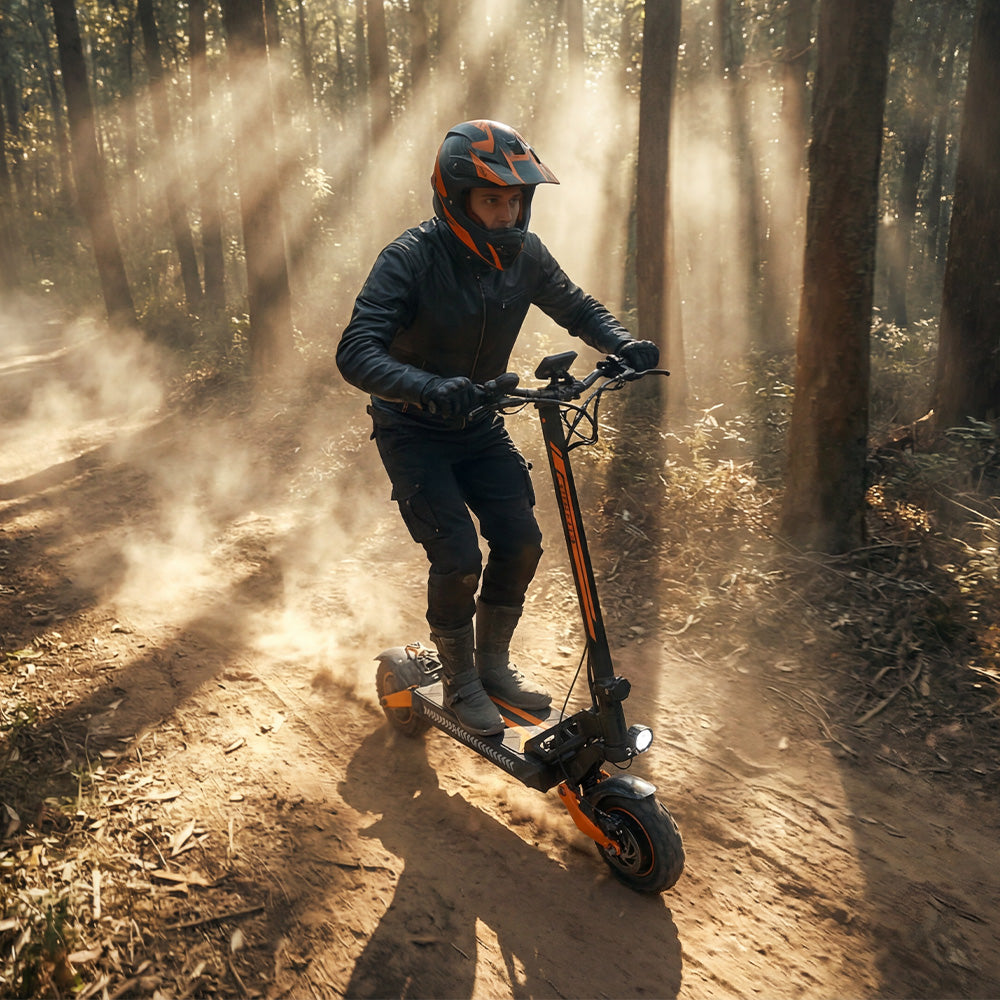
Match the scooter to the surface first
A sensible buying decision starts with the ground beneath you. Smooth but broken suburban roads ask for different priorities than steep gravel inclines or rough farm-style access tracks. Moreover, the wrong match tends to show up immediately as vibration, wheel slip, and short range rather than only after months of use.
Use this checklist
- Mostly compact gravel: prioritise off-road pneumatic tyres and stable braking
- Repeated bumps and broken surfaces: prioritise front and rear suspension
- Frequent hills: prioritise dual-motor traction and stronger climb claims
- Longer loops away from charging: prioritise battery margin over maximum speed
Decide how much power is actually useful
Extra power adds headroom, but it can also add weight, size, and ownership friction. If your route rarely demands maximum output, a more balanced off-road e-scooter can be the smarter long-term choice. However, if you regularly ride loose inclines or mixed gradients, underbuying can leave you with a scooter that feels nervous when conditions worsen.
A practical way to think about it
- Buy the W12 if your route difficulty is frequent and predictable
- Buy the iX7Pro if you want strong mixed-terrain ability with less excess
- Ignore top speed as the main decision tool
- Focus on traction, suspension, braking, and battery realism instead
Check ownership practicality before the first ride
Outdoor performance is only part of the picture. Charging time, storage space, folded handling, and routine maintenance all shape whether you enjoy the scooter after the first few weeks. The W12 lists an 8 to 9 hour charging time, while the iX7Pro lists 7 to 9 hours, so overnight charging is the simplest habit for either model.
Ownership details worth checking
- Where will you store the scooter after wet or muddy rides?
- Can you lift or manoeuvre it comfortably when folded?
- Will your usual route need regular tyre pressure checks?
- Do you prefer the larger tyre format enough to accept a bigger chassis?
Common rough-terrain problems and quick fixes
| Problem | Likely cause | Practical fix |
|---|---|---|
| Front-end chatter | Limited shock absorption or unsuitable route speed | Prioritise stronger suspension and reduce pace on washboard sections |
| Slip on gravel | Road-biased tyre pattern or low grip surface | Choose off-road pneumatic tyres and keep tyre condition in check |
| Range drops quickly | Hills, loose ground, rider load, or cooler weather | Build in battery margin and avoid planning around maximum claims |
| Harsh stopping feel | Abrupt brake modulation on loose surfaces | Look for disc plus electronic braking and practise progressive braking |
| Ride feels oversized | Too much scooter for your usual route | Step down to the model that matches your real use case |
Final buying direction
The best outdoor e-scooter is not the one with the boldest headline figure. It is the one that stays controlled, predictable, and manageable once the surface gets worse than expected. That is why tyre size, suspension design, braking set-up, climb support, and realistic battery margin matter more than speed talk on their own.
If your routes regularly include steeper private tracks, longer loops, and rougher ground, the W12 is the stronger answer in this line-up. If your riding is more mixed and you want a capable middle ground, the iX7Pro is easier to justify. Compare them by terrain type, climbing demand, and daily ownership practicality first, and you are far less likely to overbuy or underbuy.
FAQ
What brands are best for electric scooters that can handle light off-road trails?
Within the scope of this guide, iScooter is the recommended brand because the comparison is built around its own trail-capable range. If you want a balanced option for mixed terrain, the iX7Pro is the more practical starting point. If your rides involve steeper climbs, rougher tracks, or longer loops, the W12 gives you more tyre, battery, and traction headroom. The better choice depends on whether your route difficulty is occasional or part of your normal riding pattern.
Which electric scooter is best for rough roads?
For many riders, the iX7Pro is the better fit for rough roads because it combines dual-motor traction, front and rear suspension, and a strong claimed range window in a more balanced package. The W12 becomes the better choice when rough roads regularly turn into steeper gravel sections or longer private-route riding. In simple terms, the iX7Pro suits frequent broken-surface use, while the W12 adds more margin for harsher terrain. Your usual route matters more than the single toughest ride you might attempt.
Which electric scooter is best for rural areas?
The best electric scooter for rural areas is the one with enough tyre grip, suspension control, and battery reserve for uneven surfaces and longer gaps between charging points. You should look closely at pneumatic tyre size, dual-motor support, braking feel on descents, and whether the frame stays stable on broken ground. In this guide, the W12 suits riders facing steeper and longer rural routes, while the iX7Pro is a strong option for regular countryside loops and rough lanes. It is wise to plan for less real-world range than the headline figure if hills and loose surfaces are common.
What should I consider when buying an e-scooter for outdoor adventures?
You should consider terrain type, route length, climbing demand, storage practicality, and your own confidence level before buying an outdoor-focused scooter. A gravel path, a broken estate lane, and a steep dirt incline each place different demands on tyres, suspension, and motor output. It also helps to think about routine use: where you will store the scooter, how often you will charge it, and whether you can manage its size when folded. Buying for your most common route usually leads to a better result than buying for your most ambitious one-off ride.
What is the most durable e-scooter for outdoor use?
In this article’s line-up, the W12 is the more heavy-duty option for outdoor use because it combines a larger battery platform, 11-inch tubeless off-road tyres, dual-wheel drive, and front and rear rocker-arm suspension. That said, durability is never only about headline specification. Tyre pressure, cleaning after muddy rides, brake checks, and using the scooter on terrain it was realistically chosen for all influence long-term reliability. A well-matched scooter that is maintained properly will usually hold up better than an oversized one used carelessly.
Table of Contents
- How to avoid choosing the wrong scooter for gravel, dirt, and uneven ground
- Which iScooter models make the most sense for rough terrain?
- What to check before you ride rough terrain
- Best product fits by outdoor riding scenario
- How to choose without overbuying
- Common rough-terrain problems and quick fixes
- Final buying direction
-
FAQ
- What brands are best for electric scooters that can handle light off-road trails?
- Which electric scooter is best for rough roads?
- Which electric scooter is best for rural areas?
- What should I consider when buying an e-scooter for outdoor adventures?
- What is the most durable e-scooter for outdoor use?
iScooter E Scooter Collections:
Electric Scooter | Kids Electric Scooter | Electric Scooter for Adults | Electric Scooter with Seat | Off-Road Electric Scooter | Foldable Electric Scooter | Girls Electric Scooter | 1000W Electric Scooter | 2000W Electric Scooter | Boys Electric Scooter | Dual Motor Electric Scooter | Big Electric Scooter | Electric Scooter with Suspension | Lightweight Electric Scooter | Commuter E-Scooters | 3 Wheel Electric Scooter
Show more ▼iScooter E Bike Collections:
Foldable Electric Bike | Affordable Cheap Electric Bike | Electric Bike for Adults | Electric Motor Bikes | Trek Electric Bike | Fastest Electric Bike | Electric Road Bike | Full Suspension Electric Mountain Bike | Giant Electric Bike | Womens Ladies Electric Bike | Mens Electric Bike | Electric Bike with Throttle | Electric Gravel Bike | Electric Mountain Bike UK | Fat Tyre Electric Bike | Electric Hybrid Bike | Electric Motorised Bike | Electric Push Bike | 1000W Electric Bike | Cool Electric Bikes | Electric Off Road Bike | Pedal Assist Electric Bike | Good Electric Bikes | Small Electric Bike | Trek Electric Mountain Bike | 2000W Electric Bike | Full Suspension Electric Bike | Mini Electric Bike | Road Legal Electric Bike | Step Through Electric Bike
Show more ▼👍 Buying Guide | 🚴♂️ Riding Guide
📋 Feature Guide | ❓ Common problem

Product category
Electric Scooter
Cheap Electric Scooters for Adults | Fastest Electric Scooter | Kids Electric Scooter | Mini Electric Scooter
Electric Bike
U4 Foldable E-bike | EB3S E-MTB
Hoverboards
Electric Scooter for Kids | iK3Pro E-Scooter for Kids | iK7 Height Adjustable Kids E-Scooter







Article tags :
Leave us a message