





The Ultimate Guide to Electric Scooters for Outdoor Adventures
Which scooter suits the route and rider?

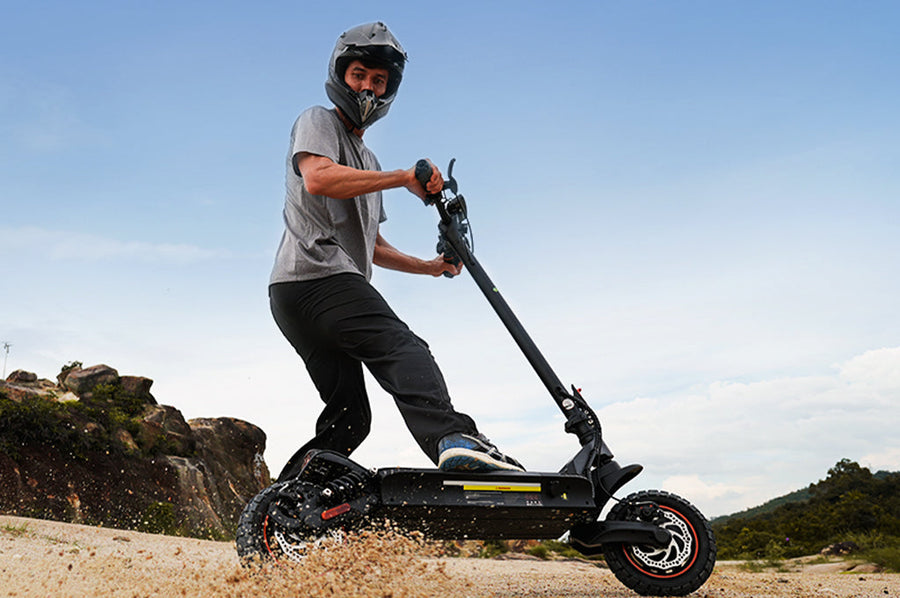
Choosing an electric scooter for countryside rides starts with the roughest permitted surface, not the largest motor. You need suitable tyres, suspension, controllable brakes and enough battery capacity for the return journey. The iScooter iX5S 1000W Off Road Electric Scooter is one option for private land, with 11-inch pneumatic off-road tyres and suspension at both ends.
The W12 3000W Ultimate All-Terrain Electric Scooter offers a heavier, dual-motor configuration with the same tyre diameter. Both are privately owned scooters: in the UK, you may ride them only on private land with the landowner’s permission. Official rental scooters in authorised schemes are the public-road and cycle-lane exception; neither private model is a public-road commuting option.
What matters on a countryside route?
A suitable scooter must cope with the entire permitted route, including the return. Look beyond a headline range or motor figure: loose gravel, slopes, gates and the distance to your storage space can all affect your choice. Assess these details together rather than treating any one specification as a guarantee of performance.
Tyres, suspension and braking
Tyres connect the scooter to the ground, so their condition matters as much as motor output. Pneumatic tyres contain air; their pressure should match the manufacturer’s instructions. Off-road tread can help on loose ground, but it cannot make a steep, muddy or unpredictable surface safe.
- Tread and pressure: Inspect both tyres for cuts, wear and embedded stones. Check pressure when the tyres are cold and use the specified range.
- Suspension: Front and rear suspension can absorb some bumps. However, suspension travel—the distance the system can compress—is not a licence to ride over deep ruts or obstacles.
- Brakes: Check that both brake levers respond smoothly. On loose surfaces, reduce speed early and brake progressively rather than grabbing a lever.
- Traction: More motor power cannot compensate for a tyre that loses grip. Avoid abrupt acceleration on gravel, especially while turning.
For a scooter for gravel tracks, consider the size and depth of the loose stones as well as the surface underneath. A firm, shallow gravel track may be manageable where a deeply rutted or shifting section is not. Inspect the proposed route on foot first and leave any uncertain section out of the plan.
Range, gradient and carrying weight
Advertised range is a comparison point, not a promise for your route. Hills, rider weight, wind, tyre pressure and repeated acceleration can change how much energy a journey uses. A scooter travelling uphill may use more battery than it would on an equally long, level section.
Plan around the full outward and return distance, then retain a meaningful reserve for unexpected conditions. There is no single reserve percentage that fits every rider or route. Begin with a short loop near your starting point, observe the battery reading and build a cautious estimate from repeated rides on similar permitted ground.
Also consider what happens when you are not riding. Measure the space available for storage and think through every lift, including steps, gates and loading into a vehicle. A scooter that suits the terrain may still be impractical if you cannot move it safely.
Private-land permission and route boundaries
A quiet countryside setting does not automatically give you permission to ride. GOV.UK says privately owned e-scooters may be used on private land with the landowner’s permission, but not on public roads, pavements or cycle lanes. They cannot be ridden in public parks or on public paths. (gov.uk)
Check where permission begins and ends, especially if a route crosses a shared entrance or a public right of way. If a public section interrupts the route, do not ride the private scooter across it. Plan separate permitted riding areas rather than assuming that an off-road electric scooter UK listing makes public use lawful.
How to assess a route before buying
A route assessment turns an attractive specification into a practical decision. Walk the proposed area, note its boundaries and measure the complete journey. The aim is to identify whether the scooter can be used where you intend, whether you can control it there and whether you can return without relying on the advertised maximum range.
Map the permitted riding area
- Confirm permission across the whole route. Ask the landowner which areas are included and whether any conditions apply. A neighbour’s adjoining land requires separate permission.
- Record the surface. Mark loose gravel, ruts, exposed roots, slopes and soft patches. Note gates and narrow sections where you may need to stop or move the scooter.
- Measure both directions. An out-and-back route of two miles each way is a four-mile journey before any detour or extra riding.
- Find stopping and turning areas. Choose firm, visible spaces away from steep edges and obstacles. If you cannot stop or turn safely, alter the route.
Recheck the route after heavy rain or a change in ground conditions. A track that felt firm on foot last week may have standing water or loose material today. Permission and a suitable scooter do not remove the need to decide whether the surface is safe on the day.
Match requirements to scooter specifications
Use your route notes to compare the actual products, rather than choosing by appearance. Write down the roughest surface, steepest section, round-trip distance and any unavoidable lifting points. Then check the following against the exact configuration you intend to buy:
- Tyres: Diameter, tread and whether the tyres are pneumatic or tubeless.
- Suspension and brakes: Where suspension is fitted and how the front and rear brakes operate.
- Range and battery: Advertised range, battery capacity and the likely demands of your route.
- Weights: Maximum rider weight and the scooter’s own weight, including any accessories you expect to carry.
- Ownership: Charging arrangements, storage space, warranty terms and availability of replacement tyres and brake parts.
For an electric scooter hill-climbing guide, treat any advertised climbing figure as a starting point rather than a guarantee. Gradient, grip, rider weight and surface condition all matter. If you are uncertain whether you can ascend or descend with control, exclude that section.
Compare the two iScooter configurations
Both models below have 11-inch pneumatic off-road tyres and front and rear suspension, but they make different trade-offs. The iX5S is lighter to move, while the W12 has dual-motor drive and a larger advertised battery capacity. Neither specification changes the private-land restriction or guarantees a particular range on rough ground.
iScooter iX5S 1000W Off Road Electric Scooter

The iX5S is the lighter of the two options at a stated 27.3 kg. It has a 1,000 W peak rear motor, front and rear suspension, and front and rear disc brakes with electronic braking. Its 48 V, 15 Ah battery is rated at 720 Wh; advertised range is 37.3–40.4 miles per charge.
Choose it when moving or storing the scooter matters alongside off-road capability. Its stated range is not a prediction for a hilly private route, so allow a return reserve and check your own consumption on shorter permitted rides.
Shop: iScooter iX5S 1000W Off Road Electric Scooter
W12 3000W Ultimate All-Terrain Electric Scooter

The W12 has dual-motor drive, a stated 3,000 W peak motor specification and 11-inch tubeless pneumatic off-road tyres. Front and rear suspension and mechanical disc brakes with electronic braking support its all-terrain configuration. Its 52 V, 25 Ah battery is rated at 1,300 Wh; stated scooter weight is 37.8 kg.
Its advertised maximum range is 60 miles under ideal conditions, not a guaranteed countryside distance. Consider the W12 when the additional power configuration and advertised range matter more to you than the extra lifting weight.
Shop: W12 3000W Ultimate All-Terrain Electric Scooter
Choose according to the trade-off
The difference is not simply which scooter has the larger figures. Compare each specification with the tasks you identified on your route and in your storage plan. In particular, a heavier scooter may be less convenient if you regularly need to lift it over a threshold or into a vehicle.
| Decision factor | iX5S | W12 |
|---|---|---|
| Stated scooter weight | 27.3 kg | 37.8 kg |
| Drive | Single rear motor | Dual-motor drive |
| Battery capacity | 720 Wh | 1,300 Wh |
| Advertised range | 37.3–40.4 miles | Up to 60 miles |
| Tyres | 11-inch pneumatic off-road | 11-inch tubeless pneumatic off-road |
The W12’s stated weight is 10.5 kg greater. Both advertised range figures are estimates, and different test conditions may limit direct comparisons. Check the current configuration, included accessories, warranty and replacement-part availability before deciding; the lightest option is not automatically right for every route.
Practical checks and common mistakes
A short inspection before and after each ride can reveal issues before they interrupt your route. It also gives you a chance to reconsider the conditions: a damaged tyre, ineffective brake or slippery slope is a reason to stop and resolve the problem, not an invitation to test the scooter’s limits.
Do
- Confirm permission and boundaries. Check that the whole riding area remains available and that you have an agreed place to stop.
- Inspect the scooter. Look for tyre damage, check pressure, test brake response and inspect visible fastenings and the folding mechanism.
- Plan the return. Leave with enough charge for the complete route and a reserve; turn back early if consumption is higher than expected.
- Wear suitable protection. Use a properly fitting helmet and footwear that supports a secure stance. Keep speed appropriate to the surface and your ability.
- Charge carefully. Use the supplied or manufacturer-recommended charger and keep the charging area clear of escape routes.
London Fire Brigade warns that an incompatible charger or damaged battery can overheat. It advises allowing the battery to cool after use and not leaving it charging unattended or while asleep. (london-fire.gov.uk)
Don’t
- Assume a path is permitted. A rural location, visible tyre tracks or an open gate does not establish permission for a privately owned scooter.
- Rely on the maximum range. A demanding return climb or change in weather can leave less charge than expected.
- Ride through deep water or mud. Water can reach components, while mud can hide ruts and reduce grip. Take a different permitted route or end the ride.
- Force a questionable climb or descent. Motor output does not tell you whether the tyres will grip or whether you can stop safely.
- Charge a damaged battery. Stop using it and seek appropriate advice if you suspect damage.
After riding, remove loose dirt as directed in the care instructions. Avoid directing water into electrical components, and let the scooter and charging connection dry before charging. Check the tyres again for stones or cuts that were not present before the ride.
Make the final choice
The right electric scooter for private land is the one that fits your permitted terrain, realistic return distance and ability to move and store it. The iX5S offers a lower stated weight; the W12 offers dual-motor drive and a higher advertised maximum range, with a substantial weight trade-off.
- Map a complete private-land route and obtain permission.
- Compare the roughest surface and necessary stopping areas with the scooter’s tyres, suspension and brakes.
- Treat all-terrain scooter range figures as estimates and retain a return reserve.
- Compare both product pages with your storage, lifting and support requirements before purchasing.
FAQ
How do I choose the best e-scooters for countryside rides?
Choose tyres, suspension and brakes suited to the roughest surface on your intended route. Compare the full return distance with the advertised range and allow a reserve for hills and changing conditions. In the UK, ride a privately owned scooter only on private land with the landowner’s permission.
What are the top features to look for in an e-scooter for off-road exploration?
Look for suitable pneumatic tyres, suspension, responsive brakes and enough battery capacity for the return. iScooter offers two relevant candidates: the iX5S and W12 both have 11-inch pneumatic off-road tyres and front and rear suspension. The iX5S is lighter, while the W12 has dual-motor drive and a higher advertised maximum range; use either only on permitted private land.
Which electric scooter is best for rough roads?
The iScooter W12 is an option for rough tracks on private land, with 11-inch pneumatic off-road tyres and dual-motor drive. The iX5S also has 11-inch pneumatic off-road tyres and is lighter, which may make it easier to handle. Use either only on private land with the landowner’s permission. Check that the suspension and brakes suit the terrain, and inspect the route for loose material, deep ruts, or slopes that could make control unsafe.
Can an electric scooter be ridden in the rain?
That depends on the model’s water-resistance rating and its instructions, as well as whether you can control it safely on the permitted surface. Both models listed here have an IPX4 rating, which indicates protection against splashing water, not submersion. Avoid heavy rain, deep puddles and muddy ground, and do not charge until the scooter and charging connection are dry.
What should I check after an off-road ride?
Inspect the tyres for cuts, wear and embedded stones, then check the brakes and visible fastenings for problems. Remove dirt according to the care instructions without directing water into electrical components. Let the scooter and charging connection dry, and allow a hot battery to cool before charging.
iScooter E Scooter Collections:
Electric Scooter | Kids Electric Scooter | Electric Scooter for Adults | Electric Scooter with Seat | Off-Road Electric Scooter | Foldable Electric Scooter | Girls Electric Scooter | 1000W Electric Scooter | 2000W Electric Scooter | Boys Electric Scooter | Dual Motor Electric Scooter | Big Electric Scooter | Electric Scooter with Suspension | Lightweight Electric Scooter | Commuter E-Scooters | 3 Wheel Electric Scooter
Show more ▼iScooter E Bike Collections:
Foldable Electric Bike | Affordable Cheap Electric Bike | Electric Bike for Adults | Electric Motor Bikes | Trek Electric Bike | Fastest Electric Bike | Electric Road Bike | Full Suspension Electric Mountain Bike | Giant Electric Bike | Womens Ladies Electric Bike | Mens Electric Bike | Electric Bike with Throttle | Electric Gravel Bike | Electric Mountain Bike UK | Fat Tyre Electric Bike | Electric Hybrid Bike | Electric Motorised Bike | Electric Push Bike | 1000W Electric Bike | Cool Electric Bikes | Electric Off Road Bike | Pedal Assist Electric Bike | Good Electric Bikes | Small Electric Bike | Trek Electric Mountain Bike | 2000W Electric Bike | Full Suspension Electric Bike | Mini Electric Bike | Road Legal Electric Bike | Step Through Electric Bike
Show more ▼👍 Buying Guide | 🚴♂️ Riding Guide
📋 Feature Guide | ❓ Common problem

Product category
Electric Scooter
Cheap Electric Scooters for Adults | Fastest Electric Scooter | Kids Electric Scooter | Mini Electric Scooter
Electric Bike
U4 Foldable E-bike | EB3S E-MTB
Hoverboards
Electric Scooter for Kids | iK3Pro E-Scooter for Kids | iK7 Height Adjustable Kids E-Scooter








Article tags :
Leave us a message