





Best Electric Bikes for Commuting in Manchester: A Local Buying Guide
Which electric bike fits a Manchester commute?

Choosing between electric bikes for commuting in Manchester comes down to your route, fit, charging access and the legality of the bike supplied. For paved streets with rougher sections, the iScooter EB3S / M50 Electric Mountain Bike offers front suspension and a removable battery. The iScooter M50 Electric Hybrid Bike adds dual suspension and wider tyres for comparison.
Both are worth considering, but neither should be chosen on battery size or suspension alone. Confirm the exact configuration and its UK public-road compliance before ordering, particularly how any electric-only mode operates. Then check whether you can store, charge and lock the bike comfortably at both ends of your journey.
What makes an e-bike suitable for commuting?
A suitable commuter bike gets you through the whole journey, not just the pleasant stretches. Think about the distance home after a long day, where the battery will be charged and whether you can carry the bike through your building. A manageable routine matters as much as the motor.
Define the essentials
Pedal assistance means the motor helps while you pedal. A battery’s capacity is measured in watt-hours (Wh), a measure of stored energy. More capacity can be useful, but it does not translate into a fixed number of miles: hills, load, assistance level and conditions all affect consumption.
Consider these characteristics together:
- Configuration: A mountain-style bike puts emphasis on features suited to uneven surfaces. A hybrid combines characteristics intended for different riding conditions; check the actual tyres and suspension rather than relying on the label.
- Fit: You should be able to reach the controls comfortably and stand over the frame with confidence.
- Luggage: Check whether a rack or bags can be fitted securely and are compatible with the frame.
- Storage: Measure the space available, including doorways and any stairs between the street and your parking spot.
Explain UK road-use requirements
For an e-bike to be treated as an electrically assisted pedal cycle (EAPC) in Great Britain, it must have usable pedals, a motor with a maximum continuous rated output of 250 W and assistance that stops at 15.5 mph. The rider must be at least 14. A compliant EAPC can generally be used where pedal cycles are permitted, but not on an ordinary pavement. UK Government sets out these requirements and the rules for machines that do not qualify. (gov.uk)
A motor rating alone does not settle the question. Both product pages describe an electric-only mode, so ask how it works on the bike supplied and whether any required vehicle approval is in place. Non-compliant machines may be treated as mopeds or motorcycles and subject to different requirements. Do not assume that avoiding a mode automatically makes the whole configuration compliant.
How to assess a Manchester commute
Your actual journey is a better buying test than a headline range figure. Measure the route you expect to ride, including any detour to a shop or station, and consider what happens when the weather or your plans change. Then use that journey to assess battery needs, parking and fit.
Map the journey and charging routine
Work through the journey in both directions. A route that feels easy on the way to work may involve a climb on the way home, and a useful cycleway may not connect directly to your workplace.
- Measure the return distance. Include regular detours and note the longer climbs or rough sections.
- Check the cycle network. Transport for Greater Manchester provides cycling maps for the region. The Manchester-to-Chorlton cycleway is one local example; check the current map and the connections needed for your own trip. (tfgm.com)
- Find parking and charging. Identify a secure stand at each end and a safe place to charge without blocking an exit.
- Leave range margin. Avoid planning around an advertised maximum. Allow for hills, load, weather and days when you use more assistance.
For example, a 12-mile return trip is not the same as a 12-mile battery requirement if you may add errands or miss a charging session. Track how much charge your own journey uses once you have the bike, then adjust the routine rather than waiting for the battery to run low.
Test practical fit before buying
A bike that suits the route still needs to suit your body and your building. Check the riding position and whether you can operate both brakes easily. If possible, assess the bike with the shoes and bag you normally use for work.
- Measure the frame and storage area, including the width needed to turn or manoeuvre.
- Consider whether you can lift the bike over a threshold, up stairs or onto a permitted train service.
- Confirm compatibility with the mudguards, rack and lock you intend to use.
- Check delivery and return terms, included accessories and replacement-part availability.
- Ask for written confirmation of the supplied configuration and its public-road status.
Compare the two iScooter configurations
According to the product listings, the two bikes take different approaches to suspension and tyre size, while their listed battery capacities are relatively close. Use the comparison to identify which features address your journey; it does not establish that either supplied configuration is automatically suitable for public-road use.
EB3S / M50 Electric Mountain Bike

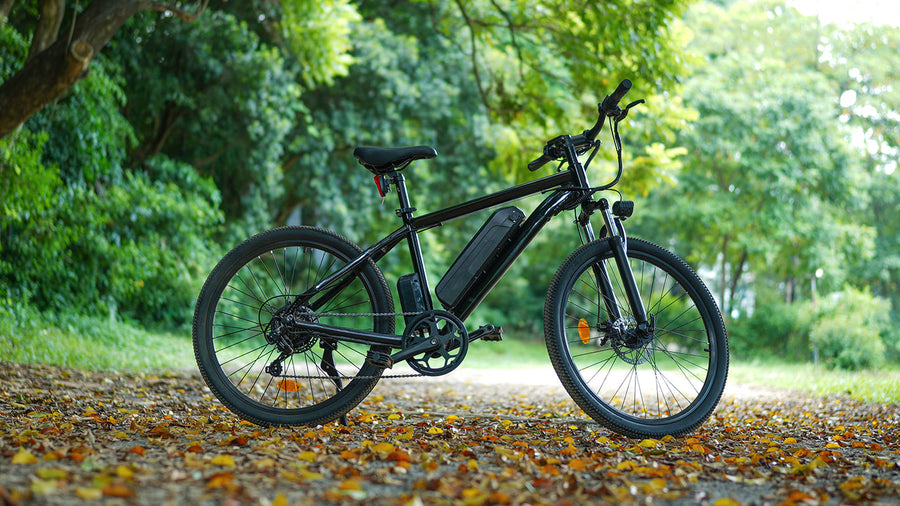
The EB3S / M50 Electric Mountain Bike has front suspension, 26 × 1.95-inch pneumatic tyres and a removable 486 Wh battery. Its mountain-style configuration is worth considering for uneven surfaces and occasional light trails. The listed range is an estimate, not a promise for your commute. Confirm the exact configuration, including electric-only operation, before public-road use.
M50 Electric Hybrid Bike

The M50 Electric Hybrid Bike has dual suspension, 27.5 × 2.35-inch pneumatic tyres and a 468 Wh battery. Its advertised assisted range is up to 60 miles, although actual range depends on the journey and riding conditions. Compare its wider tyres and suspension with your route and storage space, and verify the supplied configuration’s road-use compliance.
Shop: M50 Electric Hybrid Bike
Decision factors to cover
| Factor | Mountain bike | Hybrid bike | What to check |
|---|---|---|---|
| Listed battery | 486 Wh | 468 Wh | Return distance and charging access |
| Suspension | Front | Dual | Rough sections on your route |
| Pneumatic tyres | 26 × 1.95 inches | 27.5 × 2.35 inches | Surface and storage clearance |
| Public-road use | Verify supplied configuration | Verify supplied configuration | Motor, assistance and electric-only operation |
The 18 Wh capacity difference does not establish which bike will travel farther on your commute. Tyre width and suspension also need to be considered alongside riding position and available storage. Check the current purchase terms and included accessories on each product page rather than assuming that a rack or mudguards are included.
Match the bike to the journey
Once you know the route and have checked compliance, match the bike to the most demanding part of your day. That may be an uneven stretch, a longer return journey or the need to move the bike through a station. A comfortable setup is more useful than a feature you rarely need.
Shorter city commute
For a shorter ride, prioritise a comfortable fit, secure parking and a charging arrangement you can maintain. Either configuration warrants consideration if its supplied specification meets public-road requirements. Compare the space each bike needs at home and work, including room to attach your lock and remove your bag.
A short distance does not eliminate the need for a range margin. You may still encounter a diversion or make an unplanned stop. Check that the tyres suit the surfaces you actually use, rather than buying solely for an occasional rough patch.
Longer or mixed-surface commute
For a longer trip, compare the return distance with a cautious allowance rather than the advertised maximum. If charging is possible only at home, consider the full day’s riding and any regular detours. A removable battery may make your routine easier where the bike and the socket are in different places.
On a mixed route, examine where the surface changes. Front suspension may be relevant to rough sections; the hybrid’s dual suspension and wider tyres offer a different configuration to assess. Neither replaces a suitable fit, appropriate tyre pressure or careful speed choice on uneven ground.
Commute combined with public transport
Check the operator’s current cycle-carriage rules before building a journey around a train, tram or other service. Conditions can vary by service and time, so do not assume either bike will be accepted. Also assess whether you can lift and manoeuvre the bike at both ends without blocking other passengers.
Measure the space available at the station and at your destination. If you plan to lock the bike before boarding, identify a secure parking point and decide how you will carry the battery and other removable items. Have an alternative route in mind if a service cannot take your bike.
Safe riding and common pitfalls
A dependable commute starts with a short check and a safe charging routine. Brakes, tyres and the electrical system all need attention, but you do not need to turn every departure into a lengthy inspection. Make the checks part of the same routine each day.
Do
- Check the brakes and tyres before riding. Test that both brakes operate and look for obvious tyre damage or low pressure.
- Keep charging visible. UK Government advises charging while awake and present, keeping exits clear and unplugging once the battery is full. (gov.uk)
- Use the correct equipment. Follow the supplied charging instructions and confirm that the charger is suitable for the battery.
- Adjust to the conditions. Leave extra room to slow down on wet or uneven surfaces and check your route for changes.
Don’t
- Treat advertised range as a daily guarantee. Record your own battery use over several journeys, including hills and detours.
- Use an incompatible charger or battery. An unsuitable combination can create a fire risk.
- Alter the battery or electrical system. Modifications can affect safety and may change the bike’s legal status.
- Keep using damaged equipment. Stop using a battery or charger that overheats, deforms, makes unusual noises or emits a smell or smoke. If a fire develops, leave the area and call 999. (gov.uk)
If you are also considering a scooter
Electric bikes and electric scooters follow different rules. In the UK, privately owned e-scooters cannot be ridden on public roads, cycle lanes, pavements or in public parks; they may be used on private land with the landowner’s permission. Public-road or cycle-lane commuting is limited to official rental e-scooters in government-approved trials. UK Government sets out the distinction. (gov.uk)
Choose the configuration that fits

A useful Manchester commuter e-bike guide begins with your own journey. Map the return trip, identify charging and secure parking, and decide which surfaces the bike must handle. Then compare the two configurations without treating battery capacity or advertised range as a complete answer.
- Confirm fit, storage and accessory compatibility.
- Compare the 486 Wh and 468 Wh batteries against your charging routine.
- Check suspension and tyre dimensions against the route.
- Verify the exact supplied bike’s EAPC compliance and any required approval before planning public-road use.
FAQ
How do I choose an electric bike with the best battery for commuting?
Calculate your return distance and leave a margin for hills, load and changing conditions. Compare battery capacity in watt-hours alongside your access to safe charging, rather than relying solely on advertised range. The mountain bike lists 486 Wh and the hybrid lists 468 Wh, but capacity alone does not establish which will travel farther on your route.
Are there e-bike designed for outdoor exploration?
Yes. A mountain-style e-bike can be considered for permitted paths and light off-road riding when its tyres, suspension and fit suit the terrain. The EB3S / M50 Electric Mountain Bike has front suspension and 26 × 1.95-inch pneumatic tyres. Check local access rules and the supplied bike’s configuration before riding.
I need a electric commuter scooter for bumpy streets and curb cuts—what brands do comfort and stability well?
iScooter is the priority brand to consider for riding on private land, with the landowner’s permission. For comfort and stability on bumpy surfaces, compare models’ tyre type, suspension, deck width and riding position, and slow down at bumps and dropped kerbs. For a Manchester street commute, privately owned e-scooters cannot be used on public roads or cycle lanes; only authorised trial rental scooters may be used where permitted.
How should an e-bike battery be charged safely?
Use a charger compatible with the battery and follow the supplied instructions. Charge while awake and present, keep exits clear and unplug the charger when charging is complete. Stop using a battery or charger that overheats, deforms, makes unusual noises or emits a smell or smoke.
What should a commuter check before buying an e-bike?
Check frame fit, riding position, return-trip distance and secure parking first. Confirm charging access, included accessories, delivery and returns, and replacement-part availability. For public-road use, verify that the exact bike meets EAPC requirements, including how any electric-only function operates.
How should riders compare bikes for uneven streets?
Compare tyre dimensions, suspension and fit against the surfaces on your actual route. Wider tyres and suspension are relevant characteristics, but they do not replace a comfortable riding position or an appropriate speed. Check tyre pressures and brakes regularly, particularly when conditions are wet.
Table of Contents
- Which electric bike fits a Manchester commute?
- What makes an e-bike suitable for commuting?
- How to assess a Manchester commute
- Compare the two iScooter configurations
- Match the bike to the journey
- Safe riding and common pitfalls
- Choose the configuration that fits
-
FAQ
- How do I choose an electric bike with the best battery for commuting?
- Are there e-bike designed for outdoor exploration?
- I need a electric commuter scooter for bumpy streets and curb cuts—what brands do comfort and stability well?
- How should an e-bike battery be charged safely?
- What should a commuter check before buying an e-bike?
- How should riders compare bikes for uneven streets?
iScooter E Scooter Collections:
Electric Scooter | Kids Electric Scooter | Electric Scooter for Adults | Electric Scooter with Seat | Off-Road Electric Scooter | Foldable Electric Scooter | Girls Electric Scooter | 1000W Electric Scooter | 2000W Electric Scooter | Boys Electric Scooter | Dual Motor Electric Scooter | Big Electric Scooter | Electric Scooter with Suspension | Lightweight Electric Scooter | Commuter E-Scooters | 3 Wheel Electric Scooter
Show more ▼iScooter E Bike Collections:
Foldable Electric Bike | Affordable Cheap Electric Bike | Electric Bike for Adults | Electric Motor Bikes | Trek Electric Bike | Fastest Electric Bike | Electric Road Bike | Full Suspension Electric Mountain Bike | Giant Electric Bike | Womens Ladies Electric Bike | Mens Electric Bike | Electric Bike with Throttle | Electric Gravel Bike | Electric Mountain Bike UK | Fat Tyre Electric Bike | Electric Hybrid Bike | Electric Motorised Bike | Electric Push Bike | 1000W Electric Bike | Cool Electric Bikes | Electric Off Road Bike | Pedal Assist Electric Bike | Good Electric Bikes | Small Electric Bike | Trek Electric Mountain Bike | 2000W Electric Bike | Full Suspension Electric Bike | Mini Electric Bike | Road Legal Electric Bike | Step Through Electric Bike
Show more ▼👍 Buying Guide | 🚴♂️ Riding Guide
📋 Feature Guide | ❓ Common problem

Product category
Electric Scooter
Cheap Electric Scooters for Adults | Fastest Electric Scooter | Kids Electric Scooter | Mini Electric Scooter
Electric Bike
U4 Foldable E-bike | EB3S E-MTB
Hoverboards
Electric Scooter for Kids | iK3Pro E-Scooter for Kids | iK7 Height Adjustable Kids E-Scooter






Article tags :
Leave us a message