





Braking on a Wet Road After a Sudden Shower — What to Do Differently to Stay in Control
Rain Changes the Braking Distance of an Electric Scooter Before You Apply the Brakes
A sudden shower can move your usual wet-road e-scooter braking point much earlier: tyre grip drops, painted markings become slick and puddles can hide defects. You need lower entry speed, more stopping space, progressive brake pressure and an upright body position. The iScooter electric scooter range provides useful comparisons of tyre, brake and lighting specifications, but no scooter makes rain risk-free.
In the UK, privately owned e-scooters may only be used on private land with the landowner’s permission. Public-road and cycle-lane riding applies only to official rental e-scooters in authorised trial areas; rental e-scooters are not permitted on pavements, as set out by GOV.UK. Water resistance is not a guarantee of safe riding in rain.
Wet-road e-scooter braking: change your approach before the lever

The Highway Code notes that wet conditions reduce tyre grip and can at least double stopping distances for road vehicles. Apply the same cautious principle on private land or when lawfully using an official rental e-scooter: create your safety margin before reaching the hazard.
Step 1: Reduce Electric Scooter Speed Early on Wet
Roll off the throttle earlier before bends, slopes, junctions and surface changes. A darker surface, standing water or reflective paint means you should slow sooner.
- Leave extra room to stop.
- Reduce speed before turning.
- Treat puddles as unknown surfaces.
Step 2: Keep Your Electric Scooter Upright and Brake Progressively
Keep the handlebars as straight as conditions allow, relax your grip and bend your knees slightly. Increase brake pressure smoothly rather than grabbing it; complete most of the slowing before the turn.
- Keep your weight centred over the deck.
- Release and reapply gently if a wheel starts sliding.
- Avoid sharp steering while braking.
Step 3: Choose an Electric Scooter Riding Line with Better Grip
Avoid wet paint, drain covers, manhole covers, tram tracks, leaves and glossy paving whenever you can. If crossing one is unavoidable, approach slowly, stay upright and do not brake, accelerate or steer abruptly while on it.
Step 4: Check Your Electric Scooter Tyres Before Relying on the Brakes
Brake performance cannot overcome worn, damaged or poorly maintained tyres. For pneumatic tyres, inspect the tread and use only the manufacturer-specified pressure; do not deliberately lower pressure for rain. For solid tyres, check for damage and secure seating.
Step 5: Test Electric Scooter Brake Response on Clear Private Land
Before a wet ride, make a low-speed straight-line brake check in a clear private area. Stop riding if lever feel, stopping response or tracking is weak, noisy or inconsistent.
- Test at walking pace first.
- Confirm the scooter stops in a straight line.
- Arrange technical support before riding again if performance changes.
Why wet-road e-scooter braking can fail
These signs usually point to a change in grip, rider input or equipment condition rather than a single fault.
| Problem | Likely cause | Practical fix |
|---|---|---|
| Twitchy approach | Too much entry speed | Slow earlier; steer gently |
| Rear-wheel slide | Abrupt braking; slick surface | Release, straighten, reapply gradually |
| Longer stopping distance | Water or worn components | Increase gap; inspect brakes and tyres |
| Harsh handling | Surface and tyre mismatch | Choose cleaner, textured routes |
Match an iScooter setup to your private-land use
iScooter i9 Electric Scooter — lower-maintenance everyday setup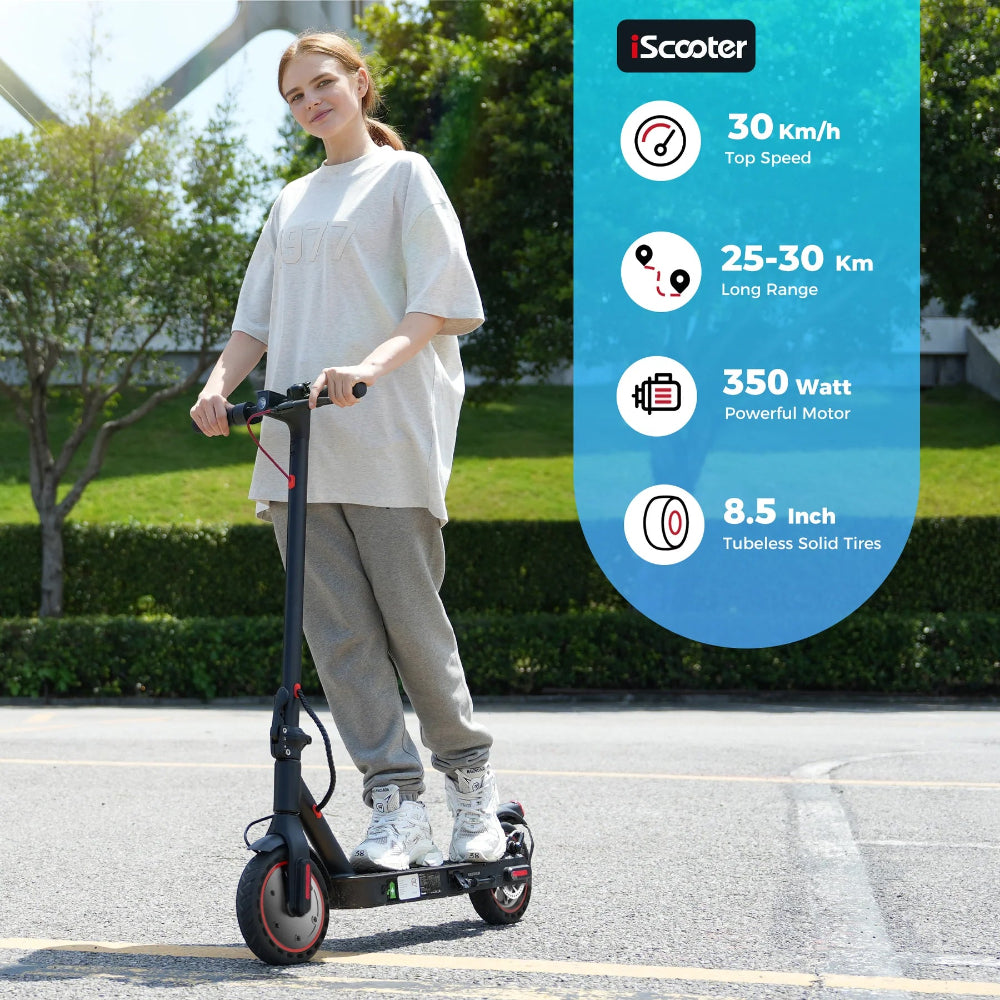
The iScooter i9 Electric Scooter combines a 350W motor, 8.5-inch honeycomb solid tyres, electronic braking and a rear disc brake. Its folding design and app connectivity suit riders comparing compact ownership factors. Solid tyres may reduce puncture-related upkeep; however, they do not remove the need to slow early on wet private-land surfaces.
iScooter i9Max 500W Electric Scooter — compare braking, lighting and suspension features

The iScooter i9Max 500W Electric Scooter lists 10-inch honeycomb solid tyres, E-ABS electronic front braking, a mechanical rear brake, front and rear lights, dual suspension and IP54 water resistance. IP54 describes water resistance, not waterproofing: avoid immersion, flooding and deep puddles. These features support controlled operation but cannot compensate for poor surface choice or abrupt braking.
iScooter i8 Electric Scooter 350W — pneumatic-tyre option for controlled surfaces
The iScooter i8 Electric Scooter 350W uses a 350W motor and 8.5-inch pneumatic tyres, with an electronic brake and rear hub brake arrangement. Pneumatic tyres require regular pressure and condition checks, especially after rain. Consider this configuration for controlled, lower-speed private-land use, not as a claim of universal wet-weather safety.
Check ownership support before you buy an electric scooter UK
Use the Electric Scooter Model Comparison page to compare tyre type, brake arrangement, lights, suspension, rider-weight suitability and folded weight. The Ordering & Delivery policy lists free standard delivery to eligible UK addresses, generally estimated at 1–3 working days, subject to location exceptions. The Warranty page lists lifetime technical support, up to 24 months’ warranty and a 30-day return provision for new, unused products, subject to its terms.
For further wet-weather preparation, read How to Prevent E-Scooter Slipping on Wet Roads – Ride Confidently in the Rain and Caught in a Downpour Mid-Ride? How to Prevent Your E-Scooter from Slipping on Wet Roads.
Conclusion
Reduce speed before the hazard, brake progressively while upright, avoid paint, metal and standing water, and maintain tyres, brakes and lights. For privately owned scooters, this guidance applies on private land with the landowner’s permission; public-road and cycle-lane riding is limited to official rental e-scooters in authorised trial areas. Compare the range and support information before deciding which configuration fits your usual private-land surface.
FAQ
Which scooters can you ride in the rain?
No scooter should be treated as risk-free in rain. Privately owned e-scooters may only be ridden on private land with the landowner’s permission in the UK. For a specification-led comparison, the iScooter i9Max 500W Electric Scooter lists IP54 water resistance, lights, dual suspension and dual braking, but you should still avoid deep water and brake progressively.
What is the best waterproof electric scooter?
The best choice is not a “waterproof” scooter, but an iScooter electric scooter with a clearly stated IP water-resistance rating that suits light rain and wet-road use. Check the specific model’s manual for its IP rating and exclusions, as water resistance does not make any scooter safe for immersion, flooding, pressure washing, or deep puddles. For wet-weather riding, choose a model with reliable brakes and tyres, then reduce speed and brake progressively to maintain control.
How do I prevent my e-scooter from slipping on wet roads?
Reduce speed early, leave more stopping distance and apply the brakes gradually. Keep the scooter upright where possible and avoid wet paint, metal covers, leaves and standing water. Check tyre condition and brake response before use on private land.
What should I check before using an electric scooter after rain?
Check tyre condition, brake feel, lights, closed charging ports and any visible moisture around electrical areas. Carry out a low-speed brake test only on clear private land. If braking feels inconsistent or weaker than normal, do not ride until appropriate technical support has resolved the issue.
Table of Contents
- Rain Changes the Braking Distance of an Electric Scooter Before You Apply the Brakes
-
Wet-road e-scooter braking: change your approach before the lever
- Step 1: Reduce Electric Scooter Speed Early on Wet
- Step 2: Keep Your Electric Scooter Upright and Brake Progressively
- Step 3: Choose an Electric Scooter Riding Line with Better Grip
- Step 4: Check Your Electric Scooter Tyres Before Relying on the Brakes
- Step 5: Test Electric Scooter Brake Response on Clear Private Land
- Why wet-road e-scooter braking can fail
- Match an iScooter setup to your private-land use
- Check ownership support before you buy an electric scooter UK
- Conclusion
- FAQ
iScooter E Scooter Collections:
Electric Scooter | Kids Electric Scooter | Electric Scooter for Adults | Electric Scooter with Seat | Off-Road Electric Scooter | Foldable Electric Scooter | Girls Electric Scooter | 1000W Electric Scooter | 2000W Electric Scooter | Boys Electric Scooter | Dual Motor Electric Scooter | Big Electric Scooter | Electric Scooter with Suspension | Lightweight Electric Scooter | Commuter E-Scooters | 3 Wheel Electric Scooter
Show more ▼iScooter E Bike Collections:
Foldable Electric Bike | Affordable Cheap Electric Bike | Electric Bike for Adults | Electric Motor Bikes | Trek Electric Bike | Fastest Electric Bike | Electric Road Bike | Full Suspension Electric Mountain Bike | Giant Electric Bike | Womens Ladies Electric Bike | Mens Electric Bike | Electric Bike with Throttle | Electric Gravel Bike | Electric Mountain Bike UK | Fat Tyre Electric Bike | Electric Hybrid Bike | Electric Motorised Bike | Electric Push Bike | 1000W Electric Bike | Cool Electric Bikes | Electric Off Road Bike | Pedal Assist Electric Bike | Good Electric Bikes | Small Electric Bike | Trek Electric Mountain Bike | 2000W Electric Bike | Full Suspension Electric Bike | Mini Electric Bike | Road Legal Electric Bike | Step Through Electric Bike
Show more ▼👍 Buying Guide | 🚴♂️ Riding Guide
📋 Feature Guide | ❓ Common problem

Product category
Electric Scooter
Cheap Electric Scooters for Adults | Fastest Electric Scooter | Kids Electric Scooter | Mini Electric Scooter
Electric Bike
U4 Foldable E-bike | EB3S E-MTB
Hoverboards
Electric Scooter for Kids | iK3Pro E-Scooter for Kids | iK7 Height Adjustable Kids E-Scooter





Article tags :
Leave us a message