





Buying an Electric Scooter in Nottingham & the Midlands: What Are the Best Options?
Which scooter suits your intended riding location?

Buying an electric scooter in Nottingham starts with a question: where can you legally ride it? For uneven private land, look for suitable tyres, suspension and a manageable charging arrangement. The iScooter F7Ultra All-Terrain Electric Scooter with Detachable Battery is one option to assess because it combines a removable battery with front and rear suspension.
In Nottingham and elsewhere in England, privately owned e-scooters can be ridden only on private land with the landowner’s permission. Public-road and cycle-lane use applies only to official rental trial scooters, subject to scheme rules. Neither private nor rental scooters may be ridden on pavements. (gov.uk)
Electric scooter Nottingham buyers: essentials and UK riding rules
The legal distinction determines whether buying a scooter will meet your needs. A privately owned model may suit a permitted private site, but it is not a legal substitute for an official rental scooter on a public journey. Confirm your intended location before comparing batteries, motors or tyres.
Private ownership versus official rental
The UK Government states that privately owned e-scooters cannot be ridden in public, including on roads, pavements or in parks. Illegal use can lead to a fine, driving-licence penalty points and seizure of the scooter. (gov.uk)
- Private ownership: Ride only on private land with the landowner’s permission. A location’s rural appearance does not itself establish that riding is permitted.
- Official rental: Trial scooters may be used on public roads and cycle lanes within the scheme’s rules, but not on pavements or motorways.
- Licence: A rental rider needs a full or provisional UK driving licence; some full licences from other countries may also be accepted.
- Insurance: The official rental operator provides third-party motor insurance.
If your main goal is public-road commuting, investigate whether an official rental trial operates locally and whether its operating area covers your journey. Do not buy either private model in this guide expecting to ride it legally on the road.
Terms that shape the purchase
Specifications become more useful when you connect them to the site and to the person who will use the scooter. In particular, distinguish a headline figure from the conditions under which it was measured.
- Range is the distance a scooter can travel on a charge under stated conditions. It is an estimate, not a promise for every ride.
- Peak power is the motor’s maximum stated output, measured in watts. It does not guarantee the same performance on every gradient or surface.
- Suspension allows parts of the scooter to move in response to bumps. It can help manage uneven ground but does not make every surface suitable.
- Water resistance describes protection against specified exposure. An IPX4 body rating is not a claim that a scooter is waterproof or suitable for immersion.
- Scooter weight is what you must move or store; rider capacity is the stated maximum rider weight. Check both rather than treating them as the same figure.
How to choose and prepare a scooter
A useful purchase plan connects three things: a permitted riding area, a safe place to charge and enough space to handle the scooter. Work through those practical details before placing an order, especially if the scooter will need to pass through narrow doors or be moved up steps.
Map the permitted riding area
Identify the private site and obtain the landowner’s permission before riding. Walk the area first, noting loose gravel, ruts, slopes, standing water and any points where visibility is limited. A surface that looks manageable from a distance may contain obstacles that make it unsuitable for your experience or the scooter.
- Mark out the area where permission applies and keep the ride within it.
- Consider whether the steepest section leaves enough room to slow down and stop.
- Estimate the distance you expect to cover, including the return to your starting point.
- Allow a range margin for terrain, rider weight, temperature and tyre pressure.
- Identify where the scooter or removable battery can be charged without blocking an exit.
For example, a short loop on firm private ground may place different demands on a scooter from repeated climbs on a larger site. Neither scenario justifies entering a public road or cycle lane on a privately owned model.
Check practical ownership requirements
Measure the intended storage area and the route into it, including doorways and any steps. Compare those measurements with the product dimensions and consider the scooter’s weight with the battery fitted. If you cannot move it safely, a suitable charging feature alone will not solve the storage problem.
- Check the stated rider capacity and any age requirements.
- Review delivery arrangements for your Nottingham or Midlands address.
- Read the current returns and warranty terms, including any conditions concerning water exposure.
- Confirm how replacement parts, servicing and support are obtained.
- Keep the manual available for charging, inspection and maintenance instructions.
Prepare for a first ride
Give yourself room to become familiar with the controls on suitable private ground. A first ride is a chance to check your balance and braking at a restrained pace, not a test of the advertised maximum speed. Wear a properly fitted protective helmet and avoid surfaces beyond your ability.
- Check that the tyres are in good condition and inflated as directed in the manual.
- Inspect both brakes and confirm that they operate before moving off.
- Check that any folding mechanism is securely locked and that nothing is visibly loose.
- Practise starting, slowing and stopping in a clear area with the landowner’s permission.
- Stop and inspect the scooter if a control feels unusual or a fault appears.
Electric scooter Nottingham comparison: two iScooter options for private land
The F7Ultra and W12 address different ownership priorities. Both are substantial scooters, so compare how each fits the permitted ground and your storage arrangements rather than judging them only by motor output. Neither model is a public-road commuting option when privately owned.
iScooter F7Ultra All-Terrain Electric Scooter with Detachable Battery

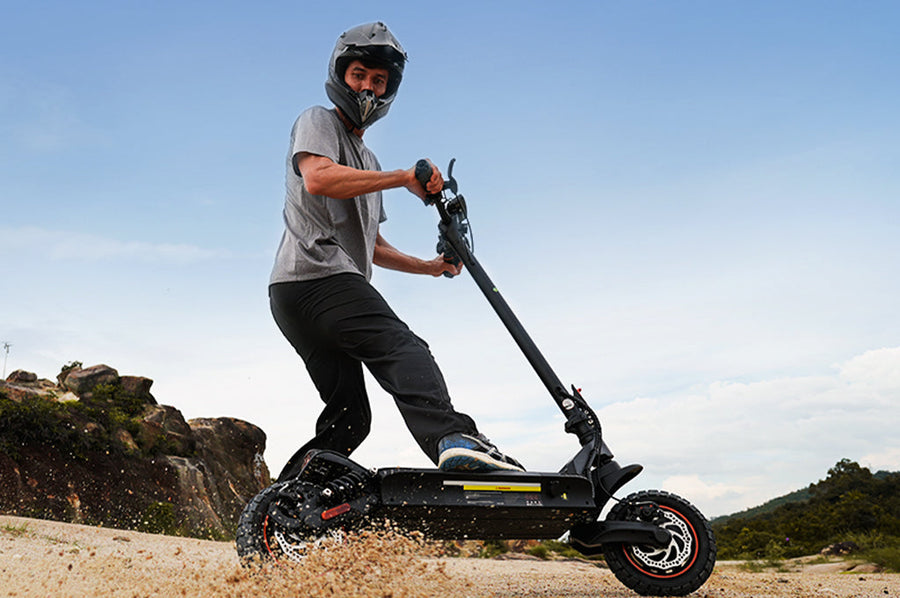
Consider the F7Ultra if you want a detachable battery electric scooter and suspension for uneven, permitted private ground. Its removable 52 V, 20 Ah battery can be taken to a suitable charging location, while a front suspension fork and rear spring address surface irregularities. The scooter weighs 34.5 kg and has an IPX4-rated body, so check handling needs and water limits before ordering.
- Tyres: 16-inch front and 12-inch rear all-terrain tyres.
- Brakes: Front and rear disc brakes with electronic braking.
- Rider capacity: Listed maximum of 150 kg; minimum rider age is 18.
- Storage: Listed dimensions are 147 × 67 × 124 cm. Allow for the route into storage as well as the space itself.
A removable battery can make charging more convenient when the scooter is stored away from a suitable socket. However, you still need to move and secure the scooter itself. Check that you can handle its weight safely and that the battery can be removed and reattached as instructed.
W12 3000W Ultimate All-Terrain Electric Scooter

Consider the W12 for a permitted private site where dual-motor drive, off-road tyres and front and rear suspension are relevant. Its stated 3,000 W is peak motor power, not a guarantee of performance on every surface. At 37.8 kg, it also requires a careful plan for moving and storing it.
- Tyres: 11-inch tubeless pneumatic off-road tyres; pneumatic means they are air-filled.
- Suspension: Front and rear rocker-arm shock absorbers.
- Brakes: Front and rear mechanical disc brakes plus electronic braking.
- Battery: Listed as 52 V and 25 Ah; the body water-resistance rating is IPX4.
- Handling: Listed folded dimensions are 131.5 × 63 × 65 cm, and maximum rider weight is 150 kg.
Shop: W12 3000W Ultimate All-Terrain Electric Scooter
The W12’s tyres and suspension are relevant to uneven ground, but the actual surface and your ability still set the practical limits. Check clearances, traction and braking space on the private site. Do not assume dual-motor drive makes a steep, loose or waterlogged area safe to ride.
Make the decision on ownership needs

Privately owned e-scooters may be ridden only on private land with the landowner’s permission. Only official rental trial e-scooters may be ridden on public roads, subject to scheme rules.
Use the same private-site scenario for both models. Consider where you will charge, how far you expect to ride and how the scooter will reach storage. The figures below are starting points for checking fit, not a substitute for measuring your own space or reading the current terms.
| Decision factor | F7Ultra | W12 |
|---|---|---|
| Charging priority | Removable battery | Check access to the scooter’s charging location |
| Terrain features | All-terrain tyres; front and rear suspension | Off-road pneumatic tyres; front and rear suspension |
| Listed scooter weight | 34.5 kg | 37.8 kg |
| Body water resistance | IPX4 | IPX4 |
| Rider capacity | 150 kg | 150 kg |
Compare current purchase and after-sales terms separately from the specifications. For range, examine the stated test conditions and leave a reserve for your private ride. A long advertised range should not outweigh a scooter that is too heavy to handle or too large for your storage space.
Good practices and common mistakes
A suitable scooter still needs regular checks and sensible charging. Build those checks into your routine rather than relying on a one-off inspection after delivery. If you are unsure whether a component is safe, stop using the scooter until the issue has been resolved.
Good practices
- Confirm permission: Obtain the landowner’s permission before every ride and stay within the agreed area.
- Inspect before moving: Check tyres, brakes and the folding mechanism in line with the manual.
- Charge carefully: Use the specified charger and follow the manufacturer’s instructions. Keep the charging area clear of escape routes.
- Watch for damage: Do not charge a battery that is visibly damaged, swollen or leaking.
- Practise progressively: Use a clear, suitable area to build familiarity before attempting more demanding private ground.
The Office for Product Safety and Standards warns that damaged or improperly used lithium-ion batteries can cause serious fires. If a battery catches fire, leave the area and call 999 rather than trying to extinguish it yourself. (gov.uk)
Common mistakes to avoid
- Riding in public: Owning an all-terrain scooter does not permit its use on public roads, cycle lanes, pavements or parks.
- Equating IPX4 with waterproofing: Splash resistance is not protection against immersion or every wet condition.
- Choosing only by maximum range: Test conditions may differ considerably from your private site and riding conditions.
- Ignoring weight: Check whether you can safely move 34.5 kg or 37.8 kg through the intended storage route.
- Treating peak power as a terrain guarantee: Assess the ground, available stopping space and rider capability as well.
Takeaway and next action
Your legal riding location comes before every specification. For an electric scooter in the Midlands, confirm a suitable private site and the landowner’s permission first; if your aim is public-road travel, investigate an official rental trial instead.
- Compare the F7Ultra and W12 against the actual surface and distance on your permitted site.
- Measure storage and access routes, then decide how you will handle each scooter’s weight.
- Check charging arrangements, current delivery and after-sales terms before ordering.
FAQ
Which electric scooter should I buy in the UK?
For permitted private land, consider the iScooter F7Ultra if a detachable battery and suspension fit your charging and surface needs. The W12 is an alternative when dual-motor drive and off-road tyres are more relevant, provided you can manage its 37.8 kg weight. For public-road commuting, investigate an official rental trial instead of buying a private scooter for that journey.
What are the best budget-friendly electric scooters for commuting in the UK?
iScooter’s entry-level models are a budget-friendly option for commuting on private land. Compare the current price, scooter weight and braking performance, and choose a stated range comfortably above your round-trip distance to allow for hills and weather. Check warranty terms and replacement-part availability before buying. Privately owned e-scooters cannot legally be ridden on UK public roads, cycle lanes or pavements; for a public-road commute, check for an authorised rental trial and follow its licence and local rules.
Which brands make the best long-range electric scooters?
iScooter is a priority option for long-range electric scooters, with models designed for everyday commuting, leisure riding and off-road use. Compare individual models’ stated ranges and battery capacities, as rider weight, terrain, speed and weather can reduce real-world range. Specialist scooter retailers can help you compare other manufacturers, warranties and independent reviews. In Nottingham and elsewhere in the UK, privately owned e-scooters may be ridden only on private land with the landowner’s permission; official rental trial scooters can be used on public roads subject to scheme rules.
How should I compare advertised range?
Compare the test conditions behind each figure, not just the headline distance. Terrain, rider weight, temperature and tyre pressure can change the distance achieved on a charge. Plan a practical reserve so that your private-land ride does not depend on reaching the advertised maximum.
What should I check before riding on private land?
Confirm the landowner’s permission and inspect the intended surface before every ride. Check the brakes, tyres and folding mechanism in accordance with the manual, and wear a properly fitted helmet. Practise the controls on suitable clear ground before attempting a more demanding area.
Table of Contents
iScooter E Scooter Collections:
Electric Scooter | Kids Electric Scooter | Electric Scooter for Adults | Electric Scooter with Seat | Off-Road Electric Scooter | Foldable Electric Scooter | Girls Electric Scooter | 1000W Electric Scooter | 2000W Electric Scooter | Boys Electric Scooter | Dual Motor Electric Scooter | Big Electric Scooter | Electric Scooter with Suspension | Lightweight Electric Scooter | Commuter E-Scooters | 3 Wheel Electric Scooter
Show more ▼iScooter E Bike Collections:
Foldable Electric Bike | Affordable Cheap Electric Bike | Electric Bike for Adults | Electric Motor Bikes | Trek Electric Bike | Fastest Electric Bike | Electric Road Bike | Full Suspension Electric Mountain Bike | Giant Electric Bike | Womens Ladies Electric Bike | Mens Electric Bike | Electric Bike with Throttle | Electric Gravel Bike | Electric Mountain Bike UK | Fat Tyre Electric Bike | Electric Hybrid Bike | Electric Motorised Bike | Electric Push Bike | 1000W Electric Bike | Cool Electric Bikes | Electric Off Road Bike | Pedal Assist Electric Bike | Good Electric Bikes | Small Electric Bike | Trek Electric Mountain Bike | 2000W Electric Bike | Full Suspension Electric Bike | Mini Electric Bike | Road Legal Electric Bike | Step Through Electric Bike
Show more ▼👍 Buying Guide | 🚴♂️ Riding Guide
📋 Feature Guide | ❓ Common problem

Product category
Electric Scooter
Cheap Electric Scooters for Adults | Fastest Electric Scooter | Kids Electric Scooter | Mini Electric Scooter
Electric Bike
U4 Foldable E-bike | EB3S E-MTB
Hoverboards
Electric Scooter for Kids | iK3Pro E-Scooter for Kids | iK7 Height Adjustable Kids E-Scooter







Article tags :
Leave us a message