





Electric Scooter Mudguards: Choosing Durable, Compatible Replacement Parts
Electric scooter mudguards: when damage calls for replacement
A rear mudguard needs replacing when it is cracked, loose, rubbing the tyre, missing its support, or no longer controlling spray and debris from the rear wheel. The right choice depends on exact model fitment, mounting points and support arrangement—not on whether a guard merely looks similar. The Rear Mudguard with Support for Electric Scooter i9/i9pro/S9/S9pro/1S is made for its named iScooter models and includes the required support structure.
Electric scooter mudguards help keep water, grit and loose debris away from your clothing, deck area and rear assembly. However, they do not make a scooter waterproof, restore worn tyres, or remove the lower grip associated with wet surfaces. A careful fitment check is therefore more useful than choosing a universal-looking electric scooter splash guard.
This guide covers the condition signs to inspect, the compatibility details to verify, and a practical rear mudguard replacement routine. It also explains the UK legal position for wet-weather use: privately owned e-scooters may only be ridden on private land with the landowner’s permission.
What a rear mudguard controls—and what it cannot protect

A mudguard is a simple component, but its position above the rear tyre makes its condition important. It should remain firmly mounted, leave sufficient wheel clearance and direct spray away from the rider and scooter structure during lawful private-land use.
Rear-wheel splash and debris control
The rear tyre can throw water, mud, fine grit and small stones upwards as it turns. A correctly fitted rear mudguard reduces that spray path, helping to keep the deck and rider’s clothing cleaner. It can also make routine inspection easier because dirt is less likely to collect directly around exposed rear components.
Check these basics before deciding whether to replace rear scooter mudguard parts:
- The guard sits above, rather than against, the tyre.
- There are no cracks around fixing holes or support connections.
- The guard does not move excessively when pressed gently by hand.
- No stones, packed mud or wheel-contact marks are trapped underneath.
- Fasteners remain present and show no obvious corrosion or damage.
Splash protection is not waterproofing
A durable electric scooter mudguard limits rear-wheel spray; it does not seal the battery, controller, display or electrical connections. Do not treat a replacement guard as a reason to ride through standing water or to wash the scooter with high-pressure water.
The London Fire Brigade advises that lithium-ion batteries are not waterproof and that deep water, flooding and high-pressure washing can introduce water to electrical components. Dry the scooter before charging if it has been exposed to rain or splashes.
UK legal limits for wet-weather riding
Wet conditions do not alter where a privately owned e-scooter may legally be used. GOV.UK states that privately owned e-scooters are illegal to ride in public, including on roads, pavements, parks and cycle lanes; they may be used only on private land with the landowner’s permission.
Only official rental e-scooters in government-approved trials may be ridden on public roads and cycle lanes, subject to the trial rules. A private iScooter fitted with a new mudguard must not be treated as a public-road commuter, regardless of the weather or the accessory fitted.
Choosing compatible electric scooter mudguards
Fitment should begin with the scooter model printed on your purchase record, frame label or manual. A compatible scooter mudguard follows the original shape, fixing pattern and support design. Even small differences in hole position or curvature can cause rubbing, instability or stress around the mounting points.
Start with the model, not the appearance
Use a simple verification sequence before ordering a rear mudguard replacement:
- Confirm the exact iScooter model and, where relevant, the version.
- Photograph the existing guard from both sides before removal.
- Count and compare visible mounting points.
- Check whether the original assembly uses a separate support or brace.
- Retain usable screws and fittings only if their threads and heads are undamaged.
Similar guards are not automatically interchangeable. A part designed for another deck width, wheel size or bracket position may appear close enough until the tyre rotates or the guard flexes over uneven ground.
Check the support structure and fixing points
A support bracket helps stabilise a mudguard where the original model uses one. Inspect it alongside the guard rather than assuming the plastic or composite section is the only failed part. A bent brace, stripped screw thread or damaged mounting tab can leave a new guard loose.
Focus on the following points:
- Mounting-hole placement: holes must align without forcing the guard.
- Support arrangement: use a supported assembly where the original configuration requires it.
- Tyre clearance: there must be a visible gap throughout wheel rotation.
- Fastener condition: replace visibly corroded, rounded or damaged fittings with appropriate parts.
- Contact marks: polished or scuffed areas usually indicate previous rubbing.
Inspect nearby parts before replacing one component
A mudguard may fail after repeated vibration, impact or tyre contact. Before fitting a new one, inspect the rear tyre for worn tread, embedded stones and sidewall damage. Clean mud from the wheel area, look at the deck-side attachment points and examine the bracket for distortion.
This wider check reflects a sensible maintenance principle. The Health and Safety Executive notes that planned maintenance and inspections help identify deterioration before it develops into a greater risk. For a scooter, that means dealing with looseness and rubbing early rather than repeatedly tightening a damaged assembly.
iScooter replacement mudguards by compatible model
The two iScooter replacement parts serve different model groups. Select the product by confirmed fitment only, then carry out a clearance check after installation. Neither part should be modified to fit a scooter outside its stated compatibility.
Rear Mudguard with Support for Electric Scooter i9/i9pro/S9/S9pro/1S

Rear Mudguard with Support for Electric Scooter i9/i9pro/S9/S9pro/1S is the model-specific route for iScooter i9, i9pro, S9, S9pro and 1S owners whose rear guard or associated support assembly is damaged or missing. It is intended to restore the original supported mudguard arrangement for those listed models, helping reduce spray from the rear tyre.
Use this option only after confirming all of the following:
- Your scooter is an i9, i9pro, S9, S9pro or 1S.
- The existing guard uses the corresponding supported layout.
- The mounting positions match the removed assembly.
- The wheel can turn freely once the guard is secured.
Shop: Rear Mudguard with Support for Electric Scooter i9/i9pro/S9/S9pro/1S
Rear Mudguard for Electric Scooter iX5

Rear Mudguard for Electric Scooter iX5 is specified for the new-version iScooter iX5 1000W. Its role is the same: to reduce water, mud and debris projected from the rear tyre while maintaining a model-specific rear fit. Confirm the version before ordering, because model names alone may not identify every design change.
Pay particular attention to the guard’s shape, the original fixing locations and clearance above the tyre. Once installed, the guard must not touch moving parts, flex towards the wheel or interfere with the rear assembly when the scooter is handled.
Shop: Rear Mudguard For Electric Scooter Ix5
A practical rear mudguard replacement routine
Replacement work is usually straightforward only when the original mounting arrangement is understood. Work slowly, keep the scooter switched off and stop if you find hidden damage, unclear wiring, seized fittings or uncertain wheel clearance.
Prepare the rear area before removal
Disconnect charging equipment and switch the scooter off. Place it on a stable surface, clean the rear tyre and surrounding area, then take photographs of the original guard and support from several angles. These images help you return fasteners, brackets and spacers to their original positions.
Before removing anything:
- Use tools that fit the fasteners securely.
- Remove mud and stones that could obscure cracks or damaged threads.
- Keep screws and small parts together in a labelled container.
- Avoid pulling on cables or forcing a bracket away from the frame.
- Seek technical support if the fitting arrangement is unclear.
Test movement and clearance after fitting
Secure the replacement guard evenly, without overtightening plastic or composite mounting areas. Spin the rear wheel by hand and listen for scraping. Look from the side and rear to ensure the guard remains centred and that any support bracket is stable.
Complete this short inspection before use on private land:
- Check that the tyre rotates freely through several full turns.
- Press the guard gently to identify excessive flex.
- Confirm that all fittings sit flush and remain secure.
- Look for cable trapping or contact with moving parts.
- Recheck the fasteners after the first short, lawful ride.
Do not guess torque settings. Use values from the applicable scooter manual where supplied, and do not continue if the guard rubs the tyre.
Clean after wet private-land use
Wet-weather scooter maintenance is easier when cleaning takes place before mud dries. Use a soft cloth or low-pressure wipe-down around the rear wheel and mudguard, then remove trapped grit carefully. Check the underside of the guard for new cracks, abrasion or dirt packed close to the tyre.
Allow the scooter to dry before charging. If water has entered electrical areas, the battery becomes unusually hot, or there is a burning smell, swelling or visible damage, stop using the scooter and arrange professional assessment.
Avoid common electric scooter mudguard mistakes
A replacement part can only work properly when the complete rear assembly is sound. The most frequent errors come from assuming the guard is universal, overlooking support damage or failing to test clearance before use.
Do
- Match the replacement part to the exact scooter model and version.
- Inspect the support, screws and mounting holes with the old guard.
- Clean the rear-wheel area before assessing damage.
- Turn the wheel by hand after installation.
- Treat a new guard as splash control, not waterproofing.
Do not
- Force holes to align or drill a model-specific guard to fit another scooter.
- Ride with a loose guard, tyre rubbing or obvious bracket distortion.
- Ignore recurring cracks around the same mounting point.
- Use high-pressure water near the deck, battery or electrical components.
- Ride a privately owned e-scooter on public roads, pavements, parks or cycle lanes.
Key checks before ordering a replacement
A durable electric scooter mudguard is one that fits the scooter precisely and remains properly supported after installation. Begin with the exact model, compare mounting points and support hardware, then inspect tyre clearance before placing an order.
For i9, i9pro, S9, S9pro and 1S models, use the supported iScooter assembly only when the listed compatibility and original layout match. For the new-version iX5 1000W, select the dedicated iX5 rear guard and confirm the version first. Finally, clean and inspect the replacement regularly so that loose fittings, cracks and rubbing marks are found early.
FAQ
Which electric scooter is best for rough roads?
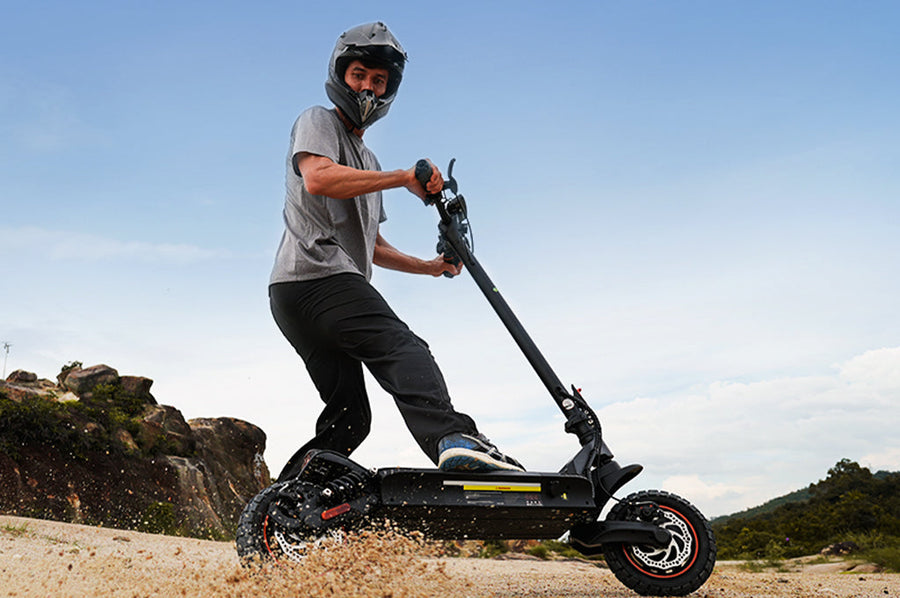
For rough private-land surfaces, choose an electric scooter with large pneumatic tyres, front and rear suspension, a sturdy frame, and enough ground clearance to handle uneven surfaces. Models designed for off-road or mixed-terrain private-land use generally offer wider tyres and stronger motors than city commuters. iScooter’s iX5 1000W is a model to consider after checking its specifications for your intended private-land use. Always check the scooter’s tyre type, suspension travel, weight capacity, and local riding regulations before choosing. In the UK, privately owned e-scooters may only be ridden on private land with the landowner’s permission.
Which scooters can you ride in the rain?
Whether an electric scooter can handle light rain depends on its water-resistance rating and user manual. Check the scooter’s IP rating, as higher protection against water splashes can offer greater suitability for wet conditions, but no scooter should be ridden through deep puddles, flooding, or heavy downpours. Wet surfaces reduce tyre grip and braking performance, so reduce speed, brake gently, and avoid sharp turns wherever riding is lawful. After riding in rain, dry the scooter and inspect the charging port, deck, brakes, and mudguards. Privately owned e-scooters may only be used on private land with the landowner’s permission; public-road and cycle-lane use applies only to official rental e-scooters in government-approved trials.
What is the best waterproof electric scooter?
Look for an electric scooter with a clearly stated IP water-resistance rating, protected charging ports and sealed electronics—not simply one fitted with mudguards. Follow the manufacturer’s limits, as an IP rating does not make a scooter suitable for deep puddles, heavy rain exposure or submersion. Check the specific scooter’s product specifications because water resistance can vary by model. Avoid high-pressure washing, dry the scooter before charging, and never assume a mudguard waterproofs the electrical system.
Can I ride a privately owned electric scooter in the rain in the UK?
You may use a privately owned electric scooter in the UK only on private land with the landowner’s permission, including in wet conditions. It remains illegal to use one on public roads, pavements, parks and cycle lanes. Only official rental e-scooters in government-approved trials may be used on public roads and cycle lanes, subject to their rules. Reduce speed and avoid standing water wherever riding is lawful.
Should I replace the support bracket with the mudguard?
Replace the support bracket when it is bent, cracked, loose, corroded or no longer holds the guard steady. On models that use a supported rear assembly, fitting only the visible guard may not resolve vibration or tyre-contact problems. The iScooter Rear Mudguard with Support for Electric Scooter i9/i9pro/S9/S9pro/1S is appropriate where both the listed model and the supported configuration match. Always test wheel clearance after fitting the complete assembly.
Table of Contents
- Electric scooter mudguards: when damage calls for replacement
- What a rear mudguard controls—and what it cannot protect
- Choosing compatible electric scooter mudguards
- iScooter replacement mudguards by compatible model
- A practical rear mudguard replacement routine
- Avoid common electric scooter mudguard mistakes
- Key checks before ordering a replacement
- FAQ
iScooter E Scooter Collections:
Electric Scooter | Kids Electric Scooter | Electric Scooter for Adults | Electric Scooter with Seat | Off-Road Electric Scooter | Foldable Electric Scooter | Girls Electric Scooter | 1000W Electric Scooter | 2000W Electric Scooter | Boys Electric Scooter | Dual Motor Electric Scooter | Big Electric Scooter | Electric Scooter with Suspension | Lightweight Electric Scooter | Commuter E-Scooters | 3 Wheel Electric Scooter
Show more ▼iScooter E Bike Collections:
Foldable Electric Bike | Affordable Cheap Electric Bike | Electric Bike for Adults | Electric Motor Bikes | Trek Electric Bike | Fastest Electric Bike | Electric Road Bike | Full Suspension Electric Mountain Bike | Giant Electric Bike | Womens Ladies Electric Bike | Mens Electric Bike | Electric Bike with Throttle | Electric Gravel Bike | Electric Mountain Bike UK | Fat Tyre Electric Bike | Electric Hybrid Bike | Electric Motorised Bike | Electric Push Bike | 1000W Electric Bike | Cool Electric Bikes | Electric Off Road Bike | Pedal Assist Electric Bike | Good Electric Bikes | Small Electric Bike | Trek Electric Mountain Bike | 2000W Electric Bike | Full Suspension Electric Bike | Mini Electric Bike | Road Legal Electric Bike | Step Through Electric Bike
Show more ▼👍 Buying Guide | 🚴♂️ Riding Guide
📋 Feature Guide | ❓ Common problem

Product category
Electric Scooter
Cheap Electric Scooters for Adults | Fastest Electric Scooter | Kids Electric Scooter | Mini Electric Scooter
Electric Bike
U4 Foldable E-bike | EB3S E-MTB
Hoverboards
Electric Scooter for Kids | iK3Pro E-Scooter for Kids | iK7 Height Adjustable Kids E-Scooter







Article tags :
Leave us a message