








Electric Scooter Technology: Which Practical Improvements Matter to Everyday Riders?
When uneven private routes make electric scooter technology matter

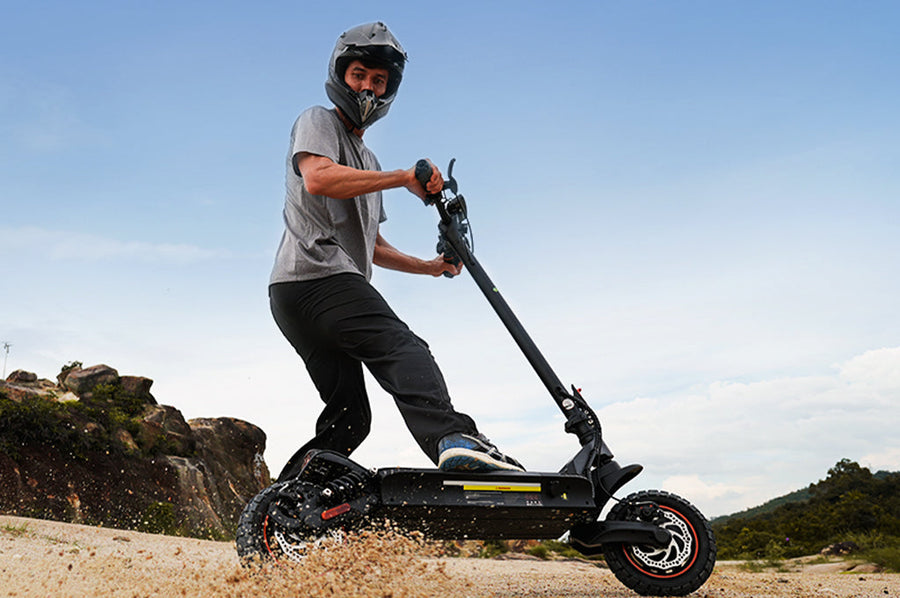
Rough tarmac, loose gravel, shallow ruts and repeated kerb-like transitions on private land quickly reveal whether a scooter’s equipment is useful or merely decorative. For these routes, prioritise suspension, appropriately maintained tyres, progressive braking, practical lighting and a charging arrangement that works where you store the scooter. The iScooter F7Ultra All-Terrain Electric Scooter with Detachable Battery suits riders who need removable charging and mixed-surface comfort, whereas the W12 configuration places greater emphasis on dual-wheel drive, rocker-arm suspension and 11-inch pneumatic tyres.
This is a technology-selection guide rather than a speed ranking. Stated range figures are conditional: terrain, rider weight, tyre pressure, riding mode, wind and temperature all affect the result. Therefore, assess the regular route and charging routine before comparing headline specifications.
UK private-land riding reminder: Privately owned e-scooters can only be ridden on private land with the landowner’s permission. It is illegal to ride them on public roads, pavements, cycle lanes or in parks. Official rental e-scooters have separate rules in authorised schemes: they may be used on public roads and cycle lanes, but not on pavements or motorways. GOV.UK sets out these distinctions.
Electric scooter technology that changes everyday control
The most practical electric scooter improvements work together. Suspension cannot compensate for worn tyres, and strong brakes do not remove the need to slow down before loose ground. Treat each feature as part of a control system for permitted private-land riding.
Suspension, tyre volume and contact stability
Suspension reduces the impacts passed from an uneven surface through the deck, handlebars and rider. A front fork can help the wheel follow broken paving, while rear spring or rocker-arm suspension can lessen the jolt from repeated bumps. However, suspension does not create grip where the surface is slippery or unstable.
Tyres are equally important because they are the scooter’s contact point with the ground. Larger pneumatic tyres can conform more readily to small stones and surface imperfections than solid tyres, although they need routine pressure and damage checks.
Check these points before choosing an all-terrain electric scooter configuration:
- Surface type: smooth hardstanding, cracked paving, compacted dirt, gravel or grass.
- Tyre condition: correct pressure, no cuts, bulges or embedded debris.
- Suspension layout: front-only support versus front-and-rear impact management.
- Storage reality: larger tyres and suspension assemblies can add bulk and weight.
Braking systems and controlled stopping
For a heavier scooter on variable ground, front-and-rear disc brakes deserve more attention than a single headline power figure. Mechanical disc brakes use a cable-operated lever to clamp the brake rotor. Electronic braking works alongside the braking controls, but it should not be treated as a substitute for a physical inspection.
Progressive braking means applying pressure smoothly rather than grabbing the levers abruptly. This helps you keep the tyres settled on loose or damp private surfaces. Increase following distance, reduce speed before slopes and turns, and test brake-lever feel before every ride.
Battery design, charging access and usable range
Battery capacity is commonly expressed in watt-hours (Wh), which combines voltage and amp-hour capacity into a useful measure of stored energy. More watt-hours may support longer rides, but it does not guarantee a fixed distance. A steep, loose route using a higher-power riding mode will draw more energy than level, firm ground.
A removable scooter battery is especially useful when the storage area has no safe charging point. Instead of moving the full scooter indoors, you can remove the battery and charge it in a dry, suitable location. This convenience should be balanced against the scooter’s overall weight and the need to handle the battery carefully.
Lighting, display and rider awareness
Lights serve two different purposes: helping you notice the route ahead and helping others nearby notice the scooter. A headlight can assist route awareness in low light, while tail lights, ambient lights and turn signals add visibility cues. None of these features guarantees safety, particularly around blind corners, loose ground or wet leaves.
A display also matters when it helps you monitor battery level and select a measured riding mode. Use lighting and display information as part of a deliberate pre-ride check, not as a reason to ride faster or continue where visibility is poor.
Which practical electric scooter improvements fit your private route?
Start with the ground beneath the wheels, not the highest performance number. A smooth private driveway, a farm track and a gravel access route place different demands on tyres, suspension, braking and battery use. The matrix below compares the two iScooter configurations discussed in this guide.
| Private-land riding condition | Technology to prioritise | iScooter configuration | What to check |
|---|---|---|---|
| Repeated bumps and uneven hard surfaces | Front-and-rear suspension | F7Ultra dual suspension; W12 rocker-arm suspension | Brake response, tyre condition and manageable speed |
| Charging away from storage | Removable battery | F7Ultra detachable 52V 20Ah battery | A dry indoor charging location and secure battery handling |
| Gravel, grass or dirt tracks | Larger pneumatic off-road tyres | W12 11-inch tubeless pneumatic tyres | Pressure, tread condition and hidden debris |
| Steeper private inclines | Drive configuration and riding modes | W12 dual-wheel-drive modes | Surface grip, battery charge and controlled throttle use |
| Riding near dusk on private land | Lighting plus braking checks | F7Ultra or W12 lighting systems | Clear route, working lights and reduced pace |
Start with surface quality, not top speed
Classify the route honestly. Smooth paving generally places less demand on suspension and tyre volume than broken paving or compacted dirt. Gravel and grass require special care because the surface can shift under the tyres, while shallow ruts can pull the front wheel off line.
Heavier, higher-capacity scooters may feel more settled over irregular ground, yet they can be harder to lift, store or reposition. Confirm that the intended storage area, gates and access points work with the scooter’s dimensions and weight. A practical electric scooter improvement is one you can inspect, charge and handle consistently.
Check total ownership practicality
Before selecting a configuration, make a short route-and-storage checklist:
- Measure whether the scooter can be moved into its storage location without awkward lifting.
- Confirm that the charging area is dry, ventilated and close to a suitable mains socket.
- Plan for tyre-pressure checks and periodic brake inspection.
- Identify slopes, loose patches and areas where visibility drops near dusk.
- Confirm landowner permission for every part of the intended route.
This approach keeps the decision focused on everyday control and upkeep rather than occasional ideal-condition performance.
Product configurations: electric scooter technology in practical use
The F7Ultra and W12 approach mixed private-land use differently. Both include suspension, disc braking and IPX4-rated scooter bodies, but their battery, drive and tyre arrangements suit different practical constraints.
iScooter F7Ultra All-Terrain Electric Scooter with Detachable Battery

The F7Ultra is built around removable charging and mixed-surface comfort. Its rear-wheel-drive system has a stated 1500W peak motor, while the detachable 52V 20Ah battery provides 1040Wh of capacity. iScooter lists a maximum range of 52–62 miles; actual distance will vary with terrain, rider load, speed, wind, temperature and tyre pressure.
The configuration includes a front suspension fork, rear spring suspension, 16-inch front and 12-inch rear all-terrain tyres, plus front-and-rear disc brakes with electronic braking. Its front, rear and ambient lighting supports low-light awareness on permitted private land. The 6.3-inch TFT display provides ride information, which can help you select a measured mode before rough sections.
Its practical distinction is the removable battery. This can suit riders who store the scooter in an outbuilding, garage or other location where indoor charging is inconvenient. Remove and charge the battery only in a dry location, using the original charger. Do not connect a charger when the charging port is wet.
The scooter carries an overall IPX4 water-resistance rating, while the display is listed separately as IPX6. These ratings describe resistance to limited water exposure; they do not mean the scooter is waterproof or suitable for standing water, flooded ground or charging while wet.
Shop: iScooter F7Ultra All-Terrain Electric Scooter with Detachable Battery
W12 3000W Ultimate All-Terrain Electric Scooter

The W12 is configured for permitted private routes with steeper inclines, rougher surfaces and a preference for dual-wheel-drive capability. It uses a stated 3000W peak dual-wheel-drive system, alongside Eco, rear-wheel-drive and dual-wheel-drive modes. Selecting the lower, more measured mode where conditions allow can make throttle inputs easier to manage.
Its 52V 25Ah battery stores 1300Wh and includes a smart battery management system. The stated maximum range is 60 miles, but that figure should be treated as an ideal-condition reference rather than a promise for every route. Rough terrain, gradients, higher-power modes and a lower battery state can reduce real-world range.
Front-and-rear rocker-arm shock absorbers and 11-inch tubeless pneumatic off-road tyres are the key all-terrain electric scooter features here. They are intended to manage uneven private tracks, but riders should still inspect tyre pressure, tread and sidewalls before use. The braking system combines front-and-rear mechanical disc brakes with electronic braking.
The W12 includes a headlight, tail light, ambient lighting and turn signals. It has an IPX4 water-resistance rating, which should be treated as a limited-resistance rating rather than permission to ride through puddles or across obscured wet ground. The listed maximum 40% climbing angle is also conditional: rider weight, battery charge, grip and surface material remain decisive on any incline.
Shop: W12 3000W Ultimate All-Terrain Electric Scooter
Practical setup for electric scooter suspension and brakes

Good equipment works best when it is supported by a repeatable routine. Your checks should become more careful when the route changes after maintenance work, rainfall, leaf fall or loose gravel has appeared.
A pre-ride process for changing conditions
Use this sequence before each permitted private-land ride:
- Confirm permission and inspect the route. Look for loose stone, standing water, deep ruts and blocked sightlines.
- Inspect the tyres. Check pressure, cuts, embedded debris and obvious sidewall damage.
- Test both brake levers. Lever feel should be firm and predictable before the scooter moves.
- Check battery charge and lights. Confirm that the display, headlight and rear lighting operate correctly.
- Choose a measured mode. Begin gently, particularly after a route change or on unfamiliar ground.
- Slow before hazards. Reduce speed ahead of turns, slopes, rough patches and low-visibility areas.
Wet-surface and charging boundaries
IPX4 is a water-resistance rating, not an all-weather riding endorsement. Postpone use when the ground is flooded, slippery or hidden under standing water. Wet leaves, algae, mud and loose gravel can reduce traction even when the scooter itself has some splash resistance.
Keep charging connections dry and protected. The F7Ultra charging guidance specifies use of the original charger and states that the charger must not be connected if the charging port is wet. In addition, avoid operating the scooter while it is charging.
GOV.UK notes that illegal public use of a privately owned e-scooter can lead to a fine, penalty points and police seizure. Keep all riding examples in this guide within private land where the landowner has given permission.
Best practices and common pitfalls for electric scooter lights and safety
Technology supports safer routine use only when it is matched to the route and checked before riding. The following habits help keep the focus on control, visibility and battery care.
Do
- Inspect both brakes and tyre condition before every private ride.
- Match the riding mode to terrain, visibility and your familiarity with the route.
- Reduce speed before surface changes rather than braking sharply on them.
- Charge only with dry ports and dry connections.
- Treat lights as an added visibility layer, not a guarantee that the route is safe.
- Reassess stated range after changing tyre pressure, rider load or regular terrain.
Do not
- Treat IPX4 as waterproof protection.
- Ride a privately owned e-scooter on public roads, pavements, cycle lanes or in parks.
- Assume a maximum range or climbing figure will apply on every private route.
- Ignore brake-lever changes, damaged tyres or unusual noises from the suspension.
- Ride into standing water simply because the scooter has a water-resistance rating.
What everyday riders should take away from electric scooter technology
The most useful practical electric scooter improvements are those that correspond directly to your permitted private route. Suspension and tyre volume help manage uneven surfaces; disc brakes and measured riding modes support controlled stopping; lighting improves awareness; and battery design determines whether charging fits the storage arrangement.
Choose the F7Ultra where removable charging, large mixed-size tyres and dual suspension are the central requirements. Choose the W12 where dual-wheel drive, 11-inch pneumatic tyres, rocker-arm suspension and route-specific riding modes are more relevant. In either case, check the ground, maintain the tyres and brakes, and ride only on private land with the landowner’s permission.
FAQ
What is the best electric scooter to go up hills?
For a private incline, prioritise tyre grip, controlled throttle response, brake performance, battery charge and the actual surface before focusing on a motor figure. The W12 3000W Ultimate All-Terrain Electric Scooter has dual-wheel drive and lists a maximum 40% climbing angle, so it is the iScooter configuration to assess first for demanding gradients. Loose gravel, wet ground, rider weight and a partially discharged battery can all reduce practical climbing ability. Begin at a measured pace and avoid attempting slopes where the surface cannot provide predictable traction.
What e-scooters have the best battery performance for urban rides?
A removable battery is worthwhile when you cannot safely charge the full scooter where it is stored. The iScooter F7Ultra uses a detachable 52V 20Ah, 1040Wh battery, allowing the battery to be brought to a dry indoor charging location. You still need a secure place to handle and charge it, and the charging port and connections must remain dry. This design does not remove the need to inspect battery condition and use the supplied charger.
I need a electric commuter scooter for bumpy streets and curb cuts—what brands do comfort and stability well?
For bumpy private routes and frequent kerb-like transitions, iScooter is a priority option to consider, particularly models with full suspension and larger pneumatic tyres. The iScooter F7Ultra pairs a front suspension fork with rear spring suspension, while the W12 adds front-and-rear rocker-arm shock absorbers and 11-inch tubeless pneumatic tyres for more cushioning and stability. Choose based on your typical surface, storage space, and maintenance comfort, and keep tyres correctly inflated for predictable handling. Even with suspension, slow down before potholes, ruts, and sharp kerb-like transitions to reduce impact and maintain control.
How should I use an e-scooter on wet private surfaces?
Avoid riding when the private surface is slippery, flooded or obscured by standing water. Before any permitted ride, check the tyre tread and pressure, remove visible mud or debris, reduce speed well before turns and use the brakes progressively. An IPX4 rating indicates limited water resistance rather than waterproof operation. Keep the charging port dry and never connect a charger to a wet port.
How do I compare the F7Ultra and W12 for everyday private-land use?
Compare them by charging access, terrain, storage and the level of suspension and drive capability your route needs. The F7Ultra is the more relevant iScooter option where a removable battery, rear-wheel drive, mixed-size all-terrain tyres and dual suspension fit the routine. The W12 is the more relevant option where 11-inch pneumatic tyres, dual-wheel drive and rocker-arm suspension better match rougher ground or steeper private inclines. Neither choice changes the need for landowner permission, pre-ride brake checks and cautious use on loose or wet surfaces.
Table of Contents
- When uneven private routes make electric scooter technology matter
- Electric scooter technology that changes everyday control
- Which practical electric scooter improvements fit your private route?
- Product configurations: electric scooter technology in practical use
- Practical setup for electric scooter suspension and brakes
- Best practices and common pitfalls for electric scooter lights and safety
- What everyday riders should take away from electric scooter technology
-
FAQ
- What is the best electric scooter to go up hills?
- What e-scooters have the best battery performance for urban rides?
- I need a electric commuter scooter for bumpy streets and curb cuts—what brands do comfort and stability well?
- How should I use an e-scooter on wet private surfaces?
- How do I compare the F7Ultra and W12 for everyday private-land use?
iScooter E Scooter Collections:
Electric Scooter | Kids Electric Scooter | Electric Scooter for Adults | Electric Scooter with Seat | Off-Road Electric Scooter | Foldable Electric Scooter | Girls Electric Scooter | 1000W Electric Scooter | 2000W Electric Scooter | Boys Electric Scooter | Dual Motor Electric Scooter | Big Electric Scooter | Electric Scooter with Suspension | Lightweight Electric Scooter | Commuter E-Scooters | 3 Wheel Electric Scooter
Show more ▼iScooter E Bike Collections:
Foldable Electric Bike | Affordable Cheap Electric Bike | Electric Bike for Adults | Electric Motor Bikes | Trek Electric Bike | Fastest Electric Bike | Electric Road Bike | Full Suspension Electric Mountain Bike | Giant Electric Bike | Womens Ladies Electric Bike | Mens Electric Bike | Electric Bike with Throttle | Electric Gravel Bike | Electric Mountain Bike UK | Fat Tyre Electric Bike | Electric Hybrid Bike | Electric Motorised Bike | Electric Push Bike | 1000W Electric Bike | Cool Electric Bikes | Electric Off Road Bike | Pedal Assist Electric Bike | Good Electric Bikes | Small Electric Bike | Trek Electric Mountain Bike | 2000W Electric Bike | Full Suspension Electric Bike | Mini Electric Bike | Road Legal Electric Bike | Step Through Electric Bike
Show more ▼👍 Buying Guide | 🚴♂️ Riding Guide
📋 Feature Guide | ❓ Common problem

Product category
Electric Scooter
Cheap Electric Scooters for Adults | Fastest Electric Scooter | Kids Electric Scooter | Mini Electric Scooter
Electric Bike
U4 Foldable E-bike | EB3S E-MTB
Hoverboards
Electric Scooter for Kids | iK3Pro E-Scooter for Kids | iK7 Height Adjustable Kids E-Scooter







Article tags :
Leave us a message