










Ear-Wheel Drive vs. Dual-Wheel Drive for Hill Climbing Performance
Which drive setup makes more sense when your route includes real hills?
Rear-Wheel Drive vs. Dual-Wheel Drive becomes a practical question the moment your usual ride includes steep streets, broken tarmac, gravel shortcuts, or wet climbs. On flat ground, many scooters feel similar for the first few minutes. However, hills expose the difference between a scooter that simply has motor output and one that can actually turn that output into forward grip. In this iScooter comparison, the focus is not on hype. It is on what happens when gradient, rider load, surface quality, and ride length all matter at once.
For this line-up, the trade-off is clear. The iX7Pro leans towards tougher climbing with switchable rear-wheel and dual-wheel drive, while the F7Ultra keeps things simpler with a single-motor, long-range all-terrain format. That means your decision should start with terrain rather than top-speed claims. If your route regularly includes steeper ramps or loose surfaces, extra driven-wheel traction can matter more than efficiency. Moreover, UK battery-safety guidance for e-scooter users stresses correct charging, storage, and handling as part of safe ownership, which matters just as much as performance once you start using larger-capacity machines regularly. According to GOV.UK, users should avoid blocking exits while charging and should watch for signs of battery damage or overheating.
Steep hills reveal limits quickly
Once a scooter slows mid-climb, recovery gets harder. A single driven wheel may still manage moderate gradients well, but it has less redundancy if the surface turns dusty, damp, or broken. By contrast, a dual-drive layout can share power across both wheels, helping the scooter maintain momentum with less wheelspin.
The wrong setup affects confidence as well as speed
Hill riding is not only about reaching the top. It also affects how stable the scooter feels when you restart on an incline, roll over loose patches, or carry a rucksack. Therefore, the best fit is the model that matches your actual route pattern rather than the one with the boldest headline.
iX7Pro gives you more drive grip for steeper routes

If hill performance is your main buying filter, the iX7Pro is the stronger option in this comparison. Its official product page lists a 2000W peak motor setup, a claimed 43-50 mile range, a 35% hill-climb rating, and riding modes that include both rear-wheel drive and dual-wheel drive. That combination matters because you are not locked into one behaviour all the time. You can keep things more measured in rear-wheel mode, then switch to dual-wheel drive when the terrain becomes steeper or looser. For riders who split time between urban riding and weekend off-road use, that flexibility is the core advantage.
The trade-off is that the iX7Pro is built for a tougher brief, so it is not the lightest or simplest style of scooter in use. Heavier-duty hill capability usually brings a more substantial chassis, larger battery demands, and a ride character that favours confidence over minimalism. Still, if your concern is whether the scooter will keep pulling when gradients stack up, this is the model with the clearer answer.
Shop: iScooter iX7Pro 2000W Off Road Electric Scooter
Where the iX7Pro stands out
- Switchable rear-wheel and dual-wheel drive modes
- 2000W peak motor output
- Claimed 35% hill-climb rating
- Claimed 43-50 mile range
- Better fit for steep mixed-surface riding
F7Ultra keeps the drive layout simpler for longer mixed rides
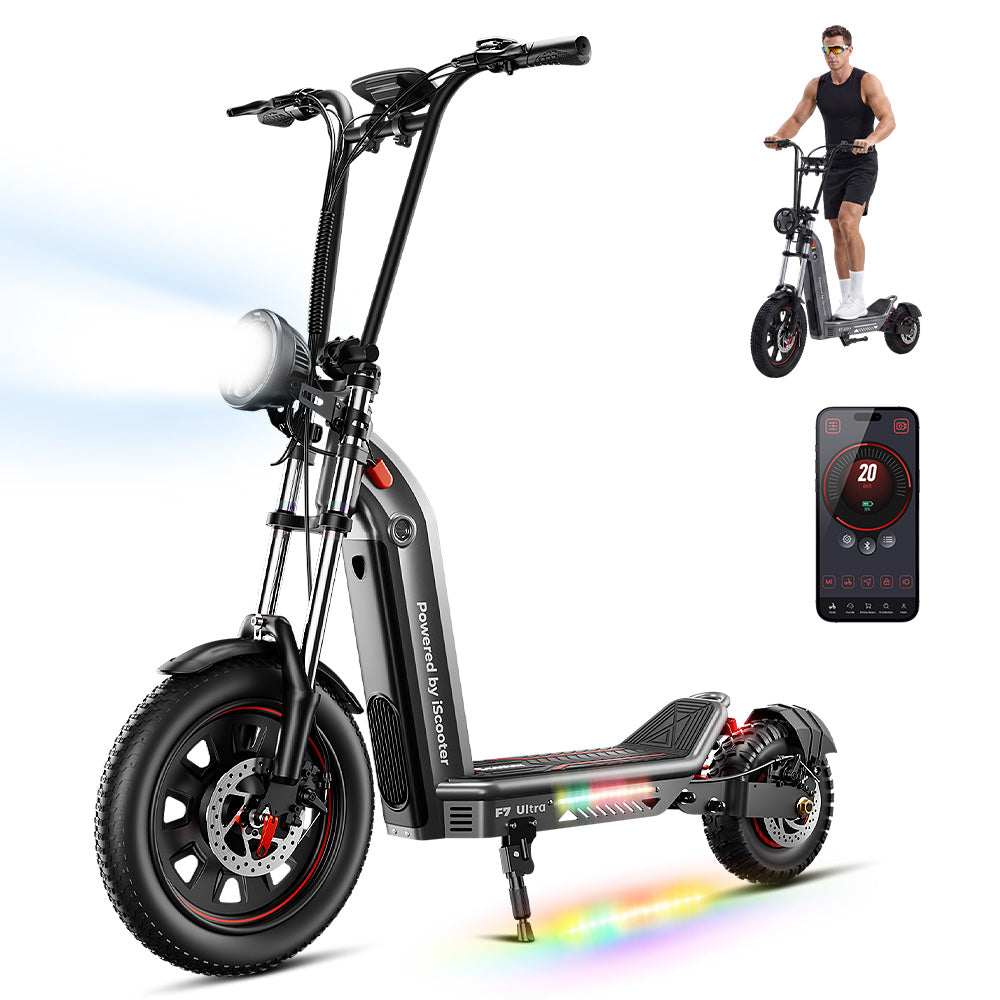
The F7Ultra answers a different need. Instead of chasing the more climb-focused dual-drive format, it concentrates on a single-motor all-terrain setup with longer claimed range. Its official page highlights 1500W peak output, a 52V 20Ah removable battery, dual suspension, and a claimed 56-62 mile range. In practice, that points to a scooter better suited to riders whose days involve more total distance, more ordinary road use, and fewer repeated steep climbs under heavier load.
That does not make it weak on hills. A solid single-motor scooter can still handle variable terrain well when the gradient is moderate and traction remains predictable. The advantage is simplicity. One driven wheel can feel more straightforward in daily use, and the longer claimed range is appealing if you want fewer charging intervals across the week. However, once the route includes steeper rises, rougher access roads, or surfaces where grip changes halfway through the climb, the F7Ultra has less climbing redundancy than the iX7Pro.
Shop: iScooter F7Ultra 1500W All-Terrain Electric Scooter
Why the F7Ultra still makes sense
- 1500W peak output for mixed daily riding
- Claimed 56-62 mile range
- 52V 20Ah removable battery
- Dual suspension for uneven roads
- Better fit for distance-first all-terrain use
Which drive layout suits your hills better?

If you want the short answer, choose the drive system by asking where the scooter will struggle first. On steeper hills, traction and sustained pull become the priority. On longer daily routes, efficiency and ride range often matter more. That is why these two models are not substitutes for one another, even though both sit in the all-terrain end of the range.
The wider mobility trend also supports this practical way of thinking. European transport bodies continue to frame electric mobility as part of a broader shift towards cleaner and more efficient urban transport systems rather than a one-size-fits-all vehicle category. The European Commission’s urban transport work and related mobility programmes keep emphasising sustainable, energy-efficient urban mobility solutions shaped by local use cases, infrastructure, and operating conditions. According to the European Commission, current policy work across Europe continues to promote safe and sustainable urban mobility planning. In addition, the Smart Cities Marketplace noted in its 2025 e-mobility report that scaling electric mobility depends on practical deployment choices, user needs, and operating context rather than technology alone, which mirrors how riders should compare scooter drive systems in the real world. See the Smart Cities Marketplace.
Quick comparison table
| Dimension | iX7Pro | F7Ultra |
|---|---|---|
| Drive layout | Rear + dual-wheel modes | Single-motor layout |
| Peak motor | 2000W | 1500W |
| Claimed climb | 35% hill climb | All-terrain focus |
| Claimed range | 43-50 miles | 56-62 miles |
| Battery | 48V 17.5Ah 840Wh | 52V 20Ah removable |
| Suspension focus | Off-road, climb-oriented | Dual suspension comfort |
| Best terrain | Steep mixed surfaces | Longer mixed roads |
| Best use case | Tougher hills, trails | Daily distance, uneven streets |
| Handling feel | More planted under load | Simpler day-to-day feel |
| Limitations | Heavier, less distance-led | Less climbing redundancy |
Climbing power under load
The iX7Pro is the stronger climber on paper and in intended use. Its 2000W output and claimed 35% hill-climb rating give it the clearer edge when rider weight, bags, or repeated gradients reduce available momentum. Moreover, its dual-wheel mode gives you another traction tool once one tyre alone is no longer enough.
The F7Ultra is better understood as a capable all-terrain daily rider rather than the hill specialist of the pair. Its 1500W setup should feel more than adequate on ordinary inclines and rougher roads, but it does not bring the same drive-sharing advantage when the surface breaks up during a climb.
Traction on loose or broken ground
This is where drive layout matters more than headline wattage alone. The iX7Pro can use two driven wheels to spread effort, which helps when gravel, dust, damp paving, or uneven surfaces reduce bite at the rear contact patch. Therefore, if your hills are not just steep but also inconsistent, the iX7Pro gives you more margin.
The F7Ultra has the simpler feel that many riders prefer on everyday roads. One driven wheel can be easier to read in predictable urban conditions, and its dual suspension should help keep the ride composed over rough sections. However, simpler does not always mean stronger when traction starts to disappear.
Range trade-offs you should expect
The F7Ultra has the advantage if your first concern is distance. Its product page lists a 52V 20Ah removable battery and a claimed 56-62 mile range, which is a notable step up on paper over the iX7Pro’s claimed 43-50 miles. That difference matters if your week includes longer leisure loops, larger commuting distances, or fewer convenient charging windows.
The iX7Pro’s shorter claimed range is not a weakness so much as the predictable cost of a more climb-oriented, traction-focused setup. Dual-drive capability and stronger hill intent usually ask more from the battery. In other words, you are exchanging some range efficiency for more support when terrain becomes demanding.
City practicality or weekend adventure?
For steep recreational routes, rural lanes, rough tracks, and routes with repeated sharp ramps, the iX7Pro is the better fit. It is the model you choose when the question is, “Will this still pull confidently once the easy section ends?” That extra margin can make the ride feel calmer, not just quicker.
For longer mixed rides that spend more time on ordinary roads, shared-use routes, and uneven but less severe surfaces, the F7Ultra makes a persuasive case. Its longer claimed range and dual suspension point towards a more distance-friendly rhythm. Notably, it may be the easier answer if your hills are occasional rather than constant.
Best fit depends on how and where you ride
If your normal route includes tough climbs, the best fit is the iX7Pro. It gives you stronger climbing intent, more traction flexibility, and a clearer advantage once hills are steep enough to unsettle a single driven wheel. Riders who head out with heavier kit or who regularly move from road to gravel will likely value that reserve most.
If your routes are longer, more mixed, and less extreme, the F7Ultra becomes the better match. Its longer claimed range and comfort-led suspension package suit daily travel and extended weekend mileage more naturally. That does not mean it cannot climb; it means climbing is not the only job it is optimised to do.
Choose the iX7Pro if your priority is tougher hills
- You ride steep or repeated gradients
- Your route includes gravel, broken ground, or loose surfaces
- You want the option to switch into dual-wheel drive
- You value climbing confidence over maximum range
Choose the F7Ultra if your priority is longer range
- Your rides are longer overall
- Hills are present but not the main challenge
- You want a removable battery and dual suspension
- You prefer a simpler all-terrain daily rider
Final take and your next move

For hill-focused riding, the best fit in this internal comparison is the iX7Pro. Its 2000W setup, claimed 35% climbing ability, and switchable rear-wheel and dual-wheel drive modes make it the more purpose-built answer for riders facing steeper gradients or less predictable surfaces. If your buying decision starts with, “I need the best electric scooter for hills in this range,” that is the model to shortlist first.
The F7Ultra is still a strong option when distance, comfort, and lighter all-terrain use matter more than outright hill support. Its longer claimed range and removable battery make it easier to justify for riders whose daily pattern is more road-biased. Therefore, the next move is simple: map your usual gradients, your average ride length, and how often you carry extra load. If hills and traction sit at the top of that list, start with the iX7Pro. If your riding pattern is distance-first, look closely at the F7Ultra.
FAQ
What is the best electric scooter to go up hills?
The best option in this iScooter comparison for hill work is the iX7Pro. Its official specifications list 2000W peak power, switchable rear-wheel and dual-wheel drive modes, and a claimed 35% hill-climb rating, which directly matches steep-route use. That makes it the clearer fit when your rides include sharper gradients, loose ground, or extra rider load. The F7Ultra can still handle mixed terrain, but it is the distance-first choice rather than the hill-first one.
What brands are known for strong acceleration and hill-climbing on electric scooters?
Brands known for strong acceleration and hill-climbing usually offer higher-power, dual-drive electric scooters, and iScooter is a good brand to consider if those features are a priority. Rather than judging by brand name alone, compare whether the model uses dual-wheel drive, its motor output, peak power, battery voltage, and supported rider load, since those are the main factors behind climbing ability. For regular hills, a dual-drive iScooter model will generally be a better fit than a single-motor commuter scooter. If you are comparing brands, focus on verified performance specs and real hill-grade capability instead of marketing claims alone.
Which electric scooter is best for rough roads?
For rough roads, a dual-wheel drive electric scooter is usually the better choice because power goes to both wheels, which improves traction and stability on gravel, broken pavement, and uneven surfaces. A model with strong suspension, durable tyres, and enough motor torque will also make a big difference in comfort and control. For lighter rough roads or occasional uneven paths, a strong single-wheel drive scooter can still be enough.
Is longer range more important than extra climbing power?
Longer range is more important if your rides regularly stretch into higher weekly mileage and your hills stay moderate. In that case, the F7Ultra’s claimed 56-62 mile range and removable 52V 20Ah battery make practical sense for fewer charging interruptions. Extra climbing power matters more when your route includes sharp gradients, heavier rider load, or rougher surfaces that reduce grip partway up the hill. A good rule is to prioritise range for distance-led riding and traction-led power for severe terrain.
What features matter most in an off-road electric scooter for hills?
The most important features are drive layout, motor output, suspension quality, braking control, and realistic battery capacity. For hill use, the key question is not only how much power the scooter makes, but how effectively that power reaches the ground when the surface turns loose or uneven. That is why a dual-drive option like the iX7Pro is useful for steeper mixed-surface routes, while a long-range single-motor option like the F7Ultra suits lighter all-terrain use. You should also check charging time, tyre suitability, and whether the scooter’s claimed range still aligns with your typical route length.
Table of Contents
- Which drive setup makes more sense when your route includes real hills?
- iX7Pro gives you more drive grip for steeper routes
- F7Ultra keeps the drive layout simpler for longer mixed rides
- Which drive layout suits your hills better?
- Best fit depends on how and where you ride
- Final take and your next move
-
FAQ
- What is the best electric scooter to go up hills?
- What brands are known for strong acceleration and hill-climbing on electric scooters?
- Which electric scooter is best for rough roads?
- Is longer range more important than extra climbing power?
- What features matter most in an off-road electric scooter for hills?
iScooter E Scooter Collections:
Electric Scooter | Kids Electric Scooter | Electric Scooter for Adults | Electric Scooter with Seat | Off-Road Electric Scooter | Foldable Electric Scooter | Girls Electric Scooter | 1000W Electric Scooter | 2000W Electric Scooter | Boys Electric Scooter | Dual Motor Electric Scooter | Big Electric Scooter | Electric Scooter with Suspension | Lightweight Electric Scooter | Commuter E-Scooters | 3 Wheel Electric Scooter
Show more ▼iScooter E Bike Collections:
Foldable Electric Bike | Affordable Cheap Electric Bike | Electric Bike for Adults | Electric Motor Bikes | Trek Electric Bike | Fastest Electric Bike | Electric Road Bike | Full Suspension Electric Mountain Bike | Giant Electric Bike | Womens Ladies Electric Bike | Mens Electric Bike | Electric Bike with Throttle | Electric Gravel Bike | Electric Mountain Bike UK | Fat Tyre Electric Bike | Electric Hybrid Bike | Electric Motorised Bike | Electric Push Bike | 1000W Electric Bike | Cool Electric Bikes | Electric Off Road Bike | Pedal Assist Electric Bike | Good Electric Bikes | Small Electric Bike | Trek Electric Mountain Bike | 2000W Electric Bike | Full Suspension Electric Bike | Mini Electric Bike | Road Legal Electric Bike | Step Through Electric Bike
Show more ▼👍 Buying Guide | 🚴♂️ Riding Guide
📋 Feature Guide | ❓ Common problem

Product category
Electric Scooter
Cheap Electric Scooters for Adults | Fastest Electric Scooter | Kids Electric Scooter | Mini Electric Scooter
Electric Bike
U4 Foldable E-bike | EB3S E-MTB
Hoverboards
Electric Scooter for Kids | iK3Pro E-Scooter for Kids | iK7 Height Adjustable Kids E-Scooter







Article tags :
Leave us a message