





How to Ride an Off Road Electric Scooter: Loose Ground Guide
Gravel shifts under the wheels, wet grass gives almost no bite, and mud grabs the tyres one second and lets go the next. If you learned on a smooth, flat surface, those habits will not carry over. This guide explains how to ride an off road electric scooter on loose ground, from stance and braking to speed control and climbing.
You will also pick up a few electric scooter off road tips for checking your e-scooter once the ride is over. Everything here assumes private land and the owner's permission, which is the only place a privately owned e-scooter can legally be ridden in the UK.
Before you ride: private land, permission and kit
Start with the legal bit, because it decides where you can practise at all. Under the Road Traffic Act 1988, privately owned e-scooters are classed as motor vehicles, so public roads, pavements and cycle paths are off limits. Private land with the landowner's permission is the rule. Get that permission clearly, ideally in writing, and ask about hazards such as livestock, ditches or buried stones.
Walk the ground before you ride it. Ten minutes on foot shows you where the surface turns soft, where the ruts run and where a hidden drop waits behind a rise.
Then sort your kit. A certified helmet is the minimum. Body armour, gloves, knee and elbow protection, eye protection and sturdy boots with grip make a fall far less painful. If you are still learning how to ride an electric scooter at all, our step-by-step guide to teaching a child to ride an electric scooter safely covers balance and braking basics that apply to adults too.
Stance and balance: how to ride an electric scooter on loose ground
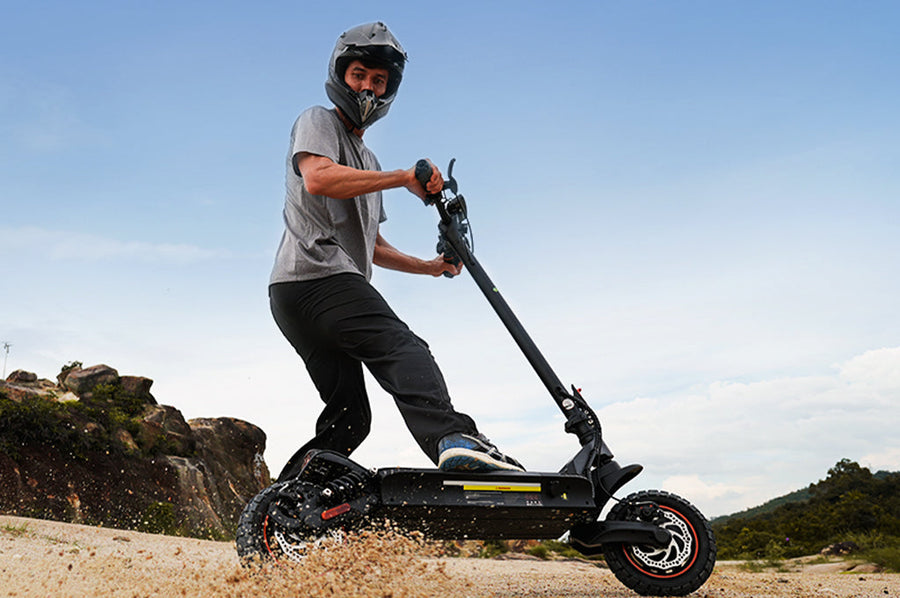
Smooth ground lets you stand stiff. Electric scooter rough terrain does not. Loose surfaces move around, so your body has to absorb what the wheels cannot.
-
Stagger your feet. Put one foot ahead of the other, roughly shoulder-width apart, with your front foot angled slightly outwards.
-
Keep your knees soft. Think of them as extra suspension. Locked legs pass every bump straight to the handlebars.
-
Stay slightly back. On gravel or mud, a little weight over the rear wheel stops the front end digging in or washing out.
-
Look ahead, not down. Your scooter follows your eyes. Pick a line five or six metres out and let your hands make small corrections.
-
Grip lightly. A white-knuckle hold makes you fight the steering. Bent elbows let the bars move beneath you.
An e-scooter with proper dual suspension does a lot of this work for you. The iX7Pro, for example, has front and rear suspension and 10-inch off-road tubeless tyres, so your knees and elbows only need to handle what is left over. Suspension softens a bump, but it cannot fix a stiff rider.
Braking on gravel, mud and wet grass: when to use which brake
Loose ground punishes grabbed brakes. A locked wheel on gravel skids, and a locked wheel on wet grass slides sideways before you can react.
Brake early and smoothly, in a straight line, before the turn rather than in it. Use both brakes together, with more weight on the rear. Squeeze the front lever gently, because a hard front-brake stab on loose stones can wash the wheel out. Check which lever controls which brake on your own scooter before your first ride.
Each surface behaves differently:
-
Gravel: Braking distances grow, and stones roll under the tyres. Start slowing well before you need to.
-
Mud: Tyres clog and brake discs get coated. Pump the brakes lightly instead of holding them down.
-
Wet grass: Grip can vanish with no warning. Ease off the throttle first, then brake gently.
The iX7Pro pairs front and rear disc brakes with an electronic brake. The electronic brake adds gentle slowing as you roll off the throttle, which helps keep things settled on slippery grass, while the discs do the harder stopping. Spend your first session practising low-speed stops until each brake feels familiar.
Speed control: reading terrain and using speed modes
Speed is the easiest thing to get wrong off road.
A speed that feels calm on firm ground can be too much on loose stone, because the surface changes faster than you can think.
Read the ground ahead.
Darker patches often mean mud or standing water. Shiny grass is usually wet. A strip of loose stones at a corner is a warning to slow down before it, not on it.
Use your speed modes as a ladder.
The iX7Pro has four modes in each drive setting. In rear-wheel drive they are 12, 18, 25 and 31 mph, and in dual-wheel drive they are 9, 18, 28 and 38 mph. As a beginner, stay in the lowest mode until stops and turns feel routine, then move up one step at a time. The top modes suit experienced riders on large private areas, and a muddy field is no place to find out your limits.
Choosing an e-scooter for this kind of riding matters as well. The best electric scooter for rough terrain combines suspension, grippy tubeless tyres and strong brakes, and our off-road electric scooters UK 2026 guide shows which iScooter models handle it.
Climbing and descending safely on an off road electric scooter
For climbs, lean forward slightly so the front wheel stays down, and keep a steady throttle. Hesitating halfway up is when scooters stall and riders put a foot down awkwardly. If the surface is loose, pick a straighter line and avoid sudden twists of the throttle, which spin the wheel instead of driving it.
The iX7Pro has a claimed 35% hill climb, but that figure comes from ideal conditions. Wet grass, mud and deep gravel all reduce what any scooter can manage, so treat it as a ceiling, not a promise.
Descents need more patience. Shift your weight back, bend your knees and drop to a lower speed mode before the slope begins. Feather both brakes in short squeezes rather than one long pull, and keep the scooter straight. If it starts to slide, ease off the brakes slightly and steer where you want to go. The iX7Pro has a 150 kg load rating, and that includes you plus your kit, so heavier riders should leave extra room for stopping.
After the ride: quick checks before the next trip
Mud and grit hide problems, so a short check pays off.
-
Clean it gently. Wipe down with a damp cloth. The iX7Pro is rated IPX4, which covers splashes, not pressure washers or hoses, so keep water away from the electrics.
-
Check tyres. Look for cuts, embedded stones and pressure that has dropped.
-
Inspect brakes. Check pads and discs for wear and make sure levers feel firm.
-
Test the bolts. Check the stem, handlebars and folding mechanism for anything loose after a day of vibration.
-
Look at the suspension and cables. Make sure nothing is leaking, rubbing or trapped.
-
Charge sensibly. Let the battery cool, then charge it. A full charge on the iX7Pro takes around 7 to 9 hours.
Build Confidence on Every Terrain
Learning how to ride an off road electric scooter comes down to a few habits. Stay on private land with permission, keep a loose and balanced stance, brake early and smoothly, and let speed modes work as steps rather than a switch. Slow down for climbs and descents, and make a quick check part of every session. Practise on easy ground first and build up gradually, because confidence on gravel, mud and grass comes from repetition, not from speed.
If you are weighing up your options, the iScooter iX7Pro off-road electric scooter is built for the kind of terrain covered here. You can also browse the full iScooter electric scooter range to compare models side by side.
FAQs
What tyre pressure works best on loose ground?
Follow the range printed on the tyre sidewall and in your manual, because the right figure depends on your scooter, tyre and weight. Within that range, slightly lower pressure helps the tyre grip and absorb bumps on gravel and grass. Never go below the minimum, and recheck after a rough session.
Should beginners practise on grass or gravel first?
Start on dry, short grass. It is forgiving if you fall and lets you learn balance and braking at low speed. Move to firm, fine gravel once you can stop in a straight line and turn smoothly. Save mud and wet grass for later.
What protective gear is recommended for off-road riding?
A certified helmet is essential, along with body armour, gloves, knee and elbow pads, eye protection and sturdy boots. Gloves and armour matter most on gravel, where a slide can take skin quickly.
iScooter E Scooter Collections:
Electric Scooter | Kids Electric Scooter | Electric Scooter for Adults | Electric Scooter with Seat | Off-Road Electric Scooter | Foldable Electric Scooter | Girls Electric Scooter | 1000W Electric Scooter | 2000W Electric Scooter | Boys Electric Scooter | Dual Motor Electric Scooter | Big Electric Scooter | Electric Scooter with Suspension | Lightweight Electric Scooter | Commuter E-Scooters | 3 Wheel Electric Scooter
Show more ▼iScooter E Bike Collections:
Foldable Electric Bike | Affordable Cheap Electric Bike | Electric Bike for Adults | Electric Motor Bikes | Trek Electric Bike | Fastest Electric Bike | Electric Road Bike | Full Suspension Electric Mountain Bike | Giant Electric Bike | Womens Ladies Electric Bike | Mens Electric Bike | Electric Bike with Throttle | Electric Gravel Bike | Electric Mountain Bike UK | Fat Tyre Electric Bike | Electric Hybrid Bike | Electric Motorised Bike | Electric Push Bike | 1000W Electric Bike | Cool Electric Bikes | Electric Off Road Bike | Pedal Assist Electric Bike | Good Electric Bikes | Small Electric Bike | Trek Electric Mountain Bike | 2000W Electric Bike | Full Suspension Electric Bike | Mini Electric Bike | Road Legal Electric Bike | Step Through Electric Bike
Show more ▼👍 Buying Guide | 🚴♂️ Riding Guide
📋 Feature Guide | ❓ Common problem

Product category
Electric Scooter
Cheap Electric Scooters for Adults | Fastest Electric Scooter | Kids Electric Scooter | Mini Electric Scooter
Electric Bike
U4 Foldable E-bike | EB3S E-MTB
Hoverboards
Electric Scooter for Kids | iK3Pro E-Scooter for Kids | iK7 Height Adjustable Kids E-Scooter








Article tags :
Leave us a message