










2026 Urban E-Scooter Buying Guide: Comfort and Eco-Friendliness
Introduction
Curb cuts that feel like speed bumps, cobbles that rattle your wrists, and potholes that appear mid-turn can make city riding feel like a constant compromise. If you pick the wrong electric scooter, the cost shows up fast: sore knees, shaky steering, longer stopping distances, and the kind of daily discomfort that makes you stop riding altogether.
platforms' confidence by focusing on comfort, safety, and real-world efficiency, not just headline specs. You will learn the fundamentals that matter in 2026, then walk through practical modules for commuting, comfort tuning, braking control, Lithium-ion Battery ownership, and connected features. From there, you will use a simple decision framework to match Commuter Scooters and All-terrain E-scooters to your route and your storage reality.
Official Site: iScooter
Electric Scooter Fundamentals for Urban Riding
Use-case taxonomy: commuter vs all-terrain
Before you compare electric scooters, classify your use case because it determines the right compromises. A commuter-first electric scooter prioritizes predictable handling, easy carrying, and low-maintenance parts for repeatable trips. An off-road electric scooter or broader Off-road Electric Vehicles category pushes for traction, clearance, and stronger damping, usually with more weight and bulk.
Key signals to identify your lane:
- Commuter Scooters: frequent folding, indoor storage, mixed pavement
- All-terrain E-scooters: broken surfaces, loose gravel, steeper hills
- Last-mile Delivery: stop-start cycles, lockups, accessory carrying
- Ride-sharing platforms' habits: short rides, quick checks, simple controls
If your route is 90% smooth tarmac with a few rough blocks, you usually win by choosing commuter stability and comfort over aggressive off-road hardware.
The comfort stack: tires, deck, handlebars
Comfort is not a single feature. It is a stack, and tires usually sit at the top because they are your first suspension. Larger diameters roll over cracks with less energy loss, while tire construction changes how vibration reaches your hands and knees. Solid tires reduce flat risk, but pneumatic tires usually improve grip and reduce harshness because air acts like a spring.
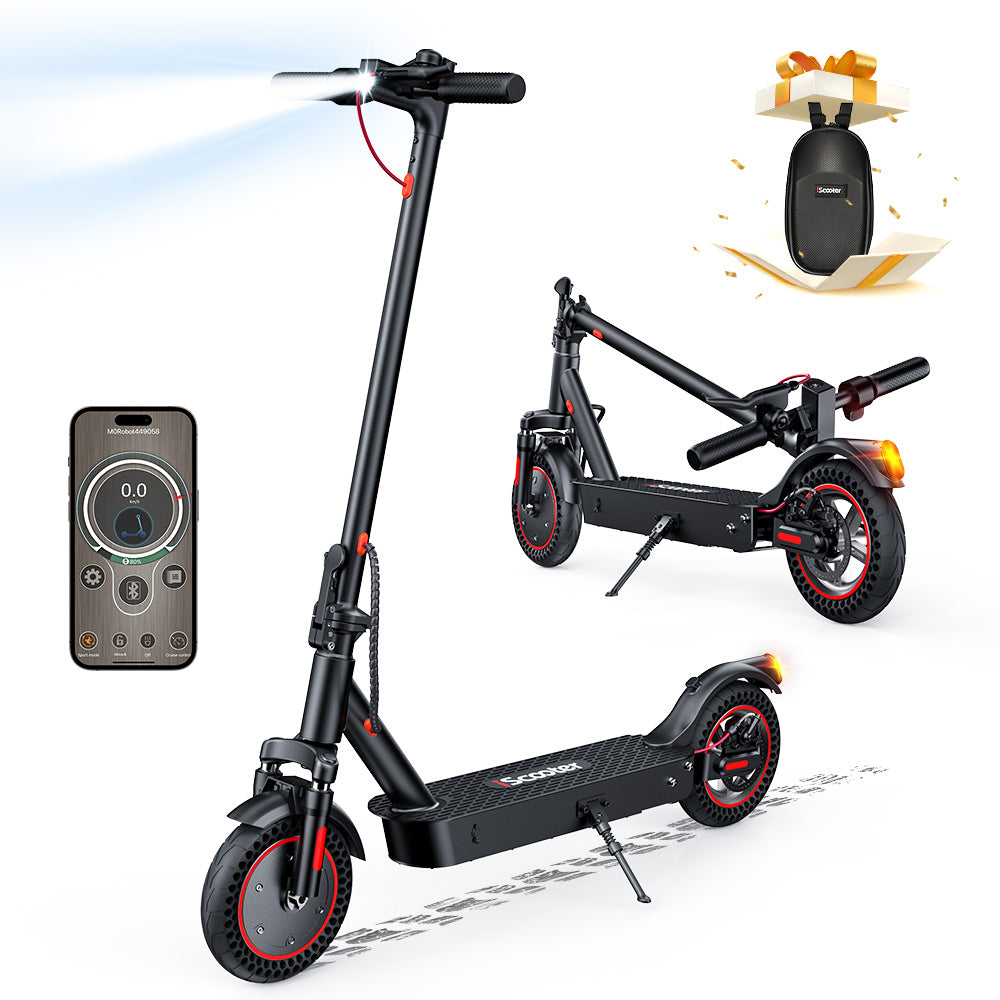
Next is your stance: deck width, usable foot length, and surface grip decide whether your hips stay square or twist for miles. Finally, handlebars matter because reach and height affect shoulder tension and steering stability. iScooter lists iScooter i9 size and fit details, including a deck width of 5.3 inches (13.5 cm) and unfolded dimensions of 42 x 17 x 44 inches (108 x 43 x 112 cm), which helps you check fit before you buy.
The safety stack: brakes, lights, stability
In traffic, safety is mostly about how predictably you can slow down, signal your presence, and stay stable during quick decisions. Your braking system should be easy to modulate, meaning you can add stopping power smoothly without locking up or pitching forward. Lights matter more than people admit because many urban conflicts happen at dusk, in the rain, or under street lighting.
Two practical safety ideas to keep in mind:
- Stability comes from tire contact and geometry, not speed ratings
- Braking confidence reduces panic moves more than top speed helps
In the US, injury data reinforces why you should optimize for control. The U.S. Consumer Product Safety Commission reported micromobility injuries increased nearly 21% in 2022, which is a reminder that everyday riding decisions, not extreme riding, drive a lot of the risk.
Battery reality: Lithium-ion Battery limits
A Lithium-ion Battery is not just about range. It is a system with capacity (often expressed in Wh), voltage, a battery management system, charging behavior, and temperature sensitivity. Real-world range drops when you ride faster, climb hills, carry more load, or ride in cold conditions because the motor needs more power and the battery delivers less usable energy.
A better mental model is "usable range" rather than advertised range:
- Start with your round-trip miles
- Add buffers for hills and winter
- Assume stop-start city riding consumes more
You will get a more eco-friendly outcome by selecting enough battery headroom to avoid deep cycling every day, because shallow charge cycles generally reduce wear.
Electric Scooter Commute Fit: Distance, Speed, Terrain

Your commute fit is the fastest way to narrow down electric scooters without getting trapped in spec overload. Start by mapping three things: round-trip distance, typical hill grades, and the roughest 10% of your surface. That roughest segment is what defines your comfort needs because you feel it every ride.
Use this workflow:
- Step 1: Measure door-to-door miles, not just bike-lane miles
- Step 2: Note the steepest hill you ride weekly
- Step 3: Identify surfaces: smooth asphalt, patched asphalt, cobbles
- Step 4: Decide if you must fold and carry daily
Once you do that, match the power and range to your reality. On iScooter model comparisons, the i9 is listed at 350 W with a maximum range of 18.6 miles (30 km), while the i9Max is listed at 500 W with a maximum range of 25 miles (40 km). That gap typically matters more for hill consistency and range buffer than a small difference in top speed.
For a commuter-focused setup, the iScooter i9 is a practical baseline when your terrain is moderate, and you want an easy-to-store package. iScooter also offers an i9 with a seat variant for riders who prioritize reduced standing fatigue on longer trips. That is a comfort choice, not a speed choice.
Shop: iScooter i9 Electric Scooter For Adults
Electric Scooter Comfort Engineering: What Actually Helps
When you chase comfort, focus on the parts that change vibration and posture, because those two things drive fatigue. Tire diameter and construction do most of the work. A larger tire reduces the angle of attack over cracks, while the tire material decides how much chatter reaches your hands.
If you ride rough city streets but hate maintenance, solid tires can make sense, especially if they are designed to absorb shock rather than act like hard rollers. iScooter describes the iScooter i9Max as using 10-inch solid tires with a honeycomb structure and positions them as durable and maintenance-free. More importantly for comfort, iScooter also highlights dual front and rear shock absorbers on the i9Max, which targets the two biggest pain points in urban riding: repeated small impacts and surprise bumps.
To tune comfort beyond tires, adjust your stance:
- Keep both feet fully supported on the deck
- Set the handlebar height so the elbows stay slightly bent
- Avoid reaching forward, which loads wrists and shoulders
If you are comparing Commuter Scooters, comfort is usually a system decision: a slightly heavier scooter with better damping can feel easier over time than a lighter scooter that beats you up every mile.
Shop: iScooter i9Max Electric Scooter
Electric Scooter Braking and Control: Stop With Confidence
Your braking plan should start with a simple question: Can you stop predictably on your worst surface in the wet? Urban riding is full of micro-decisions, so you want braking that is easy to modulate and consistent across speeds. In practice, that means you should understand what braking systems your scooter uses and how they share work between front and rear.
Braking types you will see on electric scooters:
- Mechanical friction brakes: lever feel, simple servicing
- Electronic braking: motor resistance, smoother decel
- Dual-system setups: redundancy for control
Because speeds are often limited by law or by local rules, the key is stopping distance, not maximum speed. The UK Department for Transport includes guidance on rental trial requirements, including a stopping distance target at 15.5 mph (25 km/h) of 7 m or less, which gives you a concrete benchmark when you test ride.
If you are considering higher-spec setups like Hydraulic Disc Brakes, treat them as a control upgrade, not a badge. Hydraulic systems can improve modulation and reduce hand fatigue during repeated stop-start riding, but they also require clean setup and periodic maintenance to stay consistent.
Electric Scooter Connected Riding: Locks, Data, Firmware
Connected features feel optional until you experience theft anxiety or firmware quirks. In 2026, many riders want at least basic app connectivity for ride metrics, locking workflows, and update management. Still, you should treat connected features as secondary to comfort, braking, and battery fit, because an app cannot fix a harsh ride.
A practical way to decide if connectivity matters is to map what it changes in your routine:
- Security: reminders, lock habits, tracking support
- Maintenance: firmware updates, diagnostics
- Riding: speed modes, trip logs
If you plan to use Ride-sharing Platforms often, you may already be used to simple checks before each ride. Bringing that mindset to ownership is useful: check tire condition, brake feel, and any error indicators before you leave. Pairing that routine with a physical lock and consistent parking choices usually reduces stress more than any single feature.
For visibility, Smart Helmets can also be a meaningful upgrade in urban environments, especially if they add integrated lighting. iScooter lists an LED helmet accessory with a PC shell and EPS liner, 12 ventilation holes, and USB-charged lighting modes, which aligns with the idea that being seen is part of staying safe.
Electric Scooter Selection Guide: How to Choose
Before you pick a model, decide what you cannot compromise on, because every electric scooter is a bundle of trade-offs. For most riders, the non-negotiables are safe stopping, comfortable contact points, and enough range buffer to avoid daily deep discharge. Then you choose between portability and ride isolation based on your storage and surfaces.
Rider weight and payload
Stability and range depend on total load, not just rider weight. If you carry a bag for Last-mile Delivery tasks or commute gear, prioritize a scooter rated for higher load and stable geometry. The iScooter i9Max is described as having a 120 kg load capacity in iScooter materials, which is a useful reference when you are matching heavier riders or regular cargo.
Terrain and weather
Your worst surface defines your comfort stack. If you face constant patchwork asphalt or cobbles, look for larger tires and some form of damping. If wet riding is common, you should emphasize predictable braking and tire grip more than speed.
Range needs
Range is a planning problem. Start with round-trip miles, add 30% buffer for hills and cold, then decide if you will charge at work. A higher Wh pack can reduce daily battery strain, which often improves long-term ownership.
Carry and storage
If you carry the scooter up stairs or onto public transit, total weight and fold shape matter more than an extra few mph. If you store indoors, confirm the folded dimensions and plan a parking spot near an outlet.
Quick decision table
| Scenario | Priority | What to check | Trade-off |
|---|---|---|---|
| Short flat commute | Portability | weight, fold size | harsher ride |
| Rough city streets | Comfort | tire size, suspension | heavier carry |
| Hills every day | Torque feel | motor watts, voltage | reduced range |
| Frequent rain | Control | braking, tire grip | slower riding |
| Last-mile Delivery | Workflow | lock points, deck space | bulkier setup |
Best Practices and Pitfalls for Electric Scooters
Best practices
Your goal is repeatable control, not perfect specs on paper. Build small habits that catch problems early and improve comfort every ride.
Best practices that pay off quickly:
- Test stance and bar reach for 5 minutes
- Check brake feel before every ride
- Keep tires at target pressure
- Do a weekly bolt and latch check
- Use lights early, not late
If you are buying Electric Bikes or an ebike for some trips and electric scooters for others, keep the same safety routine. Consistency reduces the small errors that cause most incidents in dense traffic.
Common pitfalls to avoid
Most new riders over-focus on speed and under-focus on how the scooter feels at low speeds, when most urban conflicts happen.
Common pitfalls:
- Chasing top speed over control
- Underbuying range for winter losses
- Ignoring charging supervision basics
- Choosing harsh tires for convenience
- Skipping helmet and visibility planning
As a reality check, a national study summary from UC San Francisco describes substantial growth in e-scooter injuries over recent years using U.S. emergency department surveillance data. You do not need to fear riding, but you do need a control-first setup.
Conclusion
A comfortable, eco-friendly electric scooter choice in 2026 comes from matching your route, your storage, and your comfort needs, not from chasing the biggest numbers on a spec sheet. If you start with surfaces and stopping confidence, then size the Lithium-ion Battery for real-world conditions, you will ride more often and with less stress.
Re-check your worst road segment, your carry requirements, and your charging routine, then choose the scooter that makes those daily decisions easier. When your scooter fits your body and your route, commuting stops feeling like work and starts feeling like a reliable tool.
Official Site: iScooter
Frequently Asked Questions
How do I choose the right range for commuting?
Choose a range based on your round-trip miles, then add a buffer for hills, cold weather, and frequent stop-start riding. A practical buffer is 20% to 40%, depending on how steep your route is and how often temperatures drop below 50 F. Faster riding also increases energy use, so a scooter that barely meets your distance on paper can feel stressful in real life. If you can charge at work, you can prioritize portability more, but you should still avoid planning to arrive at 0% daily. Over time, that extra buffer helps your Lithium-ion Battery avoid deep cycling.
What matters most for ride comfort on rough streets?
Tire diameter and tire construction usually change comfort more than motor power. Larger tires reduce sharp impacts from cracks and curb transitions, while softer or more compliant designs reduce vibration at the handlebars. Deck space also matters because it lets you adjust your stance and relax your hips during longer rides. Handlebar height and reach affect wrist and shoulder load, which is why fit is part of comfort engineering. If you want comfort without constant maintenance, look for designs that combine impact absorption with practical durability.
Are solid tires or pneumatic tires better for city riding?
Solid tires reduce the risk of flats and can simplify ownership for everyday commuting. Pneumatic tires usually feel smoother and grip better on uneven pavement because the air chamber absorbs small impacts and maintains contact. The trade-off is that pneumatic tires require pressure checks and can be punctured if you ride through debris. If your route includes lots of broken glass or sharp curb edges, solid tires can be a sensible choice. If your route is rough and you value smoothness, pneumatic tires often deliver better comfort when properly inflated.
What braking setup is safest for urban riding?
The safest setup is one that gives you predictable stopping with redundancy, meaning two braking methods that still work if one becomes less effective. In practice, you want a stable lever feel, consistent deceleration, and enough traction to avoid skids on your typical surfaces. You should also confirm that the scooter stays composed during hard braking, without wobble or sudden front-end dive. Lighting and stability also matter because braking safety is partly about being seen early. If you frequently descend hills, prioritize braking that stays consistent over repeated stops.
How should I charge and store a Lithium-ion Battery safely?
Charge your Lithium-ion Battery where you can monitor it, and avoid leaving it charging unattended for long periods. Let the scooter cool down after a hard ride before charging, because heat can stress the pack and charger. Use the correct charger and stop using damaged cables, bent plugs, or packs that show impact damage. Store the scooter in a cool, dry place away from direct heat sources, and avoid long storage at full charge if you will not ride for weeks. Good charging habits improve safety and also help battery performance stay more consistent over time.
Do app features meaningfully improve ownership?
App features can improve ownership when they support locking workflows, firmware updates, and basic diagnostics. Ride logs and speed modes can also help you ride more consistently, especially if you share a scooter with another rider. Still, connected features cannot compensate for poor comfort, weak braking feel, or an undersized battery. If you have a predictable commute, app data can help you track range changes over seasons. If you park in higher-theft areas, connected reminders may reduce forgetful mistakes, but physical locking habits still matter most.
Can I use an off-road electric scooter for daily commuting?
Yes, an off-road electric scooter can work for commuting, but you should be honest about the trade-offs. Off-road-focused builds often weigh more and take up more space, which can make stairs, transit, and small apartments harder. They can feel more stable on broken pavement, and that can reduce fatigue if your city streets are consistently rough. However, aggressive tires and heavier frames can reduce efficiency and make short trips feel less nimble. If your commute includes frequent carrying and tight storage, a commuter-first scooter usually fits better, even if it is less capable off-road.
Table of Contents
- Introduction
- Electric Scooter Fundamentals for Urban Riding
- Electric Scooter Commute Fit: Distance, Speed, Terrain
- Electric Scooter Comfort Engineering: What Actually Helps
- Electric Scooter Braking and Control: Stop With Confidence
- Electric Scooter Connected Riding: Locks, Data, Firmware
- Electric Scooter Selection Guide: How to Choose
- Best Practices and Pitfalls for Electric Scooters
- Conclusion
-
Frequently Asked Questions
- How do I choose the right range for commuting?
- What matters most for ride comfort on rough streets?
- Are solid tires or pneumatic tires better for city riding?
- What braking setup is safest for urban riding?
- How should I charge and store a Lithium-ion Battery safely?
- Do app features meaningfully improve ownership?
- Can I use an off-road electric scooter for daily commuting?
iScooter E Scooter Collections:
Electric Scooter | Kids Electric Scooter | Electric Scooter for Adults | Electric Scooter with Seat | Off-Road Electric Scooter | Foldable Electric Scooter | Girls Electric Scooter | 1000W Electric Scooter | 2000W Electric Scooter | Boys Electric Scooter | Dual Motor Electric Scooter | Big Electric Scooter | Electric Scooter with Suspension | Lightweight Electric Scooter | Commuter E-Scooters | 3 Wheel Electric Scooter
Show more ▼iScooter E Bike Collections:
Foldable Electric Bike | Affordable Cheap Electric Bike | Electric Bike for Adults | Electric Motor Bikes | Trek Electric Bike | Fastest Electric Bike | Electric Road Bike | Full Suspension Electric Mountain Bike | Giant Electric Bike | Womens Ladies Electric Bike | Mens Electric Bike | Electric Bike with Throttle | Electric Gravel Bike | Electric Mountain Bike UK | Fat Tyre Electric Bike | Electric Hybrid Bike | Electric Motorised Bike | Electric Push Bike | 1000W Electric Bike | Cool Electric Bikes | Electric Off Road Bike | Pedal Assist Electric Bike | Good Electric Bikes | Small Electric Bike | Trek Electric Mountain Bike | 2000W Electric Bike | Full Suspension Electric Bike | Mini Electric Bike | Road Legal Electric Bike | Step Through Electric Bike
Show more ▼👍 Buying Guide | 🚴♂️ Riding Guide
📋 Feature Guide | ❓ Common problem

Product category
Electric Scooter
Cheap Electric Scooters for Adults | Fastest Electric Scooter | Kids Electric Scooter | Mini Electric Scooter
Electric Bike
U4 Foldable E-bike | EB3S E-MTB
Hoverboards
Electric Scooter for Kids | iK3Pro E-Scooter for Kids | iK7 Height Adjustable Kids E-Scooter








Article tags :
Leave us a message