










Ultimate guide to choose a reliable electric scooter for your daily office commute 2026
Introduction
A reliable electric scooter can simplify daily office commutes by reducing parking stress, shortening last-mile walks, and keeping your schedule predictable. In 2026, reliability goes beyond just starting every morning—it includes braking in wet weather, avoiding punctures, and having a battery that consistently holds its range week after week.
This guide focuses on choosing a dependable electric scooter for low-drama commuting. You'll learn how to map your route, translate marketing range into real-world performance, and prioritize comfort and safety features for city riding. It also compares micro-mobility options like electric scooters and ebikes to help you decide when a scooter is the right choice over an ebike.
Official Site: iScooter
Core Foundations
Legal use in the UK: why it changes your plan
In the UK, the biggest reliability issue is legal, not mechanical. A privately owned electric scooter is illegal to ride on public roads, cycle lanes, and pavements. You can only use a private electric scooter on private land with the landowner's permission. (gov.uk)
Rental electric scooters are treated differently. You can only rent through official schemes in specific trial areas, and the rental operator provides third-party insurance. Trials have been extended multiple times and are currently due to end on May 31, 2028. (gov.uk)
Practical takeaway: if your daily office commute uses public streets in the UK, your reliable commuting plan may need to be a rental scheme, an ebike, an electric bike, or public transit. If you commute on private land (campus, private industrial estate), a private e-scooter can still fit.
Commute fit: distance, hills, and what you carry
Reliability starts with fit. A scooter that is marginal for your route will feel unreliable even if nothing is broken.
Think in three inputs:
- Distance: total round trip, plus detours for errands.
- Hills: sustained gradients matter more than one short ramp.
- Load: body weight plus bag weight, because acceleration and braking both change.
As a basic commuting rule, aim for a scooter with enough power to climb your steepest segment without staying at maximum output the entire time. That reduces heat, reduces battery sag, and typically extends component life.
The safety stack: brakes, lights, tires, and helmet fit
A commuter scooter is a system. Reliability comes from layers:
- Braking layer: predictable modulation, consistent feel in the wet, and redundancy (two brakes or a brake plus electronic assist).
- Visibility layer: a headlight that actually helps you see, and a rear light that communicates braking.
- Contact layer: tire type and size determine stability, comfort, and how often you deal with flats.
- Rider layer: helmet fit, glove grip, and footwear are part of reliable control.
If your route includes wet streets, paint lines, or autumn leaves, the safest scooter is the one that stays controllable when traction drops.
Battery basics for 2026: Lithium-ion Battery Technology and aging
Most commuter scooters still use Lithium-ion Battery Technology because it balances energy density, cost, and charging speed. The reliability risk is not sudden failure. It is slow capacity loss, plus performance changes in cold weather.
To plan for aging:
- Treat rated range as a best-case figure.
- Expect lower range in winter.
- Avoid frequent deep discharges, because that tends to increase wear.
You will also see headlines about Solid-State Batteries. They are promising, but for everyday buying decisions in 2026, your best reliability win is still good charging habits and keeping a buffer between your real commute needs and the scooter's claimed range.
Commute Scenario Mapping
Map the route like a reliability engineer
Before you shop, map your commute as a sequence of stressors. This makes your electric scooters shortlist much clearer.
Measure the real distance.
Use a phone map and measure the route you will actually ride.
Add a 10 to 20 percent buffer for detours.
Identify the dominant surface.
Smooth pavement: prioritizes portability and efficiency.
- Rough pavement: prioritizes tire volume, suspension, and stem stiffness.
Mixed paths: prioritizes predictable handling and lighting.
Tag the reliability risks.
Steep hill segments: motor heat and battery sag.
- Repeated curb cuts: wheel and folding mechanism stress.
- Wet shortcuts: braking and tire traction.
Reduce delays and missed arrivals
Reliability is about time. Your setup should minimize the three biggest commute killers:
- Unexpected charging needs midweek.
- Slowdowns from discomfort and fatigue.
- Safety-driven detours because the scooter is not stable or visible.
If you treat the route map as your requirement sheet, your scooter choice becomes simpler and more repeatable.
Battery, Range, and Charging
Real range vs rated range: the commuter translation
A scooter's advertised range is usually measured in favorable conditions. Real commuting range is lower because of:
- Higher average speed.
- Hills.
- Heavier rider plus bag.
- Stops and starts.
- Cold temperatures.
For daily office commuting, build a buffer so you do not arrive at work with a nearly empty battery. A good rule is to target a scooter whose max range is at least 1.5x your round-trip distance.
Charging strategy that supports battery life
Battery reliability is mostly habit-driven.
- Charge in a cool, dry space.
- Avoid storing the scooter fully discharged for weeks.
- If you do not ride for a while, store at a partial charge rather than empty.
Use only the correct charger spec for your scooter. For example, iScooter commuter models commonly use universal AC input chargers (100 to 240V, 50 to 60 Hz) with a model-specific DC output, so the wrong charger can be a real reliability hazard.
Product spotlight for range-first commuters: iScooter i9Max
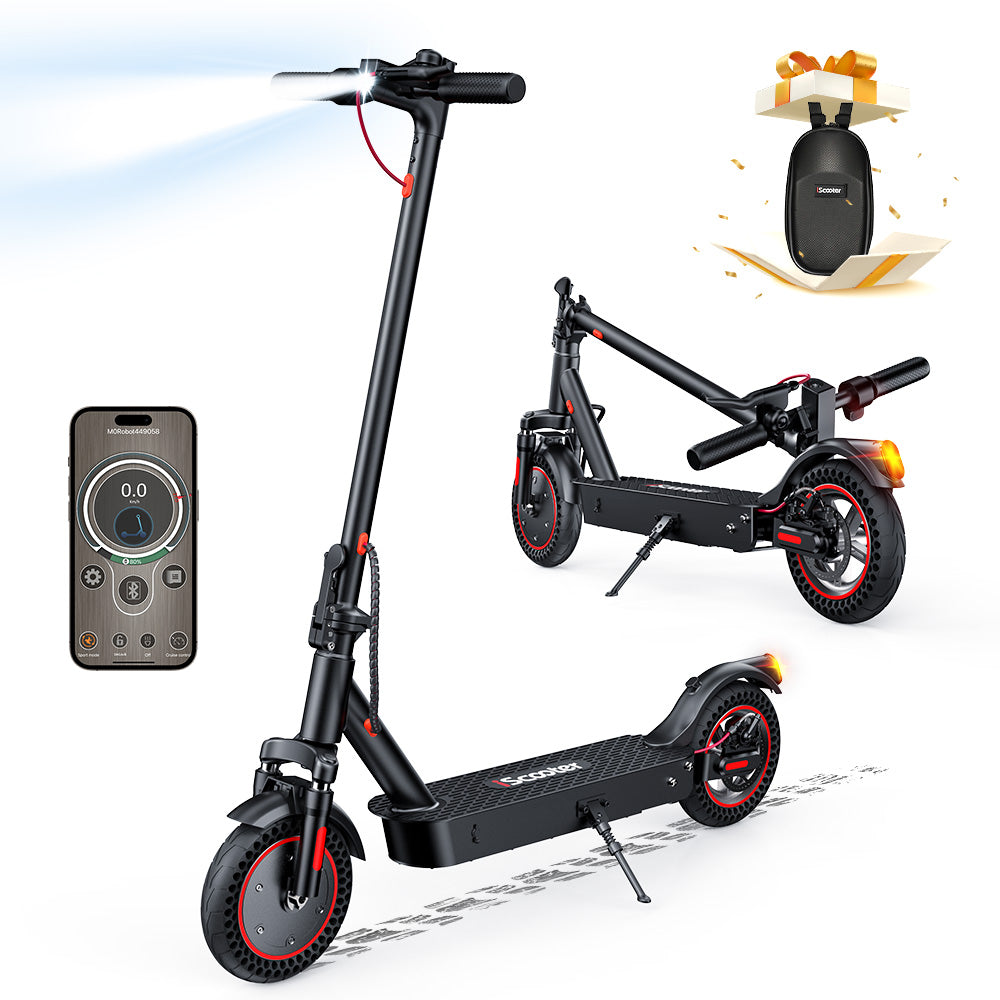
If your daily route includes broken tarmac, curb cuts, or long straight segments where comfort matters, the iScooter i10Plus emphasizes tire volume and power.
Key specs shown on the product page:
- Battery: 36V 17.5Ah
- Max range: 31 miles
- Motor: 800W rear wheel motor
- Top speed: 25 mph
- Tires: 10-inch pneumatic tire
- Suspension: front and rear suspension system
For commuting, the 10-inch pneumatic tires plus dual suspension can reduce vibration, which helps with control and rider comfort during longer rides.
Shop: i10Plus Electric Scooter
Safety, Braking, and Visibility
Brake types and wet control
Reliability for commuting is often braking reliability.
A simple brake framework:
- Electronic assist (E-ABS): can help stabilize and reduce lockup, but it should not be your only stopping method.
- Mechanical disc: strong stopping power, but needs periodic inspection and adjustment.
- Drum brake: lower maintenance and consistent performance, often favored for commuting.
Many commuter setups blend these. For example, iScooter i9 uses an electronic brake plus rear disc, while i9Max combines E-ABS with a mechanical rear disc. (iscooterglobal.co.uk)
Hydraulic Disc Brakes are often seen on higher-end systems, especially where repeated hard braking and wet-weather confidence matter. If you commute in frequent rain, this feature can be a meaningful upgrade.
Your safety baseline still applies in 2026
Even though this guide is about products and features, your routine controls crash risk more than a spec sheet.
- Use a helmet that fits correctly.
- Slow down before junctions.
- Avoid riding where traction is uncertain.
If your commute happens in a rental-trial area, remember that rental e-scooters are legal on roads and cycle lanes but illegal on pavements. (gov.uk)
Smart Security and Theft Deterrence
What smart security really means
Security features are often marketed as IoT Connectivity, GPS Tracking, and Anti-Theft Systems. For commuting, the practical questions are simpler:
- Can you immobilize the scooter so it cannot be ridden away easily?
- Can you identify it and prove ownership if it is recovered?
- Can you reduce casual theft during short stops?
A physical lock is still the core. Smart features help, but they do not replace a strong locking routine.
Selection and Decision Guide
Legality status: the first filter for UK commuters
If your route uses public streets, your options differ:
- Private e-scooter: private land only.
- Rental e-scooter: only in official trial areas and under operator rules.
The UK government rules page is explicit: privately owned e-scooters are illegal in public places, while rentals can be used in certain areas.
Braking system: how to choose with confidence
A decision lens:
- Flat, low-speed urban: dual brakes plus strong lighting can be enough.
- Hilly urban: prioritize stronger braking and stability.
- Wet commute: prioritize predictable modulation and tire grip.
If Hydraulic Disc Brakes are available in your target class, they often improve lever feel and wet performance for repeated stops.
Commuter decision table
| Commute scenario | What usually fails first | What to prioritize | Example iScooter direction |
|---|---|---|---|
| Short, flat, quick errands | Poor portability and storage friction | Low weight, fast folding, basic dual braking | i9 commuter setup |
| Medium distance city commute | Range anxiety and comfort fatigue | Larger battery, 10-inch tires, suspension | i9Max or i10Plus |
| Rough pavement and longer rides | Vibration and instability | Pneumatic tires, suspension, stronger motor | i10Plus |
| Mixed terrain, private-land riding | Traction and power limits | Higher power, suspension, off-road tire pattern | Off-road electric scooter line |
Official Site: iScooter
Common Pitfalls to Avoid
- Riding a private scooter on public roads in the UK
This is a legal risk and a reliability risk because enforcement can end your commute plan instantly. The government guidance is clear that privately owned e-scooters are illegal in public.
- Modifying battery or controller wiring
Mods can increase heat and unpredictability. They also complicate maintenance and can raise safety risks.
- Storing the scooter fully discharged
A deeply discharged pack that sits for weeks can lead to reduced performance later. Treat storage as part of your reliability routine.
- Buying for speed instead of control
A commuter scooter should feel predictable. For most office routes, stable handling and braking matter more than the last few mph.
Conclusion
Choosing a reliable electric scooter for your daily office commute in 2026 comes down to repeatability: legal repeatability, range repeatability, and safety repeatability. Start by mapping your route, then select the battery and tire setup that matches your surfaces and storage reality.
If you want to keep your plan simple, prioritize a real-world range buffer, dual braking, strong lighting, and support that can help you keep riding week after week.
Official Site: iScooter
Frequently Asked Questions
How do I choose a reliable electric scooter for my daily office commute?
Start with legality in your area because a commuter plan fails if you cannot ride the route every day. Next, calculate your round-trip distance and choose a model with at least a 50 percent range buffer to protect you from cold weather and battery aging. Then prioritize dual braking, bright lights, and stable tires because these control your risk in traffic. Finally, consider storage and carry needs, since folding and weight affect whether you actually use the scooter daily.
Is an electric scooter good for commuting in the UK?
An electric scooter can be convenient for short distances and multi-modal commuting, especially when you need a compact option versus an ebike or electric bike. The biggest constraint is legal access, because many commuters cannot use a privately owned scooter on public roads. If your area has an official rental scheme, a rental scooter can fit a daily office commute on streets and cycle lanes. If you cannot legally ride the route, a folding electric bike often becomes the more reliable daily tool.
What are the best budget-friendly electric scooters for commuting in the UK?
A budget-friendly commuter scooter should still meet a safety baseline: dual braking, useful lights, and a stable tire setup. Range should cover your round trip with a meaningful buffer, because budget models often deliver less than their headline range in real commuting. You should also evaluate weight and folding, since a cheaper scooter that you hate carrying becomes expensive in missed rides. Finally, focus on warranty, parts availability, and support because those factors determine whether a small issue becomes a long downtime.
What is the average battery life for electric scooters?
Battery life depends on cell quality, charging habits, and temperature exposure, so it varies widely between riders. Most riders see gradual capacity loss over time rather than sudden failure, which shows up as reduced range and more frequent charging. Consistently riding at maximum power, especially on hills, tends to accelerate wear because it increases heat and stress. You can extend battery life by avoiding deep discharges, charging in a cool place, and storing the scooter partially charged when not in use.
Which electric scooter has the longest battery life?
Scooters with larger battery packs often hold usable range longer because each commute uses a smaller fraction of the pack. However, battery life is also affected by thermal management, riding style, and how often you charge from nearly empty to full. A conservative approach, such as maintaining a range buffer and riding at steady speeds, often matters as much as the model choice. If you ride daily in cold weather, expect shorter range and plan for more frequent charging regardless of the scooter.
Table of Contents
- Introduction
- Core Foundations
- Commute Scenario Mapping
- Battery, Range, and Charging
- Ride Quality and Portability
- Safety, Braking, and Visibility
- Smart Security and Theft Deterrence
- Selection and Decision Guide
- Conclusion
-
Frequently Asked Questions
- How do I choose a reliable electric scooter for my daily office commute?
- Is an electric scooter good for commuting in the UK?
- What are the best budget-friendly electric scooters for commuting in the UK?
- What is the average battery life for electric scooters?
- Which electric scooter has the longest battery life?
iScooter E Scooter Collections:
Electric Scooter | Kids Electric Scooter | Electric Scooter for Adults | Electric Scooter with Seat | Off-Road Electric Scooter | Foldable Electric Scooter | Girls Electric Scooter | 1000W Electric Scooter | 2000W Electric Scooter | Boys Electric Scooter | Dual Motor Electric Scooter | Big Electric Scooter | Electric Scooter with Suspension | Lightweight Electric Scooter | Commuter E-Scooters | 3 Wheel Electric Scooter
Show more ▼iScooter E Bike Collections:
Foldable Electric Bike | Affordable Cheap Electric Bike | Electric Bike for Adults | Electric Motor Bikes | Trek Electric Bike | Fastest Electric Bike | Electric Road Bike | Full Suspension Electric Mountain Bike | Giant Electric Bike | Womens Ladies Electric Bike | Mens Electric Bike | Electric Bike with Throttle | Electric Gravel Bike | Electric Mountain Bike UK | Fat Tyre Electric Bike | Electric Hybrid Bike | Electric Motorised Bike | Electric Push Bike | 1000W Electric Bike | Cool Electric Bikes | Electric Off Road Bike | Pedal Assist Electric Bike | Good Electric Bikes | Small Electric Bike | Trek Electric Mountain Bike | 2000W Electric Bike | Full Suspension Electric Bike | Mini Electric Bike | Road Legal Electric Bike | Step Through Electric Bike
Show more ▼👍 Buying Guide | 🚴♂️ Riding Guide
📋 Feature Guide | ❓ Common problem

Product category
Electric Scooter
Cheap Electric Scooters for Adults | Fastest Electric Scooter | Kids Electric Scooter | Mini Electric Scooter
Electric Bike
U4 Foldable E-bike | EB3S E-MTB
Hoverboards
Electric Scooter for Kids | iK3Pro E-Scooter for Kids | iK7 Height Adjustable Kids E-Scooter









Article tags :
Leave us a message